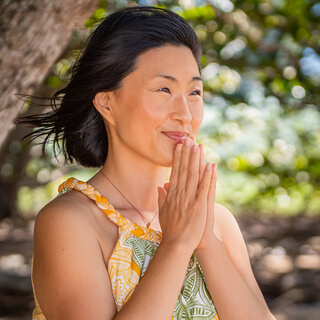
Welcome to Emotional Boundaries for Resilience.
This month's theme is Emotional Resilience.
So let's talk about this and how we can cultivate better strength against stress.
I remember when I first started on my coaching path.
Have you ever felt like you've given too much for too little?
This idea started to come to me when people began asking me if I wanted to have tea.
And it was a curious thing because of course,
Yes,
I'd love to have tea.
And I noticed that while having tea,
It would turn into a full on coaching session.
People started telling me their problems,
What was going on in their life.
And in some way,
I felt really touched because they trusted me enough to tell me what was really happening with them.
I love helping people.
But I started noticing that this was becoming a pattern and that it wasn't really a two-way street.
It was where I was giving a coaching session for the price of the cost of tea.
So I realized then that I had to be more mindful and even say something if I felt that someone was subconsciously trying to ask me for free coaching.
Where I would actually say,
Hey,
If you want to set up a session,
We can do that.
Or just have a very strong awareness even before I agreed to meet for tea.
We have boundaries with how we are in terms of our behavior and our emotions,
Especially in places like work where people don't feel comfortable losing their shit at work.
It's not really kosher to start being hysterical and crying and becoming overly emotional.
And there is a reason for that,
Because how can we focus on the task at hand when people are having emotional breakdowns,
Even if they might be necessary?
And that's what people are really going through.
So having this awareness that there are these unspoken emotional boundaries in our lives.
We have this thing called civilization.
That's why we live in a civilized community is because it's not always comfortable or appropriate to be unleashing our rawest emotions out in public,
Even though people do it.
Not everyone knows how to handle it.
So emotional boundaries are what feels okay for you emotionally and what doesn't feel okay.
And this can even begin with ourselves.
For example,
A boundary we might have for ourselves is I don't feel comfortable crying in front of other people.
That's something that I can deal with on my own in my own space.
But there's maybe only a few people in my inner circle who I'm willing to be vulnerable with and share what's really going on with me,
Because I know that's going to be held in a safe space.
And it's not okay for me to tell random people what's happening.
And just knowing what feels comfortable and right for us,
What doesn't feel comfortable and right,
Because when we open ourselves up,
Maybe it's not appropriate to open ourselves up to certain people in certain situations because we might not be met in those spaces.
And it really begins with what were those boundaries when we were growing up?
Did we have emotional boundaries with our parents?
Did our parents expect us to please them or caregive them and be there for their emotional well-being?
Or was it the other way around?
And was there any sense of obligation that I had to be a certain way in order for my parent to be happy?
That's an emotional condition that only if I'm this way will my parent accept me.
So we learned to flow our emotions in a certain way in the presence of our parents.
Maybe it was completely unacceptable to show any emotion,
To show any anger or any rage.
And if we did,
We'd get immediately shut down and shut out,
Put in our rooms and disconnected from the feeling of love from our own parents,
Our own caregivers.
So a lot of what turns into our own sense of emotional boundary comes from our childhood.
And sometimes we have to relearn what that is.
Did you have clear boundaries when you were growing up?
And if you didn't,
That's okay,
Because a lot of us did not.
Our parents didn't know what they were doing.
They didn't have a book on emotional intelligence and emotional awareness that we also badly needed.
And so if you recognize that some of the enmeshment and codependent tendencies,
Whether it was between your parents or your parents and yourself and your siblings,
To have a stronger awareness of when you're not feeling emotionally free,
When you feel restricted and what you need to do to take care of yourself.
So how responsible do you feel for the way other people feel?
Are you over-responsible?
Do you not care at all?
How do you relate when somebody's going through a challenging time?
Do you give them a lot of space?
Do you back away?
Do you withdraw?
Do you lean in?
Do you ask questions?
Do you start a conversation?
Noticing how you are and how you engage when hard emotions are coming up for others,
Because a lot of that is reflected in how we feel comfortable in handling our own emotions.
So do you feel the need to please?
And do you feel guilty if you're not there for somebody,
You feel like you're going to disappoint them?
And I coined this term over-empathizer.
Are you somebody who just abandons yourself to jump in and save other people?
And you're constantly giving at your own expense,
Because these can be unhealthy,
Imbalancing tendencies.
It's learning about releasing the enmeshment,
That feeling of being totally wound up with somebody else and what they're doing,
How they're feeling,
And understanding that you that very clear distinction of where I end and where somebody else begins.
How much are these hard emotions coming up because of me?
And how much of this is coming up because of them?
And having an awareness of what's really happening.
So when you have that boundary,
Which is almost like a separation in order to have more connection,
More intimacy,
More authenticity,
It's a feeling of separation and boundary.
But when we're highly boundaried,
We're also in a position to be deeply compassionate and very much knowing how to be of best service.
Because we're there for ourselves and we're there for others.
But when we don't have that clear boundary,
That's when we can lose ourselves,
Where we can start to feel shame and guilt and rage and resentment because we've over given now and we've lost our space.
And ultimately,
When we can start to understand what's okay for us and what's not really okay for us in terms of handling other people's emotions,
When somebody's oversharing,
Maybe you just met someone and they're telling you all of their past traumas and stories.
Is that okay for you?
Does that feel appropriate for you to hold that and to be with it and to process it for others?
Or is that something that you need a boundary in?
Ultimately,
We have an awareness of this so that we can feel free and be true to ourselves,
Be true to others,
And be healthy,
Happy,
And autonomous.
I hope you enjoyed this little talk on emotional boundaries.