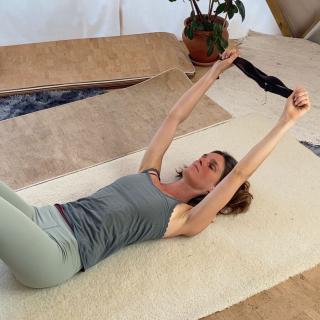
Hi and welcome to this first session where we will explore movement in the lower body.
So mainly movement of the leg bone in the pelvis.
And as I've shared with you before,
We're going to work on pure movement and look out for the compensations and other signals that might be happening in your body.
Please note that I cannot see your body.
I do not know your history.
I also don't know the current state of your body.
So if you have any questions or any doubts,
You can reach out to me.
Or you can also always speak to your healthcare professional to see if what you want to do is a clever thing to do and good for your health.
Also,
You can feel your body best.
So if something doesn't feel right or you're not sure,
Then,
Go to the site of caution.
Or don't do it.
Having said that,
I also do really believe that this practice and this program can benefit you in the form of bringing relief.
From pain and definitely greater awareness of your body and of your movement.
So,
I think that is very important too.
To be aware of and listen to your body,
Listen to your inner wisdom.
And be curious.
Explore what you can do without force and gentleness.
So as I will show you here,
With my skeleton Ben,
The movement that we're looking for is movement of the leg bone.
Femur this bone in the pelvis in this bone So we're going to explore whether you can sense the movement.
Of these bones like if they're moving in this direction or in that direction.
So to focus more on the movement of the bones and not so much on the muscles,
Just to give you a different perspective,
Because muscles don't always do what we want them to do.
And if we focus on bones,
Then at least we can get the directions,
As you've seen in the planes and directions of movement video.
You will be able to be more clear about the joint that you're moving and in which direction you want it to move.
The movement that's going to be an exploration of how that is functioning for you today and how to work with that.
So the invitation is to pay attention to your movement,
To your opinion about it,
To feel really what is happening.
And I really recommend to have a mirror or to record yourself on Zoom or some kind of way or see yourself on Zoom.
To be able to see what's happening,
Because sometimes what we think is happening might not really be what is actually happening.
And yeah,
And it might be that when you encounter a compensatory pattern that your movement becomes really small.
To be really pure.
So don't worry about that and just really stay with the practice.
Honor those signals of your body,
Those limits that your body's putting.
However frustrating or however tedious that might be,
And just feel and notice that.
Through practice and with time,
Change might happen.
If you're curious and respect those limits.
Then your body might surprise you.
So always try to focus on working with ease.
If you're always experiencing pain,
Then notice the time when pain is either staying the same or when it becomes less.
But never go into more pain,
Because if pain becomes worse.
.
.
Or discomfort is starting to happen,
Then that's a signal of your body that your nervous system is being activated.
It's your body saying,
Like,
This is your range of movement.
Don't push it further.
And if you do,
Then your nervous system will stay activated and it will not be able to let go.
So even though we're working with bones and with movement,
We're actually really working with the nervous system here.
And the more comfortable you can be,
The more support you can create for your body.
The more your nervous system can wind down,
Can be relaxed.
And easier your movement can become.
In between movements,
I will also invite you to come back into constructive rest.
To just notice,
To feel what the body has experienced the effect of the movement of the practice on your body.
Noticing if tensions are releasing,
So if compensation patterns actually did sneak in that you didn't notice.
If that was in the standing posture,
Then you can also move around a bit to see if that helps and how that feels now.
And there's just the invitation to be curious and to explore your movement,
Your body,
The signals that you're receiving from your body.
And less really is more.
So see if you can play with that,
And I hope you have a lovely practice.