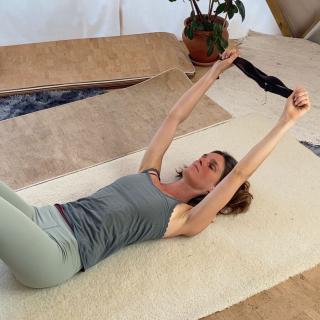
This video is about movement with the block and the strap.
If you don't have a block or strap,
See if you can find an alternative for it.
A Tupperware box or a book or a belt.
Or whatever has that shape and function of a block and a belt.
And so we'll first start with the belt.
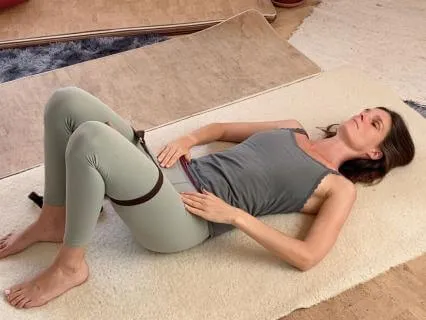
So place it around your upper legs as you lie in constructive rest.
And tighten it in such a way that your legs are still hip width apart.
Make sure that it's around the middle of your legs.
And come lying in your constructive rest position.
Again,
Place your hands on top of those hip flexors on the pelvis.
So that when you lift up your leg a tiny bit,
You feel an activation below your hands and that activation that you feel are the hip flexors.
So make sure that you feel them and that you know that these are the ones.
That you're feeling.
And then with the movement that we're going to do now.
It's the same as we did with the butterfly movement.
So you're going to move your legs out into the belt.
But now,
Because there's a belt,
You will find resistance here.
So gently push out your legs into the belt.
You're not trying to snap it or.
.
.
Put a lot of pressure on it.
You're just going to move your legs,
Pressing into the belt.
And then letting that go.
So it's a very small movement.
And in this movement again,
Notice.
Whether there's activation below your hands happening at some point of the hip flexors,
That again don't have a function in this movement.
So just feel if they're activating.
And if they are at some point in bringing pressure,
Then don't push any further.
That is the range that you can play in.
Arrange until you feel activation or.
.
.
Just before that,
And then you move back.
Find support for your back from the ground.
Your feet from the ground and notice whether that can relax those flexors if they're activating.
Also bring your awareness to your back.
Your shoulders.
Your jaw.
As you push your legs out into the belt.
Notice whether they are activating,
Whether they're responding.
Whether your back is arching.
Whether your shoulders are moving.
And it may just be a little tension in the chest.
Where the shoulders are.
Being rounded forward.
And it doesn't mean that you have to push your shoulders down into the ground.
You can just allow your shoulders to rest there as relaxed as they can be.
And notice if anything changes in their position.
And again,
Can you just sense the movement of the leg bone?
In the pelvis even though it's a small movement.
Sensing that your lower back is relaxed.
The rest of your torso is relaxed.
Your face is relaxed.
And quiet.
You're gently pushing out into the belt.
Noticing if there's anything happening besides the movement of the leg bone in the pelvis.
Is your belly soft?
And maybe it's all relaxed and soft and quiet.
And that's great.
Then relax the movement and notice how you feel.
How does your lower back feel?
How do your shoulders feel,
Your legs?
Has anything changed?
You're breathing.
And then take your blog or your substitute for your blog.
Then place it on a middle width between the thighs,
So not the most narrow position or the widest.
But in the middle.
So if you have a substitute blog,
Find something.
That is about.
.
.
15 centimeters width.
You can leave the belt on you can loosen it a little bit if necessary And bring the block really between the thighs,
Not so much the knees.
So push it down a little bit.
And then again,
From constructive rest with your hands on those flexors.
You squeeze the block a little bit.
Don't squeeze it until it breaks or you're trying to break it.
So just squeeze it a little bit and then let go.
Squeeze it a bit.
Then slowly let it go.
So it's also not an abrupt movement.
So we're trying to make smooth movements.
And again,
Explore as you make this movement.
What else is happening in your body?
Or in your mind.
Notice if those flexors below your hands are becoming active or not.
There's a range where they aren't active,
Which is the pure movement range.
And if they become active,
Then that's where the compensation starts.
And it's where you want to.
Release the movement again and that's the area where you can play in.
Also notice your back,
Your feet.
What's happening in your feet as you're making this movement.
Your belly and your shoulders.
Can all of that stay quiet as you just gently move your legs to squeeze into the block.
Notice what's happening in your lower belly and maybe if you can feel it,
Your pelvic floor.
And notice your breath.
Are you still breathing as you do this?
Sense your neck,
Your head.
Your face.
Is there any crunching,
Holding,
Bracing or tightness happening?
In these other areas.
And maybe for some people,
Because you're squeezing a block using the inner leg,
This might bring up some emotional sensations or thoughts.
And see if you can just witness those.
If it's too much,
Then always stop.
Take out the block.
But see if you can just be curious with whatever comes up,
Sensing the sensation.
And don't go past.
Any of those.
Compensatory signals that your body might be giving you.
And that might also be an emotional or a mental one.
If you start to feel nervous or angry or frustrated,
See if you can sense those feelings as bodily sensations.
That you still feel safe or that you feel that you need to stop.
Try to not get into the story that you can create in your mind about frustration or anger or whatever emotion it is that you're feeling.
But stick to the physical sensation.
Is it a tightening in the chest you're feeling?
Is your breath stopping?
To tightening your belly.
And just record those signals.
As signals that your body is giving you during the movement that you're doing.
Your nervous system is responding to this gentle movement of you squeezing a block.
And that's all that it is.
And if you haven't already you can now stop the movement.
Take a pause and sense your body.
Notice how it feels.
That's your lower back feel.
How do your shoulders feel?
And always make sure that if you feel pain or discomfort at some point in a movement,
Don't move into that.
And now gently remove the block and remove the belt and take notice.
Of which of the two may be more beneficial to you in this moment?
And if you practice them again,
You can also switch it around so that you first start with the block and then with the bell to just notice the difference between the movement and its effect on you.
And if there's one movement that doesn't work for you,
That creates more pain or more discomfort,
And leave it for the time being.
And maybe come back to it at some other point if that feels more appropriate.
So just notice what this movement has done for you.