Welcome everyone.
This practice today is going to be a yin yoga.
With myofascial release.
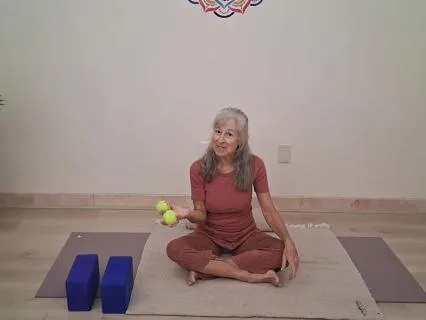
So if you have two tennis balls or other type of therapy balls,
You can make the poses a little juicier,
But you can still do this practice without them.
You'll also want to have a couple blocks.
And maybe one or two blankets.
I have one of my blankets on my mat to make it a little cozier.
It's just an option.
And then another blanket.
Either to sit on or to use as a prop in some poses can be really helpful.
So our first pose is going to be getting into the glutes a little bit and also the upper back and shoulders.
We'll be getting into a relaxing position.
And just letting our body's weight get into the hips a little more.
So place your blocks.
On the low setting,
One block at one end of your mat.
And the other block may be about the distance of your hand.
Spread Y,
Just a guesstimate.
And we're going to lay on the block.
So that the first block is just about at your upper back and the other block is for your head.
Have your tennis balls handy on either side of your hips so that you can easily reach them.
We'll be getting into position first to make sure the blocks are in the right position.
And then we'll be.
Positioning the balls.
With the legs bent to start,
Sort of tucked under.
The outer glue.
And then straightening the legs.
And then if it feels like you're just on a bone,
Adjust the balls until you feel it's sort of like on the outer glutes.
You might have to straighten the legs first and then position the balls.
So feel free to adjust that.
Whatever feels good to you.
Onto your elbows first.
Keep your knees bent.
And you might feel the edge of the block just about at your mid back.
One hand behind your head,
Other hand feeling for that walk for your head.
And then you might decide to turn that block up a notch,
Which I'm going to do to start.
So that your head's a little higher.
So make sure the block under your upper back feels comfortable.
You might need to adjust it up or down.
Just a little bit so that it feels like your shoulders are dripping towards the mat.
In between that space between the blocks.
And your arms will be in whatever position's comfortable for you.
Maybe out in a T shape or a little closer to your body.
Or you might have your arms up overhead for a deeper stretch.
In which case,
Maybe that blanket.
The end of the mat so you can rest your hands or arms on the blank.
So once you're in position,
Straighten one leg out and then the other.
Make sure everything feels comfortable with the blocks.
And then bend one knee and the other and sort of tuck those tennis balls under the glutes.
And then straighten your leg.
It should feel like some pressure.
If it's not enough,
You might need to add more.
But just a little bit wiggle around.
I feel like the tennis balls are just below the sitz bones.
And sort of vent that.
Lower part of the glute,
Slightly to the outside.
That's where I like to feel that pressure.
Make sure you're not on a bone and find what feels good to you.
Start our timer.
Position your arms where they're comfortable.
Take a nice inhale through your nose.
And exhale,
Soften.
Relax your feet.
Allow your legs to be heavy.
Soften those glutes.
Relax your upper body.
Soften into your shoulders and arms.
Make sure your neck is comfortable.
And if you want to go a little deeper with the position of your head.
At any time you might lower that block to the lower setting if you had it on the medium.
Stay present with your breath.
And encourage each exhale.
To be an invitation.
To surrender into gravity.
Like you're melting over your props.
Releasing long held stress.
Tightness and tension.
Let that go.
Notice the gentle rise and fall of your lower belly as you breathe in.
Breathe in through your nose.
And either exhale through your nose or your mouth.
Sometimes a soft sigh can help us relax a little more.
Release a little deeper.
Imagine your shoulders are melting towards the earth.
Melting over that wall.
And then gently begin to deepen your breath.
Bring your arms a little closer towards your body.
Bend one knee and then the other.
And take those tennis balls away from your hips for a moment.
One hand behind your neck.
Lift your head.
And then make your way,
Whatever way makes sense to you.
Back up to a seat.
And pause.
Notice sensation.
Notice your upper back.
Your shoulders.
You might notice your hips.
Maybe drink some water.
So we'll be coming into a pose where we'll be on our back.
And we'll want to have the block handy.
And the tennis balls hand together.
So I'm going to position the blocks just about at the mid part of the mat.
And the tennis balls you want to have where you can easily reach them.
Will be coming into a supine butterfly.
With the tennis balls on our upper traps.
So I'm just going to show you where we're going to position them.
If you have your tennis balls at the top of your shoulders on either side,
And you roll them down.
On either side of your spine.
And you just sort of push the tennis balls into that.
Usually tight area of the upper shoulders there.
It's above your shoulder blades on soft tissue,
Probably tight tissue.
When you're laying on the ball,
You'll probably have the top of the ball.
Ever so slightly.
Above the top of your shoulder or just even with the top of your shoulder.
As if you were to just slide the ball from here to the back,
Just about as far as you can reach.
It's not gonna have to go down much further.
You'll position them one at a time after we're laying down.
Lay down on your back in constructive rest.
Take the tennis balls.
One in each hand,
Lift one shoulder up and position the tennis ball.
Just at that upper trapezius.
And then other side.
So once you get both on there at the top of your shoulder,
Blocks are an option.
Bring your feet together.
And then knees out for a butterfly pose.
So if this is too intense,
You might use those blocks.
So that your knees can rest on the wall.
Arms where they're comfortable to you.
So you can move the feet further away or closer,
Whatever feels good.
Sometimes having the feet further away is easier to relax into the legs and hips.
Take an inhale here.
Exhale,
Sigh it out.
It should feel like those tennis balls are on soft tissue above your feet.
Your shoulder blades there.
Soften into your shoulders and arms.
You might feel like you're getting a little bit of a back bend in your low back.
Make sure that feels comfortable to you.
If it feels like your head is going back too much,
Again,
You might benefit from having a blanket under your head.
Continue to watch your brow.
And invite soft.
With each exhale.
Imagine you're melting over those balls.
If you want to deepen into your hips,
You might set the blocks aside if that feels okay.
So begin to gently deepen your breath.
Take a nice inhale through your nose.
Exhale,
Sigh it out,
Let it go.
Now.
And then thoughtfully set any blocks aside.
Lift your knees up.
Keep your feet on the mat.
Remove one ball and then the other.
And we're going to come into rebound,
Which is like Shavasana.
So set your balls aside,
Set the blocks aside,
Slowly straighten one leg and then the other.
If you had a blanket under your head,
You might want to move that.
Unless your head goes back a lot.
And then just pause here,
Relax completely.
And notice sensations.
Notice where your body is making contact with the mass.
Notice anything that's going on in your body.
Be the observer.
Take one more breath here.
Maybe sigh it out.
Bend one knee and then the other.
Maybe shift your hips to one side,
Roll over to one side.
And then use your hands and arms to press yourself back up to a seat.
And palm.
Notice what you're feeling.
So our next pose is a two-sided pose and we'll be using two tennis balls as a little extra if you want.
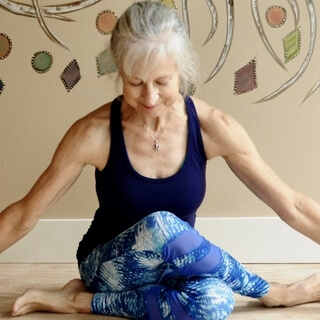
We're going to be coming into deer pose.
Deer is great for the hips as well as the legs.
It's an internal and external rotation.
So whichever leg you want to start with.
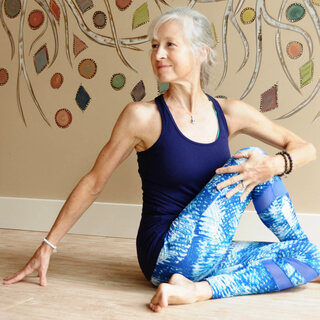
One leg is going to be in front,
Externally rotated,
And one leg is internally rotated.
With the internally rotated foot.
Close to your outer hip.
Externally rotated legs.
The shin somewhat parallel to the long edge of your mat blanket.
Now make sure that your knees feel okay.
If you need to move your foot.
Closer or farther.
Away whatever feels good.
So we're going to start.
With the internally rotated leg first.
And place that tennis ball.
Between your calf and thigh.
To get a compression into the calf.
So you might have to rock over a little bit towards that other hip.
Maybe move that leg.
Lower leg away from you a little bit,
And place the tennis ball just about at the thickest part of your calf.
Sort of hold it there as you bring that leg back in.
And then sit up again and notice what you're feeling.
If it's too much,
Maybe move the foot away a little bit or reposition the ball.
And then the other ball.
You might just lift that knee up of that externally rotated leg and place it somewhere maybe at your mid back.
Side,
The outer side.
It may not be as intense as the other one.
If you want to just use one ball,
That's totally fine.
Maybe one or the other,
Whichever you're enjoying.
Or enjoying the sensation of most.
Try to relax your legs as best you can again make sure knees are happy.
You can just have your hands on either side of you.
You can rest your hands on your knees or legs.
Or if it's a little too intense in that area.
Internally rotated.
Me.
Shifting over for a little twist towards that externally rotated leg so that internally rotated hip lifts up and it should relieve some pressure in that knee.
Experiment.
Find what works for you.
You can close your eyes.
And just begin to tune into your breath.
We're not going to hold each side as long as some of the other poses we've done.
And if some of you would like a little variation,
As we're here in deer.
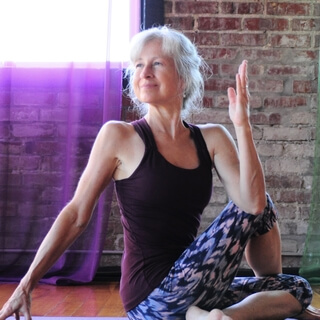
You might come into a stretch.
Either starting with whichever side you want.
Having one hand on one side of the leg.
Lift the other arm up and just come into a little side strap.
Again,
These are just options and variations.
Stretching into the side body a little bit.
You might look up,
Straight ahead,
Or down to release your now.
And sometimes doing variations like this with the upper body as we're getting into the hips and legs.
Sometimes can make the time go faster.
And then you might come up.
If you're into that side bend,
Pause for a moment,
Notice any sensation.
And if you're doing that variation,
Come into the other side.
Moving slowly and thoughtfully,
Make sure you're still feeling the sensation.
Maybe in your hips or with the tennis ball placement.
And if you're coming into this side bend variation,
You get a really nice stretch if you focus on elongating through that upper arm.
The arm for the bottom hand support,
Keeping that arm straight.
So that you don't overdo.
If you're doing that variation,
Maybe thoughtfully coming back up.
Pause.
Notice your breath.
Take a nice full inhale.
And sigh it out,
Let it go.
She might rock over towards that.
Externally rotated legs.
And then remove the tennis ball from between your calves.
And then remove the other tennis ball.
Lifting your legs up.
And switching position.
So the other side is our counter pose.
So initially,
Just notice what's going on.
Notice your needs.
This side might feel quite different.
So you might experiment and try.
The ball under.
Externally rotated thigh first.
And then place the ball in between your calf and thigh on the internally rotated leg.
Again,
Choose what works for you.
You might use both balls,
You might just use one.
The side might be different.
Maybe this side's internally rotated me is happier or less happy than the other side.
I'm thinking this cap is a little tighter on this side.
Always adjust with the foot a little further away or a little closer to make it more or less intense.
Or maybe coming into that twist a little bit.
Invite your legs to be heavy and soft.
And if you did that variation with the upper body on the first side.
Maybe you do that again on this side.
Or if you want something different,
Maybe you get into your nap.
So if you want to get into your neck.
Keep your fingertips supporting you on both sides so that your shoulders stay level.
Take an inhale to lengthen through your spine.
And then take one ear towards the nearest shoulder.
Notice that stretch in your neck.
And this is just an optional variation.
You can think of lengthening through the fingertips.
Or on the side of your neck that you're feeling the stretch.
And then thoughtfully releasing your neck.
Bringing your head back to center,
Pause for a moment before you do the other side.
And if you want that next stretch on the other side,
Lengthen as you inhale.
Exhale.
Head tilts,
Ear towards the other shoulder.
Reaching through the fingertips.
On the side you're feeling the stress.
And when you're ready bring your head back to center.
And if you want,
Maybe doing a few shoulder rolls or anything that would feel good if you were doing that neck stretch.
Sometimes that feels nice.
Take a few more breaths here.
Take a nice inhale through your nose.
Exhale,
Sigh it out,
Let it go.
Thoughtfully bring yourself out of deer pose.
And straighten your legs out into a straddle.
So initially just pause with the legs straight.
This is going to be sort of our counter pose before we come into straddle.
Notice sensation.
Maybe drink some more water.
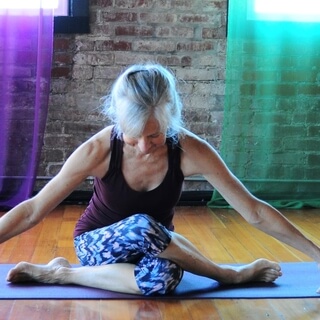
And our last pose is going to be straddle.
So we're going to start.
In whatever position.
With the legs wide feels good to you.
If you have any low back issues you might sit on the edge of a blanket so your hips are up slightly higher.
If your hamstrings are super tight.
You might need to bend the knee.
If you have two blankets instead of sitting on one,
If you're bending the knees.
I would suggest placing the blankets under each knee.
Maybe rolling them,
That can be really comfortable so the legs are supported.
Or you can use blocks,
A little less comfortable,
But if you place the blocks.
.
.
On your thigh rather than right below the knee.
Sort of at a little bit of an angle.
This might be your straddle.
And then you can relax the legs.
So now we're going to come forward.
Option to have your blocks handy.
You can use them as armrests,
You can use a block to support your head,
Or two blocks to support your head.
Make sure your feet and ankles are relaxed,
Legs relaxed.
Inhale,
Lengthen through your spine.
Exhale,
Start to walk your hands forward.
You might stay here with your hands supporting you.
You might have blankets or blocks under your legs if your hamstrings are tight.
Avoid rounding your spine.
So you want to feel like your pelvis is tipped forward.
You can support yourself.
Maybe with the blocks.
Or your forearms might even just come to your mat.
And then just soften.
Surrender into gravity.
Stay present with your breath.
We'll be here for a few more breaths.
Begin to gently deepen your breath.
Inhale through your nose.
Exhale,
Sigh it out,
Let it go.
Thoughtfully press yourself back up onto your hands.
Set aside your block.
Pause for a moment.
And then you might use your hands to get under the thighs to sort of help rebend one knee and then the other.
And bring your legs back in.
Pause for a moment.
And then maybe a sip of water if you would like.
And bring yourself into Shavasana.
Take a nice full inhale.
Exhale,
Sigh it out.
Legs heavy and soft.
Invite your hips to solve and then release.
Bring your awareness up the spine.
Envision space between all your vertebrae.
Soften into your upper back and shoulders.
Let this softening continue down your arms and hands and fingers.
Pat is happy.
Face soft.
Jaw relax.
And let go.
Gently bring your awareness back to being on your mat.
Notice your body.
Notice your breath.
And observe your mind.
Begin to make small movements,
Maybe wiggling fingers or toes,
Whatever would feel good.
And eventually bend one knee and then the other.
Maybe rock gently side to side.
And then rolling over to whichever side feels best to you.
Support your head with a prop or your bottom arm and pause there.
And then press your way back up to a comfortable seat.
Maybe keeping your eyes closed.
And with appreciation for your focus and awareness,
Bring your hands together at your heart in Anjali Mudra.
The light in me sees and honors the light in each of you.
Namaste.