Hi,
I'm Kelly,
And I'm going to walk you through a brief yin yoga practice today that helps you to connect to and have more capacity for feelings of courage.
When I think of what we need for courage,
I think first we need to be grounded and connected to the physical body.
So often when we're in fear,
We leave the body,
We're disembodied.
It's a really important practice to get really grounded and feeling safe in the body.
We need to understand our sensations,
What sensations in the body feel like.
Again,
When we come up against a situation where we need courage,
There's often fear,
Sometimes panic.
And to be able to be with the sensations and understand.
What's happening in our bodies without escaping or avoiding requires a lot of courage.
And then finally,
An open heart and an open voice.
So when we have courage,
We really lead with our heart and how we feel,
What's important to us.
And we often use our voice to express ourself and express what is coming through us.
So those three components we'll touch on.
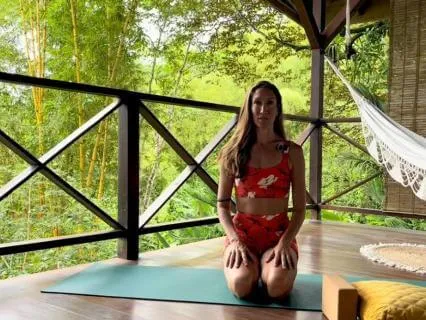
Today in this short class so when you're ready let's speak it you don't need much for today's class just a yoga block if you don't have a block you can just use a pillow if you have both bring both just to make yourself comfortable So find yourself in a comfortable seated position.
So you could just sit on the hips in an easy cross-legged pose.
As I am now.
You can use a block,
Sit on a pillow,
Or find yourself in a hero pose.
Again,
You could use a block under the hips.
If this is too much for the tops of the feet,
Just raise the hips.
Choose whatever is comfortable for you.
And as you're ready,
We'll begin to take a moment to close the eyes or send the eyes downward.
In order for us to come a little bit more inwards.
And always starting the practice,
Really feeling the body by using the breath.
Taking a few cleansing breaths to start,
Which is just a full breath in through the nose.
And open the mouth,
Exhale,
Let it go.
I like to make a little sound to accentuate the release.
Let's try that again.
Inhale through the nose.
Open the mouth,
Sigh it out.
Let the body settle.
One more like that.
Full breath in.
Exhale,
Say it out.
Good.
And then we'll take a few rounds of just slowing the breath down to a pace of breathing in on the count of five and breathing out on the count of five.
This helps us to deepen the inhale.
And lengthen the exhale.
So together we'll empty out the breath and together breathing in two,
Three,
Four,
Five.
And release two,
Three,
Four,
Five.
Breathing in through the nose.
Two,
Three,
Four,
Five.
And release and relax.
Two,
Three,
Four,
Five.
Breathing in.
And breathing out.
One last one here,
Full breath into the nose.
Maybe hold at the top for a moment.
And then exhale slowly fully completely Relax the shoulders,
The face,
And the jaw.
And whether you're in a cross-legged pose or this hero's pose,
I want you to really lengthen through the spine and feel the sits bones or your hip bones really connected to the earth or the block beneath you.
As you feel the hip bones moving down into the ground.
With the inhale,
Lengthen the spine and feel the crown of the head reaching out.
And already connecting to any sense of or embodiment of courage in the body as we ground down to find strength.
And then rise up.
Grounding down.
And rising up.
So really expanding through the body with these full breaths in and out.
And as you're ready,
You can begin to open the eyes.
Good.
Wiggle the fingers and the toes.
And we'll move into our first posture of toe squat.
We'll also open.
The hands at the same time but we'll start focusing on the feet which is most often our foundation So coming to all fours here for a moment.
And we're going to spread the fingers wide.
As wide as you can,
And find as much contact as you are able to with the hand and the ground.
Good.
So not just the wrist,
But the fingertips,
The pad of the fingers,
The palm.
Good.
And pressing into the ground,
I want you to then Take the toes,
Tuck the toes under and.
.
.
Press down into the toes to start to open the bottom of the feet.
So you control the intensity here of this toe squat and opening the bottom of the feet.
We're just going to bring our full attention.
To the sensations of the feet.
So to increase intensity,
We're going to start to walk the hips back towards the heels.
Adding a little weight and pressure onto the feet.
Good.
So everyone's very different with this posture.
Some people can easily sit all the way up and put their full body weight on their feet.
Other people,
This is very intense.
So we're not looking for full intensity here,
Just sensation.
If it's so intense,
I want you to keep your hands on the ground.
Okay?
So find your most comfortable position.
I want you to be at about 60% of intensity.
So I'm going to go to mine,
Which is my hips on the feet.
I do this every day.
It's one of my favorite practices.
As I open up my feet,
I notice huge difference,
Huge benefits of opening the fascial line all up the back.
To the base of the skull.
This is a great one to do every day.
But no matter where you are,
Take a moment and just close the eyes.
And then you feel the sensations of the feet.
Without trying to escape or get out of the pose too quickly.
Feel what's there.
Take a breath.
And as we're trying to stay with the body,
And stay with the breath.
Get really curious about what's happening.
If you feel a lot of intensity happening,
I want you to.
.
.
Change where you are.
Okay,
You could bring your hands to the mat.
Keep those toes opening.
And at the same time,
Now we're feeling the foundation of our hands.
We're gonna open the hands a little bit just by rotating the fingers out.
For some people the fingers go just to the outside of the mat.
Other people can rotate fully the fingers.
Towards the knees.
Go to the place where you are not forcing it,
But you feel it.
And from here I want you to press into the fingertips.
Not dumping the weight into the wrist,
But press into the fingertips so much that you can start to lift the palm of the hand.
Staying here for just a couple breaths.
You might feel that sensation in the palm.
Maybe the back of the wrist or the fingers.
Full breath in.
Full breath out.
One more.
Breathing in.
And breathing out.
Good.
If the palms are lifted,
You can place the palms back onto the ground.
If it's too intense make the rotation a little bit less.
You can just shift from left to right.
Continuing to press down through those fingertips.
Good.
And as you're ready,
Slowly bring those hips back.
Peel the palms off of the mat.
Hips onto the heels and just shake out the hands.
Take a couple breaths.
And feel what's going on in the body.
Open the hands,
Close the hands for a moment.
Good.
If the feet are screaming,
Let's give them some relief.
Hands back to the mat.
And then slowly untuck the toes it's been about a minute and a half or so wiggle the toes squeeze the toes Excellent.
I like to tap my feet on the top of the mat.
And take a child's pose after I do toe squat.
Good,
So bring the hips back.
Bringing your forehead to the mat or a block.
And resting for two breaths here.
After Ichi in posture,
We give a moment just to let that opening be and give it some breath,
Some life.
Good.
More breath,
Inhaling.
And exhaling.
As you're ready,
Inhale,
Come back up to all fours.
Might feel good to take a little cat-cow action here.
Breathing,
Opening the chest,
Looking up.
Exhaling,
Rounding the back,
Tucking the tailbone under,
Looking between the legs,
Full flexion here.
Inhale,
Come back to center,
Neutral spine.
Placing the block off to the side for a moment but still within reach in case we need it.
Coming into our next posture of shoelace pose.
So working into the hips.
So I'd like you to come bring the right knee a little bit more towards the middle of the mat.
Press into the hands,
Belly button to the spine.
Seeing if you can cross your left leg.
Over the right in front of you.
Good.
If that is not possible,
No worries.
You can come to seated and cross your left leg over the right in a seated position.
Okay,
So either way you get there.
We're looking to kind of stack those knees on top of each other.
And if you're entering the posture this way,
We're going to slowly sink the hips back.
Let the front knee or the top knee,
I should say,
Lift off the mat.
And then walking your hands back.
Letting the hips arrive to the mat.
Doesn't work for everyone.
If the ground feels far away and the tension in your hips is stopping you from getting there.
Simply place a block under the hips.
Beautiful.
For me,
This is uncomfortable.
Going to set it to the side.
So this is quite an intense hip opener.
Feel free to uncross the legs a little bit.
If this is still uncomfortable,
You can even straighten the bottom leg,
Keeping just the top leg crossed.
So make this posture work for you.
No matter what,
It's going to open the hip.
So don't worry so much about the shape.
What we're looking for is the sensation of hip opening.
So if you're here with the legs crossed,
One more thing is you can play with how open or far away the heels are from the hips.
Farther away,
More intense.
Little bit closer,
Less intense.
You can use a pillow or a block to support your bottom knee if it feels far away from the ground.
From here,
We're going to ground into the body.
Feeling the foundation.
Of the hips,
Allowing both hip bones to really connect with the ground beneath it.
And sometimes we need to shift our top knee back a little bit,
Bringing that left hip back so that both hip points really connect with the ground.
And returning to that slow.
Five,
Count,
Breath in.
And five count breath out.
And you can stay upright just like this,
Just gravity alone.
Is helping to Open the hips.
You don't need to put any more effort into it.
Just the shape itself.
Time and breath.
We'll start to allow sensations to come up to the surface.
And again,
This is a big part of courage.
When we're facing a fear or doing something new,
There's a lot of sensations.
That come up in the body.
There might be a lot of sensations in the hips right now.
To be able to observe them.
Without running.
Is an act of courage.
So taking these next moments to just notice in a neutral way what sensations You feel in the hips.
Maybe even the sides of the thighs.
See if you can meet them with a breath,
A conscious breath in.
And a conscious breath out.
And you can stay right where we are.
Or if you'd like a little more intensity,
Start to bring the chin towards the chest,
Letting the head fall.
The chin comes towards the chest,
Now opening the back of the throat.
The back of the neck.
If you feel a lot of sensation there,
Don't force it.
Just feel into it.
We don't need to get anywhere,
We're just.
.
.
Connecting to sensation.
With the grounding breath.
And again,
You can stay exactly where you are.
You'd like to invite a little bit more sensation.
Can start to lean forward.
It's totally fine to let the back round here.
So keeping that head dropped,
Good place a pillow between.
The belly and the thigh,
If that feels good for you.
Or if you don't need it,
Just let the head drop.
You could start to let the head.
.
.
Come down towards a pillow or a block.
And notice how sensation changes.
Notice your automatic reaction to sensations in the body.
Just giving yourself an opportunity to slow that down for a moment and notice.
You can meet it with one more breath.
And then calmly make a choice of how to proceed.
You could stay exactly where you are.
Make the conscious choice to back off a little bit.
So that you can have a deeper breath.
Release any tension or holding.
It takes courage to choose the option that is right for you.
Not by force.
But through noticing,
Through intentions.
One more breath here.
Inhale.
Exhale,
Let it go.
On the inhale,
Start to walk the hands back towards the body,
Lifting the chest and the head and the heart.
And when I come up here,
I love to lift the head and lift the chin and the face towards the sky.
Opening the front of the throat And then exhale,
Bring the chin back parallel to the ground.
Beautiful.
So to exit this pose,
We're just going to lean back a little bit.
Good.
Uncross that left leg from the right.
Place both feet out in front of you.
We'll get a little windshield wiper action here.
So bending both knees,
Letting the knees drop to the left and you can look to the right.
Inhale brings you back up and then exhale,
Knees go to the right.
Look to the left.
Good,
And just go slowly here,
Letting the opening.
Find some movement and breath.
It's the moment that the body knows that this range of motion is safe.
Beautiful.
Opposite side.
Okay so this time your right leg will be the top leg.
So you can go ahead and bend the bottom left leg.
And we're going to be crossing the right knee over the left.
Again your options are to sit on a pillow or a block to lift the hips that makes it less intense you can even straighten the bottom leg if it's way too much for you If you want to make it more intense you'll stack the knees and bring the heels further away from the hips.
So choosing wherever you are,
My hips,
The right and left are very different.
So this posture feels very different on both sides.
You might find the same.
No matter where you are,
Again,
Fully enter the pose and the body with the conscious breath in.
And a conscious breath out.
Feeling into the senses of the body.
And really.
.
.
Being with what is here without running.
It's often our tendency to Escape.
Intensity or strong emotions and feelings,
And that's fine and normal.
The yin practice,
We really learn how to adjust.
Intensity.
Understand how to move in a place where we can breathe and be with it and actually feel what's happening.
A very empowering feeling.
And again,
On this side,
You could stay right where you are upright with those really grounded hips and lengthening the crown of the head.
Or on an exhale,
You can start to bring the chin towards the chest,
Opening the back of the throat.
Releasing tension in the back of the neck.
And here is just an allowing of the head to drop,
Not a forcing.
Of anything down.
Pause and breathe with any sensation.
From this place,
Connected to the body,
You decide.
You make the choice of.
.
.
Staying here.
Or leaning forward,
Rounding the back.
Bringing the forehead to the block,
Replacing a pillow between the belly and the thighs.
Releasing any expectation of how it should look or should feel.
Instead,
Just being with what is there.
This is how we create a relationship of safety and respect in the body.
Your mind will wander.
It's not a problem.
When you notice,
Just bring it back with the breath.
The willingness to let go with the exhale.
Softening in the shoulders.
The jar.
Relaxing a little more with every exhale.
Two more breaths here.
Full breath in.
And full breath out.
Stay with yourself.
Full breath in.
And full breath out.
Good,
And now start to allow the inhale to lift the back of the heart,
The head,
The chest.
Letting the face come up towards the ceiling and the sky,
Opening the throat,
The front of the throat with the inhale.
And exhale,
Bringing that chin back to parallel to the ground.
Beautiful.
You can place your pillow or your block to the side for a moment.
Uncross those legs.
It feels so good to uncross the legs after shoelace pose.
Beautiful.
Take any movement that feels good for you right now.
I typically love windshield wipers after that posture.
But your body will tell you how it wants to move.
So please listen to that above all else.
Beautiful.
I like to take a reverse tabletop pose after shoelace as well.
So pressing down into the foundation with my hands and my feet to help lift the hips,
Squeeze the glutes,
Open the heart.
One breath here.
Inhale.
And exhale,
Hips come down to the mat.
Click,
Just have a little release.
Coming into our last posture,
My favorite yin posture of supported fish.
So again,
If you don't have a block,
You can use a pillow.
But we're going to place whatever you have,
A block or a pillow.
Pretty much the mid-back towards the upper back.
Some people like the block.
Lengthwise and some across.
I like it across the back.
I feel more supported.
So I'm just going to place the block or your pillow.
On the mat and then slowly guide myself down.
Elbows and I place the bottom of the block about the middle of my back.
Laying all the way down.
And so the block is about just right under my scapula.
Good.
Letting the hips release into the ground and really.
.
.
Allowing the shoulders to roll open and come towards the ground as well.
Palms face up.
Supported fish is a posture that should feel really good,
No stress in the body.
So if you feel like the block is too high or too low,
I want you to take a moment and adjust where it is.
Find the most comfortable position for you.
It'd be a higher level of the block or lower.
Right place in the back,
Just to let the chest really open.
Coming to a place where the legs are long,
The feet can fall to the side.
Breathing deep into the belly.
And really feel the support from the block beneath you.
There's no need to actively arch the back to open the front.
By the contrary,
Just allow the upper back to sink into the block.
And invite the front of the body to de-armor.
Truly open and relaxed.
Notice any areas that are extra tight and protective.
Just give them a little extra love or breath.
Without forcing an opening.
Sometimes shining a little bit of awareness on where we're protected is enough to.
.
.
The right amount of opening.
And now that we have found safety and connection to the physical body.
Really connected to.
Our feelings and sensations.
There's more space and capacity.
To open the heart and make the choice to move from the heart and move the voice.
With courage.
Steady breath.
The willingness to open.
I'm encouraged to stay with yourself.
Take our last three breaths here.
And that final exhale,
Really consciously let go of any.
.
.
Holding or bracing.
Pushing.
Letting the heart open,
The shoulders open,
The hands.
Beautiful,
Connecting with this feeling of openness.
To exit this posture,
I typically will bend both knees,
Feeling both feet on the ground.
Good.
And then I roll to one side.
I'll roll to my right over on the shoulder just enough to remove the block.
Put it to the side.
And roll back onto the back.
Ah.
Good let the legs go long Feel the back of the heart even more surrendered and connected to the earth,
To the ground.
And if you have a little bit more time,
I highly recommend lying here in Shavasana for three to five minutes at least.
So let the body continue to stay connected to sensation and openness and presence.
Breathing in.
And breathing out.
And if that's all the time that you have today,
No worries.
Gently let yourself.
.
.
Roll up.
Find yourself in the seated pose to close the practice.
Feeling safe and connected and grounded in the body.
Present with the sensations and the feelings.
And an open channel for the heart and the voice to find its courage.
Thank you so much for practicing with me today.
I'll see you soon.