Excellent,
It's now three o'clock,
So we can begin today's continuing meditation class.
Some people sitting on the chairs,
Some people sitting on the floor,
On the little Zen stools which we have here,
They're all very amazing little places which you can try to meditate,
You don't always have to sit in the same place,
Except if you're me,
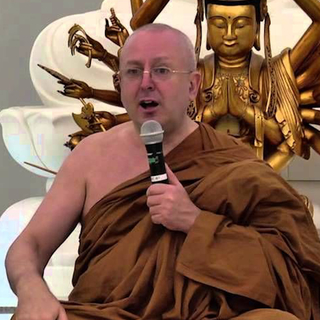
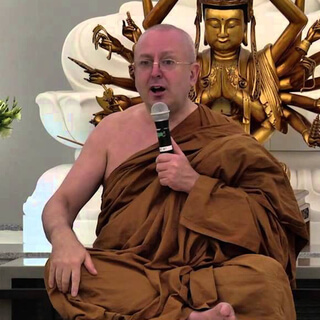
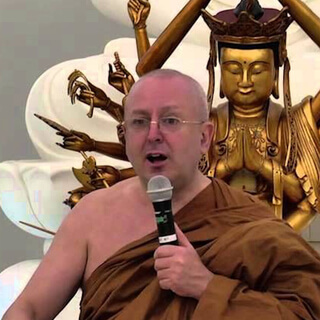
I have to sit up here,
Other than myself,
You can sit anywhere where you find it comfortable,
And the important point is you do find it comfortable where you are putting your body,
And you make it even more comfortable by being aware and being kind and finding how you can arrange this body to be as comfortable as it possibly can under the circumstances.
Under the circumstances is,
We're going to try and be still for 45 minutes,
It may be hot for a few people,
Even amazingly cold for a few other people,
There's still always people sometimes who wear blankets during meditation,
But whatever you like,
You try the very best you can to make your body comfortable,
Because when the body is comfortable,
It means that the mind can just apply its attention to something which is even more interesting,
Which is understanding the nature of our emotional world,
The thing which we call the mind,
And to be able to see that emotional world first of all,
The body just relaxes,
Almost like you can put it down,
Let it go,
And you can follow just the way this mind works,
And as this mind works,
First of all that people have a lot of,
You might call,
Familiarity with the world of sights and sounds,
Not so much with feelings,
Mostly sights and sounds,
Which is one of the reasons why we close our eyes when we meditate.
When you close your eyes,
It means you don't have to look outside anymore,
You can actually look inside,
By looking inside,
I don't mean you start to imagine how that your organs might appear if you suddenly took them out of your body and put them in front of your eyes,
I mean you start to feel this life when the eyes are closed,
You start to feel what it's like to actually to be,
And all of the things which take up the momentum,
The importance which drives your mind forward,
All of the emotional world is where you start to understand,
And you start to understand that this takes up so much of our energy,
Wondering about how are we going to do this,
How are we going to do that,
Where are we going to go next,
How are we going to manage to achieve this,
How are we going to pay for it,
And that world goes on and on and on and on and on.
So here in this meditation,
It's like we come into a monastery,
We come into a holy place,
We come into a place where all those thoughts get put aside for a while,
We're not really being concerned with the matters of our finances,
And with our achievements,
With paying our bills,
We see if we can also put aside all those problems in our life,
In our relationships,
In our family,
Put aside as much as possible so you can come to this person,
This being,
You know,
Inside of you.
It's as we come inside,
Inside,
Inside,
We go in,
In,
In to our life,
That's when we start to come across just this essential being,
You know,
Which bears your name,
And to try and understand exactly what this is,
How it works,
So as we go in,
In,
In,
And be able to put aside all these external things,
You know,
Sometimes you come into a temple,
You come into a monastery,
You sit down and meditate,
And after a while,
You even just,
You almost like forget your name,
Forget your age,
Forget your position in this world,
And you just are.
So we let go of all these other things which we have to deal with in our daily lives,
All this stuff which obsesses our mind,
That's all on the outside.
As you go inside,
You go beyond that,
Inside of it to this thing we call this body and mind of ours,
And especially the mind of ours,
And as you go deeper and deeper in,
More and more inside this thing which bears your name,
Then we can start to understand exactly what's going on in here,
How it works,
And how we can even make this a more wonderful experience.
One of those things we go inside of when we start meditating is inside of time,
And we spend so much of our lives wondering about where we're going to go next,
Always just on the next stage of the journey,
All lingering on where we've come from and the,
All the difficulties mostly of our past.
But here in our meditation we just let all of that go,
We close our eyes to sight,
We next close our mind to time,
So we're not worried about where we're going to go to next,
What's going to happen after the meditation,
What's we're going to go tonight,
What we're going to eat,
Where we're going to go tomorrow,
It all becomes just way off into the distance and we don't even go anywhere close to that,
We just stay in this moment,
This present moment called now,
It's going inside towards this now,
And as we go into this now,
We don't even worry about where we've come from,
And all the problems and difficulties we've experienced in the past,
We leave all of that outside as we go into this present moment.
And we really get into this present moment,
This now,
In our meditation,
Go so deeply into it,
That sometimes that they can't even have a thought,
It is so in this moment,
And just I've said this to him many many times,
But I do recall going to concerts when I was a young layman,
And going to concerts and wondering just why it was that I enjoyed those concerts,
Mostly classical music,
So much,
And it was because all the time that orchestra was playing,
I wasn't thinking,
I couldn't think,
Because the notes were following one another so rapidly,
That if I said anything,
If I thought anything,
Then I'd miss the next note.
I was right in every moment,
With every chord being played by the musicians,
So much so that you were always in this present moment.
And that was one of the reasons why I enjoyed those classical concerts.
And it showed me just how you don't even need music to be able to do that,
Just when you meditate,
You're sitting here going into this present moment,
Right into this now,
And you get into this state where you're just here,
Experiencing this moment,
Experiencing it so fully in this present moment,
That you can't even have the space to think,
And to say where you're going to go next,
Or what are you going to do.
You haven't even got the time to actually to pass judgment on this moment,
Whether it's good or bad,
It just is,
And then the next moment comes,
And the next moment comes,
And the next moment comes,
It becomes just so quiet,
Deeply in this present moment.
And just that becomes just the beginning place of my meditation,
Almost like the starting point,
Because once you get into the present moment,
The silent present moment,
Just here,
Just observing what's going on,
Then things start to disappear.
It's in this present moment,
So much of my life,
And all the things which you have to deal with,
All the business which lies out there for you in the future when you come out of meditation,
All the successes and failures which you've experienced beforehand,
They actually disappear for a while,
Because they just can't find a way into this present moment awareness.
And as you get deeply into this present moment awareness,
Not even thinking can happen,
Simply because you don't have the time to express the thought,
You just are in this moment,
Just being a silent witness to what's happening in this moment.
And from there you rest there for a while,
And of course what happens next is,
As things vanish,
As things disappear,
It's usually the breath which starts to arise,
And the reason why the breath arises is simply because that's perhaps the only thing which is moving.
Everything else in this moment is just starting to stop.
And as this breath is moving,
Just going in and going out,
You think it's a boring thing to watch,
But because the mind has become still,
Because it's not disturbed by all these more loud images,
I'm not just talking about sound,
I'm also talking about visual images,
It's very refined just in this moment,
Just watching this,
Whatever's right here,
Right now,
Because it's so refined,
The breath becomes very beautiful,
Because watching the breath go in,
Watching the breath go out in this moment,
There's something which is not hard to do,
It just means all that happens is just you let go of the past and the future,
You really go into things rather than onto the next thing.
I know this is a different thing which we practice in meditation than what you usually do in your life.
In your life you're always going on to the next appointment,
Getting this one finished with and then go to the next one,
And then the next one,
And the next one,
Always looking for where you're going to next.
Here in meditation there is no next,
We just go right into this moment happening now,
So much into this moment happening now,
Even the word next makes no sense,
We're just here in this moment,
With whatever's happening,
And quite naturally what's happening will become the breathing.
You're just watching your breath going in and going out,
And because if you do it properly,
You don't force it,
You don't rush it,
You don't make it happen,
But you let it happen,
Making it happen comes from too much sense of self,
Ego,
Me,
I,
When you don't use that method,
We use this beautiful letting go method,
Going inwards into this moment,
Inside this body,
Inside this mind,
Inside of time,
This is what happens.
You get this beautiful sense of just the breath coming in and going out.
Sometimes I just compare it to just sitting by the beach,
For the lonely part of the beach,
Where there's hardly any other people,
Maybe early in the morning when it's cool,
Just sitting on the beach and just watching the waves come in and the waves go out.
I'm sure each one of you have done that in your lives so far.
Just sitting there,
Just not really,
Can't,
I was going to say wasting time,
But that's the wrong word,
But really enjoying time,
Making use of the time,
By doing something which is peaceful,
Peaceful and helpful for your body and for your mind,
For your well-being,
Just watching the waves come in and the waves go out,
Hardly even thinking,
Not philosophizing,
Not solving problems,
But just literally just watching waves come in and waves go out from the great Indian Ocean.
And as one does that,
You can compare that to watching the breath come in,
This air coming into your body and the air going out again.
And as you're watching that air coming into your body and air going out again,
In breath meditation as compared to washing waves on the ocean,
You get really peaceful.
And when you get really,
Really peaceful,
The breath becomes far more refined.
Happens naturally,
It's not something you do or aim for,
It's something which you observe.
And as the breath becomes more and more and more refined,
So does the awareness become more powerful.
It's amazing just this way the mind works.
If you do it properly,
You don't force it.
You actually lose it,
You're using less energy.
Because you are using less energy,
The energy can go towards your awareness,
Your mindfulness.
Your mindfulness increases.
You're not just mindful,
You're powerfully mindful.
You see so much in just one breath.
One breath going in,
You think that all these breaths going in and going out are totally the same.
You notice that each breath is absolutely different,
Clearly different than how many breaths you've made in your life so far.
And there's no two have ever been the same.
Easy to say,
But it's true when you get mindful enough to watch your breathing.
There you are just watching your breathing,
Everyone totally unique.
Which means makes it interesting,
Not boring at all.
And as you start watching your breath and it's very interesting,
Then again,
Just you keep going inwards.
You keep going inwards until you just come to just a place where there's just this moment of breath.
There's this moment of breath happening right in this present sliver of time called now.
And there you just have just this bit of breath happening,
That breath happening now.
And you can hardly even call it a breath because there's no beginning and no end,
It's just the part you're in now.
There's somebody reminded me,
It's an old simile from the Vistudha Magga,
Which is an interesting commentary on the Buddha's meditation.
It was written so many,
Oh,
1500 years ago,
I think,
Somewhere around that time.
But anyway,
There it was saying as you focus in just naturally,
The breath is just like watching a saw blade as you're sawing a piece of wood in half.
You can begin by seeing the whole saw from the beginning of the cut to the end of the cut.
But as you focus in,
You zoom in until all you can see is one or two saw blades and this tiny bit of wood where the saw is touching the wood,
Where the cut is being made.
You don't know whether it's the beginning of the saw or the end of the saw because these two or three saw teeth are all that you can see.
And that's a beautiful simile of what happens in the meditation.
You get so into this moment,
All you can see is just this awareness of this part of the breath happening right now.
And as you go even deeper into it,
Of course,
The breath vanishes,
The joy takes over.
It's like the joy becomes so strong,
The feeling of the breath is there,
But the joy dominates your experience and that's what you are knowing,
Just the joy.
Amazing,
Just beautiful happiness as you're meditating.
And that joy soon becomes these beautiful lights in the mind we call the nimitta.
It's not something you do,
It's what happens when you stop doing things.
So if you try and gain these nimittas,
Of course,
They will go away.
If you just let them happen,
They will come and stay with you.
These beautiful lights in the mind,
Very blissful,
Enjoying yourself,
Having a wonderful time and you're so still,
You don't do anything.
You're in this moment,
You can't even think.
You just experience a beautiful light in the mind.
These are the nimitta world where you see these.
And what's happening here is your five senses have almost totally turned off.
No seeing,
No hearing,
No smell,
Taste or physical touch.
What you're left with is your mind,
Your mental sense.
The sixth sense in Buddhism,
The mind,
The citta.
And as you're watching this mind,
And if you can just not be scared,
But realize this is just the path which very many,
Many,
Many people just follow.
You go deeper into those nimittas,
Very beautiful.
And then you go into the world of the mind,
Into the jhana lens.
Beautiful states of meditation.
So this is actually how it happens,
Just to go inwards.
Wherever you're experiencing right now,
Go right into it.
Then where you are,
Go into that.
And where you end up with,
Go into that.
Always going in,
In,
In,
In.
This is the path of meditation.
And no matter how new you are or how experienced you are,
It doesn't really matter that much because even the first parts of meditation is just so wonderful,
So joyful and so beneficial in so many ways.
Whether it's beneficial with your health,
Your peace of mind,
With your general sense of well-being.
All of those things are dealt with by this gorgeous path of meditation,
Of always going inwards.
And that's just how it works.
Simple but powerful.
So that's the introduction.
So those of you who want to just adjust your body just before we begin,
Please do so.
And in a moment I'll start this meditation for Saturday afternoon.
So sitting down,
I should mention once again that this is the class,
The ongoing class of meditation.
We're going to meditate for about 45 minutes.
So if you come here for the first time,
There's another class in the room to my right.
That's the introduction to meditation class.
So you're sitting down and you close your eyes.
Bring your awareness to your body.
Be careful in the first part of meditation.
Don't go too fast.
With your eyes closed,
We become aware of our body.
This body,
Old or young,
Male,
Female or in between,
Sitting here.
How is your body?
You can start if you wish with your legs.
How are your legs?
Do they need adjusting?
Don't assume that everything is okay.
Look more carefully.
The skillful meditator just knows the importance of a comfortable body.
It will linger,
So how are your legs?
Do they need adjusting?
If they need adjusting,
Please adjust them.
How is your butt sitting on the stool,
The cushion,
The chair?
Does that need adjusting?
If so,
Please fidget.
How's the back?
I usually give my back a stretch at this stage.
It brings awareness to that area of my body.
And when I have awareness there,
I can just check that everything is in a good position.
If it's not in a good position,
I'm going to suffer.
I've done that too many times,
Suffering,
Because I was careless at the beginning.
Now I'm careful.
When my back is comfortable,
I check my shoulders,
Making sure the muscles aren't tight.
There's no reason to have any part of the body tight.
I try and get this body in an upright sitting position.
As comfortable as possible.
The top of my back and my shoulders,
I learn how to relax them.
I feel them.
There are many methods.
One I've been doing just recently,
Just scrunch up those muscles and then let them go.
By scrunching them up and letting them go,
They usually fall to a place which is more relaxed than when I began.
And then once my shoulders are relaxed,
I go down my arms to my hands,
Becoming aware of how my hands are situated.
And spending a few moments with them,
Making sure that everything is okay down there.
And adjusting them if necessary.
I think sometimes just when you care for somebody,
That they relax.
When I care for my hands,
They relax.
When I feel they're relaxed enough,
I go back up to my shoulders and to my neck.
Making sure my head on top of my neck is not too far to the left or to the right,
Not too far forward or too far back.
Making sure that my head is balanced on top of my neck.
And the inside of my neck,
The throat,
If there is any irritation there,
Which is usually because of some allergy.
And the other day I can't feel anything there,
It's great.
But just learn just how to relax things.
And to bring peace to these parts of the body which if you had a coughing fit during the meditation,
Will cause you and others some disturbance.
I look at my body first,
Deal with it at the beginning,
So everything is settled during the meditation.
And lastly I go towards my head and just perceive the muscles around the eyes and the mouth.
Making sure that they're all relaxed to the max.
Of all these years I've got to know those muscles so well.
And it's easy for me now just to look at them,
To loosen any holding,
Any stretching.
So those muscles around the eyes and the mouth all go very loose and easy.
And before I leave them I try to put a little smile on my face,
Smile of joy and happiness,
Just before I leave the body.
But I don't leave the body totally because I now look at the body as a whole,
This is one unit,
Which is being dealt with part by part,
Sitting here,
Set up for meditation.
I just check it once more.
And I notice,
As I often notice,
That the body feels delightful.
It's a delight of relaxation.
It's the reason why people do sit in these comfortable chairs,
Where they have massages,
Where they have saunas,
Hot baths,
In order to relax this body.
I do it just by this little method of meditation at the beginning.
But I don't leave that delight yet,
I stay with it,
Appreciating the delight of a relaxed body.
Because I know that the body thereby gets more relaxed,
It goes deeper into this feeling of ease.
But I don't stay with that relaxation for too long.
Once my body is at ease,
I let it go and go inside.
Those who've been coming to my meditation classes week after week know the next thing which I start looking at is my peace-ometer.
How peaceful am I?
And give it a number from one to ten.
One means really peaceful,
Ten means agitated.
But I know just how,
What to do,
Or rather,
What not to do,
In order to bring this number down,
Getting closer and closer to peace of mind,
Deep peace of mind.
When the awareness is placed in a correct focus,
It's looking at the right thing.
It's easy to know what makes you peaceful,
What makes you agitated.
You learn,
You learn just how to pacify your own mind without falling asleep.
The awareness of mindfulness gives you feedback,
Tells you in which direction you're going,
More calm or more dullness.
You choose calm,
Calm,
Beautiful awareness of this moment.
Your peace-ometer shows you what makes you more agitated,
What makes you peaceful.
And of course there are several types of peace.
The dimension is the peace where there's hardly any mindfulness at all,
Dullness,
Sloth and torpor,
Sleepiness.
That's not the path to go.
There's another one,
Another path where you're fully aware that hardly anything is happening.
That's the path to go,
Of calm awareness.
You might also notice that that is right here in the present moment.
It has nothing to do with what's going to happen next.
It's nothing to do with where you come from in the past.
It really is a pure present moment awareness,
Just now.
It's like you can't carry anything from the past or project anything onto the future.
All you ever have is just this moment and you're right here with it,
Getting to know it,
Being it and enjoying it,
Just now.
And in this present moment,
Just go inside.
Always this idea of going into the middle of things.
Never wondering where they're going to lead to.
We're just going inside of them.
Always going in and in and in.
And that's our path.
I'm going to be quiet now as I go in.
When I start speaking again I'll be close to the end of the meditation.
I'm going to be quiet now as I go in.
I'm going to be quiet now as I go in.
I'm going to be quiet now as I go in.
I'm going to be quiet now as I go in.
I'm going to be quiet now as I go in.
I'm going to be quiet now as I go in.
I'm going to be quiet now as I go in.
I'm going to be quiet now as I go in.
I'm going to be quiet now as I go in.
I'm going to be quiet now as I go in.
I'm going to be quiet now as I go in.
I'm going to be quiet now as I go in.
I'm going to be quiet now as I go in.
I'm going to be quiet now as I go in.
I'm going to be quiet now as I go in.
I'm going to be quiet now as I go in.
I'm going to be quiet now as I go in.
I'm going to be quiet now as I go in.
I'm going to be quiet now as I go in.
I'm going to be quiet now as I go in.
I'm going to be quiet now as I go in.
I'm going to be quiet now as I go in.
I'm going to be quiet now as I go in.
I'm going to be quiet now as I go in.
I'm going to be quiet now as I go in.
I'm going to be quiet now as I go in.
I'm going to be quiet now as I go in.
I'm going to be quiet now as I go in.
I'm going to be quiet now as I go in.
I'm going to be quiet now as I go in.
I'm going to be quiet now as I go in.
I'm going to be quiet now as I go in.
I'm going to be quiet now as I go in.
I'm going to be quiet now as I go in.
I'm going to be quiet now as I go in.
I'm going to be quiet now as I go in.
I'm going to be quiet now as I go in.
I'm going to be quiet now as I go in.
I'm going to be quiet now as I go in.
I'm going to be quiet now as I go in.
I'm going to be quiet now as I go in.
I'm going to be quiet now as I go in.
I'm going to be quiet now as I go in.
I'm going to be quiet now as I go in.
I'm going to be quiet now as I go in.
I'm going to be quiet now as I go in.
I'm going to be quiet now as I go in.
I'm going to be quiet now as I go in.
I'm going to be quiet now as I go in.
I'm going to be quiet now as I go in.
I'm going to be quiet now as I go in.
I'm going to be quiet now as I go in.
I'm going to be quiet now as I go in.
I'm going to be quiet now as I go in.
I was coming close to the end of this meditation period.
How do you feel?
How peaceful is the mind?
And how relaxed is your body?
And why?
The last minute of meditation.
How do you suddenly learn what works and what didn't work?
And now I'm going to ring the gong three times.
When the gong finishes sounding for the third time,
It is a signal to come out from your meditations.
There we go.
From Canada,
From Switzerland and from the United States.
First of all,
From Canada I have a chronic pain that overwhelms me in meditation.
It just speaks of befriending the pain,
Not feeding it with resistance,
But I often can't.
How does one open the door to the heart to fear pain?
Because there's nothing you can do to lessen the pain at the beginning,
Then that's the only other response possible,
Just to be with it and to find yourself in as comfortable as a position as possible and just to let the pain be,
Stop fighting it.
It does help if one has this present moment awareness.
So refining the attention so all you have is the content of now,
Just this moment,
Nothing more and then just in this moment nothing more,
Just be with the pain.
The problem is obviously that when you don't have that refined present moment awareness,
The pain is just spread over to the future especially that becomes unbearable.
You think,
I can't stand this any longer and it's true that the idea of any longer which is a projection of the mind,
It's not something which is true,
It's not right here.
So if you can somehow just get the body to be with this present moment really into it,
Then the pain is never that hard to endure.
Present moment awareness I think is the key there.
If you can manage it.
From Switzerland,
Does stillness mean the absence of thought?
There are many types of stillness,
Obviously just ordinary stillness,
You can still have some thinking but it's not really that still and as the thinking gets less and less,
The stillness gets stronger and stronger and when it's really still,
Of course there is no thought.
Thought is just almost the opposite of a still mind.
So in a very,
Very still mind there's no thought to be seen.
It's just awareness,
Awareness before thought.
And lastly from the United States,
As a trauma survivor,
I had long confused shutting down and denial with letting go of stillness.
Is it possible to acknowledge difficulty but not get hijacked by distress?
Of course,
Just the difficulty is being honest,
Being honest with what's going on in your mind and just letting it be as much as you possibly can,
Not fighting it,
Not trying to deny its existence,
Just being with it and after a while,
When you're with that trauma,
Again and again and again,
When you literally open the door of your heart to that trauma and let it come in,
Then it changes,
It's just the whole way it deals with you and the way you deal with it.
So we do have traumas from our past,
But little by little instead of feeling that they are something which lessens our ability,
We find after a while that increases our ability to be peaceful,
To be still.
We turn everything around.
So there's many people who have great traumas before they became fully enlightened.
One of the ones which comes to mind is the nun Patacara,
Who,
She lost her husband,
Her two children and her two parents on the same day,
Went crazy.
But fortunately,
She was wandering around not knowing where the heck she was and wandered into the Buddhist monastery where the Buddha was giving a talk.
Of course,
The Buddha invited her in,
Calmed her down,
Ordained her as a bhikkhuni and she was one of those ones who became fully enlightened and a marvelous teacher.
That was the bhikkhuni,
The female Buddhist monk called Patacara bhikkhuni.
So she had a lot of trauma and became a great,
Our heart fully enlightened and a great teacher.
So yes,
Certainly it can be done.
So but how you do that,
Have to embrace the truth of this moment and not deny any of it,
Not try to get rid of things,
But to embrace things,
To allow them to be,
Allow this moment to be and make peace with this moment.
You find you can make peace with anything,
Amazing,
But you can and thereby you don't try and get rid of things.
You just make peace with them,
Different attitude and far more beneficial.
Okay so those are some reflections on those questions.
Any questions from the audience here?
Wind myself up again.
Ah yeah,
Okay good.
That last comment,
Making peace,
You're making peace with what's happening within you.
Yes,
You're making peace with this moment,
What's happening now,
And sometimes what's happening now is the memory or some part of the memory of that very painful trauma.
But you're actually allowing it to come in.
You're not trying to get rid of it,
You're not denying it,
You're not trying to change it.
You're literally just not reacting to it,
Just letting it be.
Whole idea of like letting it be,
Not doing anything,
Not fighting it,
Not trying to change it,
Not trying to heal it,
Not doing anything,
Just letting it be.
And then see what happens when you do that 100% passive awareness of what's coming up into your mind at this moment.
Does that make any sense to you?
And you keep doing that all the time.
Yeah.
And then after a while does the mind still with it?
The point is you don't be the person decides I'm going to figure out how to fix this up.
You let the mind do that,
You just sit there and watch.
Your mind is very powerful,
Very amazing just how much skillful means it has.
If you could just let it express all the stuff it's learned over such a long time.
Any other questions from anybody?
Okay,
Great.
So okay,
We're just five minutes early so now we can just pay with respect to Buddha,
Swami Sangha and you can go and do what you need to do for today.
Thank you.
God bless you.
God bless you.