Find a comfortable position lying on your back.
You can have your knees bent.
It's especially nice for your low back.
Even with your knees together and your feet nice and wide.
Do whatever you want through your arms.
However they land is perfect.
And just give yourself a moment to kind of settle into this.
Sometimes it takes your low back a second to be like,
Oh,
Okay,
We're lying down now.
Same with your shoulders.
Let them get heavy.
Soften any expression on your face.
And let go of what you need to let go of.
Take a long breath in.
And an even longer breath out.
Again breathe in slowly and breathe out even slower.
Keep that going.
Keep dragging out every breath.
Try to breathe through your nose if you can.
That helps to keep your breath slow.
And to keep you aware of your breath.
Bring your feet flat on the floor if you haven't already.
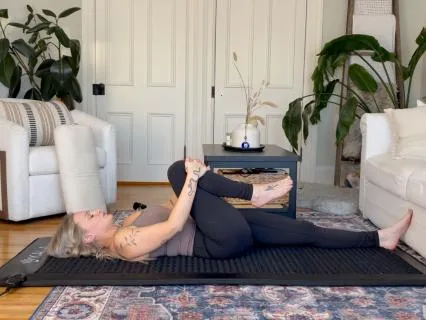
And then bring your legs in.
You can give your legs a hug.
Maybe a rock side to side.
Then just land in center there place your palms on your knees You can have your knees together or apart,
It doesn't matter.
The next time you breathe in,
Send your knees forward away from your face.
As you breathe out,
Pull your knees in close towards your chest.
Inhale,
Send your knees forward so you're giving yourself space to breathe into your belly.
And breathe out like you're pushing and pressing the air out.
Inhale,
Give yourself space to breathe into your abdomen.
Exhale a bit of compression like you're pressing the air out.
Let your breath happen first.
The movement is simply following your breath.
Rather than trying to match your breath to your movement.
It becomes a bit more meditative that way.
And eventually just set your feet down.
Bring your palms down beside your hip.
And we're going to breathe in to roll your hips up.
Then your low back,
Mid back,
Until you're up in a bridge.
Doesn't need to be high.
And breathe out to gently roll your spine down.
Hips Land Lab.
Inhale,
Lift your hips up.
Roll your spine up bone by bone.
And exhale to roll them down.
So think about your spine like it's like a string of beads.
And you're lifting up one little bead at a time.
Or you can think of it like the chain of a bite.
And sometimes.
.
.
That bike chain really needs to be oiled.
And it feels like your spine is moving more like a two by four than a.
.
.
Then a bike chain,
But just notice it doesn't need to be perfect.
Try to slow it down,
Smooth it out.
Go for one more.
This is the most kind of effort we'll do in class.
Anything more and it would turn into Pilates.
And just give your legs a hug in when you're done.
Maybe make some circles with your knees.
And set your left foot down.
Keep a hold of your right leg.
I like to stretch my left leg out.
Take a couple breaths here.
You can always have your leg out to the side a bit more or in a little closer.
The next time you breathe in,
Extend your left arm out to the left side and use your right hand to pull your right leg out to the right.
As you breathe out,
Switch.
So pass that right leg to your left hand and you can pull it way over into a nice twist.
Inhale unravel come back to reaching that right leg out Inner hip and thigh stretch.
Exhale,
Pass it across and you come into your twist.
So it's a pretty big movement for one breath.
Which means Slow your breath down.
So you have time to move slowly.
Kindly.
And that slow breath not only helps you to kind of time your movements and not rush.
But that slow breath also helps you to relax.
When you take that slow breath you send a signal to your body.
To rats.
That you've got time to breathe.
So again,
See if you can still let your breath happen first.
Your breath is the priority more than the movement.
The next time you come into your twist.
Hang out there.
So you can hook your right toes onto the back of your left leg.
And that helps to keep the leg nice and stable,
Steady.
Can reach your right arm out to the right you can make a little cactus arm sometimes that feels nice through your chest And you might be feeling this twist through your back.
Through your right hip,
Through the right side of your chest.
Gently unravel with your next breath in.
And just take a couple breaths in Shavasana.
Just lying on your back.
Notice if the right and left side feel.
A little different Notice where you are in your breath.
And use your next exhale to pull your left leg in.
So we're not racing into that flow.
We're just hanging out here for a couple breaths.
This isn't something you need to just get over with or get it done.
See if you can find a little bit of joy or maybe just some curiosity.
In each little bit of the practice.
Not about just completing the flow.
It's about like savoring your breath.
Savoring the stretch.
Or at least finding curiosity in it.
Easier said than done.
Inhale right arm out to the right left leg to the left Exhale to switch your left leg to the right hand and pull it across.
Keep that going.
When you feel ready.
Come into that twist and hang out there.
Wait for your next inhale.
And use that breath in to unravel.
And find Shavasana,
Just lying on your back.
Roll onto your right side.
You can use your right arm as a pillow.
Bend your knees.
Keep your legs stacked here and just drape your top arm over your hip.
The next time you inhale sweep your top arm up and over.
Your fingertips might touch the ground.
And see how that lower side of my waist lifts as I reach?
We're keeping that.
Breathe out and feel how the lower side of your waist lowers.
One more time,
Just like that.
Inhale,
Sweep up and over.
Exhale,
Bring it back to that starting shape.
And then you can tie in your top leg too.
As you inhale,
Stretch top leg long,
Top arm long.
Maybe your big toe touches the ground.
Exhale,
Come back to your starting shape.
So you'll feel that stretch through your side body.
It's not like the biggest side bend you've ever done,
But it is such a good one.
Really think of lengthening through your left side.
The next time.
You've got that top side extended.
Keep it there.
Breathe.
If you want a bit more opening,
Just take the slightest little roll back.
Think of just opening your heart just a touch.
It should feel pretty delicious.
Use your exhale to come back down.
And before we switch sides,
We're just going to roll onto our stomachs here.
And come up into Sphinx Pose.
So that's elbows under your shoulders.
You can do whatever you want with your arms.
Whether your fingers are interlaced or palms down.
Take a peek over one shoulder.
And the other Do that a couple more times.
And then once you're in center,
Drop your chin down to your chest.
And bring it up Look down.
Bring it up.
One more.
And then just keep your left hand down,
Sweep your right arm up.
It's not going to go as high as you think it will.
It's always kind of disappointing.
And then thread your right arm under the lath.
You can lower the right side of your head down or you can.
.
.
Rest your head on your left hand.
If you love a deep stretch then you can thread your left arm.
Over the right and let your chin or your forehead come down.
You'll feel a stretch between your shoulder blades,
Or if you're doing one arm at a time,
You'll feel it more through the right side.
Come back to Sphinx.
Then we'll switch sides.
So sweep your left arm up.
And then through under the right.
Choose what you do with your right arm.
And take a few breaths into your upper back,
Behind your shoulder blades,
Between your shoulder blades.
One more breath.
Release.
Roll on to your left side.
So your back might be to your device now I'm going to do the on-camera flip.
Left arm is your pillow.
Top arm is draped over your top hip.
Go for a couple with just the top arm.
Inhale to sweep it up and over.
Exhale,
Drop it down.
Again just the arm.
And then go for the leg too.
Big stretch.
And release.
You know the drill.
I'll quit talking.
And the next time you've got that big stretch,
Hang out there.
If you want a little bit more you can roll back just a touch.
Think of opening your heart a bit more.
Use your next exhale to lower your arm.
Bend your leg.
And then you can flip over onto your back.
Maybe some windshield wipers.
Dropping your knees side to side feels good.
So we've already moved our spines.
In all six directions that they go.
They twist either direction.
They arch,
They round,
And they.
.
.
Side bend either direction.
So just layering in those six movements,
Your spine should.
.
.
Already be feeling a little bit more.
Nice.
A little bit nicer.
Now that we've kind of opened up the back,
Let's rest.
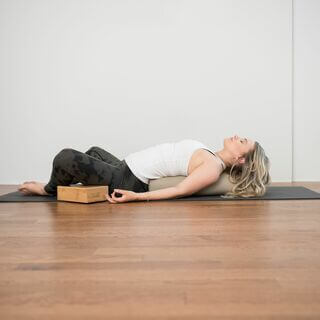
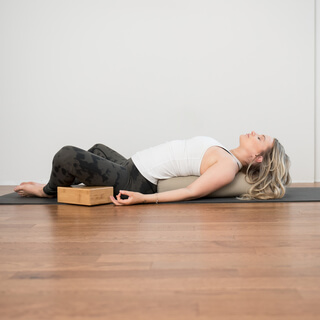
So we'll come into one of my faves.
We do this almost every rest class.
A supported fish pose.
So I'm using a fancy yoga bolster.
It doesn't matter though.
Usually I do this with a couple pillows like those.
Rectangular bed size pillows are perfect.
A normal pillow.
If you're using pillows from your bed,
You can use.
.
.
One,
Two,
Three,
It depends on.
What kind of feathers they've got in them or foam.
Sit your bum down on the ground.
Keep your feet flat on the floor.
And then just recline down onto your pillows.
A lot of people do this with their butt up in the air.
That's not going to be super comfortable.
And sometimes people do this with their heads falling off the bolster or pillows.
Again,
That's probably not going to be super comfortable either.
So,
Butt on the floor,
Head supported.
You can always add in another pillow.
Under your head if you feel like um your chin's tipping up That's very normal.
Just add support there.
You can do whatever you want through your legs.
Some people bring their feet.
Together and their knees wide.
Butterfly moment.
Some people straighten out their legs.
It doesn't matter.
Now,
It's worth saying.
That most of us spend our days rounding forward.
So with our shoulders in,
Our heads down.
So sometimes simply lying flat on our backs is a heart opener.
So be gentle with yourself here if one pillow feels like too much.
Then just lie flat on your back.
That's perfect.
We're really just using these restorative shapes as a comfortable.
Place to land.
Where we can breathe and essentially meditate.
You might feel a gentle opening,
But it's not like a deep stretch by any means.
And the joy of it is you don't need to do anything.
Let your breath be slow.
Close your eyes or let them rest on one point.
Feel the shape of your body.
Feel your breath.
And we're human.
We're going to think.
But what we're trying to do is move from thinking to feeling.
So when you catch yourself drifting into thought.
Come back to feeling.
You might have to do it a thousand times.
Perfect.
Keep coming back.
If simply feeling is a bit daunting.
You're not alone in feeling like that.
Sometimes I like to count my breaths.
So I'll breathe in,
Mentally count 10,
Breathe out,
Count 10.
And breathe in nine,
Breathe out nine.
And you're not changing the pace of your breath.
You're just noting,
Okay,
That's breath number 10,
Breath number nine.
You might make it all the way to zero.
And if you do,
Then you just start again at 10.
You might get lost somewhere along the way and lose track of your breath.
And then again,
You start to get at 10.
So it's not a competition with yourself.
Or with your breath,
It's just.
.
.
Tuning into your breath,
Noticing.
Being aware of it.
Some days I can't even get to eight without my brain wandering and thinking and me losing track.
So I know this looks peaceful.
But usually.
.
.
Just because it looks peaceful doesn't mean it actually is.
So don't be fooled by.
.
.
The relaxing posture,
Our brains are usually doing circles in our heads.
Keep counting.
Or keep feeling.
Start to move your hands,
Your feet.
Move your head.
Then you can bend your knees.
Again give your spine a second with that.
Then you can roll on to one side.
You can still use the cushion if you want.
And just a little break before our next shake.
Now you can keep your cushions exactly as they were if you'd like.
I'm going to throw an extra cushion.
Under the far end of my pillow there so i've made a little ramp i'll give you options if you are having trouble with the ramp Once you've done that,
You just.
.
.
Sit your bum down.
And line down.
So now your legs are lifted.
Now depending if you're using really squishy pillows or not.
This can work or it's.
.
.
Like a saggy disaster.
So if that's the case.
You can prop up as many pillows as you want,
Just stack them.
And then just put your calves up on them.
The same idea.
You're just putting your feet up,
Literally.
If you prefer legs up the wall or a shape like that,
Then Of course,
Use that.
And if you're starting to get cold,
That means the practice is working and you're relaxing.
So feel free to throw on a blanket or whatever and stay cozy.
Keep breathing.
Slow and steady.
Maybe you've still got that count going.
Maybe you're asleep.
Either way,
You're here,
Resting.
And if that count is turning into something rigid where you're judging yourself.
Um,
Maybe let go of the count.
Being able to count 10 breaths is deceivingly hard.
That's about two minutes of being fully present,
Which again is challenging.
We breathe about five breaths a minute.
When we're relaxed like this.
So 10 breaths is two minutes of just being fully present.
It sounds like nothing till you try it.
I'm preaching to the choir here,
I'm sure.
Here we are.
Be gentle with yourself.
When you start thinking,
Come back to feeling.
Breathing.
Perhaps counting.
Try about five more breaths.
When you're ready Move around a little.
Hands,
Feet,
Head.
A big stretch might feel good.
And your next shape is totally up to you.
So if you're really comfy here,
Don't change it.
I like to do this really advanced yoga move of just kicking my bolsters and pillows away.
Just try to move as little as possible,
But.
.
.
That's just me.
Easier than getting up.
And you can do any shape you want.
It might be a traditional Shavasana,
Lying on your back.
Can lie on your stomach,
Your side.
Prioritize your comfort.
And then we're going to do a little I guess breath-based meditation here.
So just.
Make sure you can breathe,
Which I would hope you would do anyway.
Now that you've spent so much time focusing on your breath.
You might have noticed that your breath isn't limited to just the inhale and the exhale.
There's these little pauses in the breath.
That moment where your breath changes direction.
From inhale to exhale.
Exhale to inhale.
And sometimes those pauses are short and sometimes they are long.
And we're not going to change them.
I just want you to be aware of them and notice them.
So keep breathing as you are.
And rather than sending your awareness to just the in and out breath,
See if you can feel these other more subtle elements of your breath.
That gentle,
Subtle pause.
And they're really often not very fast.
It feels like if you blink,
You'll miss them.
That every time you breathe,
You have a chance to catch.
That little glimpse of stillness.
Of wrath.
In each breath.
And you don't need to feel these little silences.
With your breath.
With doing,
With changing.
You get to just soak up the goodness of that sacred pause.
Sometimes they lengthen on their own just by you sending your awareness there.
You get comfortable with the fullness,
Comfortable with the emptiness,
And you melt into it.
Just a few more breaths.
Bring your awareness to your heart.
Maybe you even place a hand or two over your heart.
Feel the heat and weight of your hands.
Maybe you can feel your heartbeat.
Send a little mental thank you to your body.
To your heart that beats all day long for you.
To your body that breathes for you.
To our yoga practices.
And a big warm thank you to you for carving out this time.
In your day or evening.
To practice and do something really sweet for yourself.
Thank you so much for being here with me.
I hope that this class felt like one big long exhale.
Or maybe even.
.
.
That subtle but necessary pause.
Thank you so much for being here with me.