Good to see you.
For today's sequence,
We will begin in a lying down position,
Supine with your back facing the ground and your belly facing up.
We'll do some gentle breathing techniques to begin to support the clearing of the pathways of the respiratory system.
And then slowly and gently,
We'll make our way into a seated position where we'll do some gentle movements from qigong as well as yoga.
From then on,
We'll slowly come into a standing position.
Okay.
Or practice a few more of the standing postures from yoga,
Such as the warrior one,
And also some qigong forms,
Which include white monkey offers fruit,
Lung healing sound,
As well as lotus blossoms from the mud.
And at the end of today's practice,
We'll return once again into a seated position.
This might be on the ground or on a chair,
Whichever is most comfortable for you or for the women that you support.
And we'll close off with some more breathing techniques to begin to improve respiratory health.
This whole sequence.
.
.
This whole sequence has been designed to move from a very gradual,
Gentle modality all the way up into a little bit more intense and then gradually bringing the practitioner back into a very soothing and calm state of being.
So if you or any of the women that you are supporting have experienced COVID,
Perhaps you are now currently recovering from COVID,
That you're working with,
You're welcome to take any part of today's sequence or the class and feel free to adjust,
Feel free to skip any of the practices that might be too intense or that might trigger or cause some discomfort in your body.
When working with COVID or respiratory health,
It is very important to work at the level that is comfortable for you.
So that's why we begin on the ground,
Close towards the earth,
Lying down with some breathing exercises.
The breath is the most vital.
So let's begin.
We'll start by lying down on your back.
I like to turn and face my back away from the ground,
Bend my knees and slowly use my palms to support myself to slowly come to lying down.
And you might do the same if that feels good for you.
I like to also rest my palms on top of my belly area.
Just around the space underneath the belly button and to keep my shoulders relaxed.
From here,
The first thing to do is to start to check in to notice your energy levels you might begin.
By lengthening out one or both legs if this feels good for you.
If this is not comfortable and if you're working with any lower back pain,
Then you may also enjoy having a bolster underneath your knees to release the lower back area.
Starting at the base of your feet began to allow a body scan upwards.
Checking in with the different parts of your body,
Noticing how you feel.
Let this body scan move upwards along your thighs.
Hips,
Lower belly Mitt back.
Chest area back of your lungs,
The front of your lungs.
Side of your lungs.
All up along your arms to your shoulders your neck your ears,
Your jaw,
Your cheek.
Your lips,
Your eye.
And to the crown of your head.
Now taking a moment and observing the results of your body scan,
Noticing how it feels today.
Furthermore,
Observing the length.
Quality and texture of your breath.
Is your breath fast or slow?
Is it shallow or deep?
Is it smooth or perhaps is it more jagged?
Observing and noticing.
With no specific expectation,
Noticing your breath today.
Right now.
And now slowly,
I'd like to invite you to join me in the very first breath practice we're going to do.
You can keep your palms on the lower belly area or you can let the palms come by the sides of your body.
We'll start by visualizing underneath the bases of your feet.
Imagine the bottom of your feet could breathe.
From the rainbow arches underneath your feet,
Begin to breathe in.
From the toes towards your ankles,
Knees.
Hips,
Chest all the way up to the crown of your head.
And then as you exhale,
Breathe out from the crown of the head all the way down towards your toes.
Let's do this five more times,
Inhaling from the toes,
The arches of your feet,
All the way up towards the crown of your head.
And exhaling from the crown of the head all the way down towards the rainbow arches of your feet and your toes.
Flowing with the normal rhythm of your breath.
Let every inhale begin to fill you up from your toes to your crown.
And let every exhale from your crown begin to flow down towards your toes.
We'll stay here for just about three to four more breaths.
This is a wonderful breathing technique to begin to support longer and fuller breaths,
Which might be helpful,
Especially if you're experiencing difficulty breathing because of COVID.
And now you're welcome to stay with this breathing technique if this feels good for you.
If you would like to try the next technique,
We're going to slowly with your next breath.
Begin to inhale all the way to the crown of your head.
This time from the crown of your head,
Exhale down towards your toes.
With the next breath in,
Inhale from the back of your spine,
Your tailbone,
Which is behind your buttocks,
All the way up to the crown.
And exhale from the crown all the way down to your toes.
So visualizing your breath,
Your inhale has a ratio of one.
From your tailbone to the crown.
And your exhale has a ratio of two.
From the crown all the way down to your toes.
Notice how this feels when you're inhale.
Is half the length of your exhale.
Notice if any part of this breathing feels a little bit more challenging.
Acknowledging,
Embracing Noticing.
Inhaling one from tailbone to crown.
Exhaling from crown to all the way down to your toe.
We'll stay here for three more breaths like this.
This breathing technique which lengthens the exhale.
Helps to activate the parasympathetic nervous system.
It helps to bring your system into a state of rest.
Digest.
Relax and restore.
Now you're very welcome saying here,
Lying on the ground close to the support of the earth.
Keeping this breathing technique.
If you feel ready to come to sit for the next part of the class.
You may wish to bend one or both knees.
Let both feet come from the ground.
Feel the support of the Earth.
Slowly roll over to one side and take a moment here.
And at your own pace and time,
Pushing yourself up into a comfortable seated position for the next part of the class.
As you come to sit.
If you would like to,
You can gently and slowly begin to prepare a cushion or some form of elevation for your hips to create spaciousness in the pelvic region,
As well as to support the full spaciousness of your spine.
So that your psoas muscles that are actually connected to your lungs can fully be present,
Fully be available for your breathing.
You might be in a half lotus or you might be in what is called a Burmese seated position.
You might choose a cross-legged seated position.
Or some of you may prefer what is called the kneeling position or caesar.
Whichever feels best for you.
As you choose your seated position for the next part of the class,
We're going to come into a form from Qigong that works with the fire element.
And the fire element is often known as the element that helps to also balance the metal element that is present within the chest area.
We're going to interlace the fingers in front of your lower belly area,
Your tan tian or energy field.
Breathing in,
Raise the palms to your chest,
Flip the palms forward,
And begin to lift the palms all the way up to the sky.
Keep pushing the palms all the way up towards the sky while relaxing your shoulders down,
Creating spaciousness through the sides of your ribs.
Your armpit area.
If this feels good for you,
You can stay here.
You can also,
If you would like to try,
Begin to let your gaze,
Your nose,
Your chin begin to lengthen upwards towards your palms.
As you maintain the next three to five breaths here,
Let your intention and awareness be to penetrate your palms,
To penetrate the ceiling,
The sky,
And reach the heavens above.
One more breath here.
To release,
Slowly look forward.
We'll let the palms begin to draw.
A rainbow of protection above,
Palms are active as they push away.
Let the palms begin to soften as they come close to the earth.
Relaxing the shoulders.
Let's do this two more times.
Interlace the fingers,
Breathing in,
Lift the palms to the chest.
And began to support the sky.
This form is called two hands rising to support the triple heater.
At your own time,
Gently and slowly releasing without rushing,
Taking your time.
One last round like this,
Interlacing your fingers.
Inhaling letting the breath rise filling your lungs and supporting you to begin to float upwards towards the sky.
At your own pace and time when you feel ready,
Releasing that very last round.
Now we'll do a combination of this with some yoga poses to revolve the spine.
Breathing in,
Flow the palms all the way up to the sky.
As you breathe out,
Revolve your chest towards your right side.
I'm your mirror.
Let your left hand find your right knee.
And let your right hand come behind you.
Gentle twist our way to stimulate and boost lung health.
Now if this doesn't feel quite so good for you,
You might choose a very gentle variation of this revolving movement.
One more breath here.
Inhale will come back through the center,
Raising both palms up.
As you exhale,
Revolve to the other side and let the palms gently come down,
Flushing your lymphatic system,
Raising and lending your arms,
Looking behind the other shoulder.
You might also stay here or maybe find a gentler variation where your chest is only revolving slightly.
And slowly and gently coming back through the center.
Let's try this one more time.
Inhaling,
Flowing the palms up.
Creating spaciousness through the sides of your lungs.
Exhale,
Revolve the chest area slightly a little bit more and let the opposite hand find the other knee.
And if you would like looking straight ahead or behind the shoulder.
One last time on the other side,
Your inhale will bring you up.
And your exhale will bring you to the other side.
Slowly and gently,
Once again,
Returning back through the center.
With one more form that we will be practicing in a seated position.
That works with the sides of the body and one more form that works with the whole of the spine.
Now we let your hands come into loose fists.
We're going to come into a variation of what is called spinal cord breathing in a seated position.
Later on,
We'll try the standing variation.
Breathing in,
Begin to arch.
The spine look all the way up to the sky.
Breathing out,
Round the spine.
Let the inner corners of your elbows move towards each other.
Round in and look towards your belly.
Every breath in,
Imagine your lungs are expanding and the breath is flooding the front of your lungs.
Every time you exhale,
Imagine the breath is moving out from the back of the lungs.
Let's try this three more rounds.
Inhaling,
Arching the spine,
Feeling the whole of the front of your chest.
Exhaling,
Rounding the spine,
Withdrawing,
Returning into you.
You might be moving faster or slower than me.
The most important thing is that you follow your own rhythm and your own breath.
As you come to the end of that last repetition,
Let the palms gently begin to rest on your lap.
Take a moment to notice how that feels.
Now we come to the last Qigong form that works with the sides of the body,
Our revolving movement for the palms as well as your neck and head.
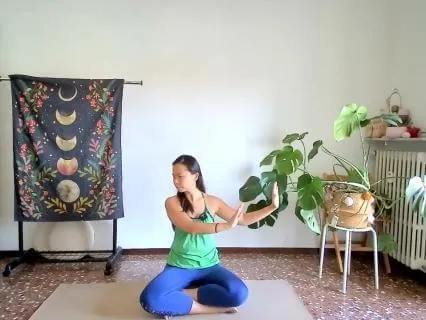
We'll begin by letting the palms come off to the side as if you're holding two mirrors,
One with each hand.
Start by looking towards the palms,
Keeping your shoulders and your neck relaxed.
This qigong form is called Dragon Turns Its Head.
Inhale here and look towards your mirror.
As you exhale,
Turn the palms away from you and look away from the palms.
Gently begin to push the palms away from you,
Still keeping your elbows soft.
With the next breath in,
Look towards your palms as you let the insides of your palms face you.
We'll do this.
Three more times on this side before coming to the other side.
Follow your own rhythm,
Your own breath.
See if you can allow your shoulders to be fairly relaxed even as you do this Qigong form.
As you complete this last round on this side,
Let the palm gently flow down.
And we'll let them begin to flow upwards on the other side.
In a similar manner,
Relaxing your shoulders down,
Let the two mirrors begin to reflect you.
One of the qualities of the metal element as associated with the lungs in traditional Chinese medicine is the capacity to refine and reflect.
So we're going to look at your reflection first through the two mirrors.
And as you breathe out,
Turn away from them,
Taking a moment.
To let the truth and the radical honesty set in.
When you feel ready to inhale once again,
Looking at that reflection.
Let it show you what you may have neglected from before.
Exhale,
Letting the palms begin to turn away,
Taking a moment,
Introspection.
This is a necessary part of connecting with the lungs.
The energy of the metal element to let go.
Let's try two more times on this side without rushing,
Taking your own.
Following your own rhythm.
Remember,
As the palms face away from you,
They are gently pushing away.
Every time you inhale,
Let the palms turn back towards you.
Every time you exhale,
You let the palms gently push away.
And with the next breath,
Slowly and gently letting the palms come back,
Looking up towards the mirrors.
Exhale,
Letting the palms gently begin to settle,
Noticing how this feels.
Now for the next part of the class,
We will come into a standing position.
I'd like to show you one of the favorite ways I love to come to Stan.
If you have a cushion underneath your sit bones or some block or support,
You can start by removing it.
Begin by placing your palms in front of you underneath your shoulders.
Come onto hands and knees on all fours,
But tuck your toes under.
Walk your hands towards your knees and roll so that the weight comes on towards the balls of your feet.
You can bounce a couple of times to activate the rainbow arches of your feet.
And then slowly begin to rise up to stand.
As you come to stand,
We will move into the next part of the class for the standing practice.