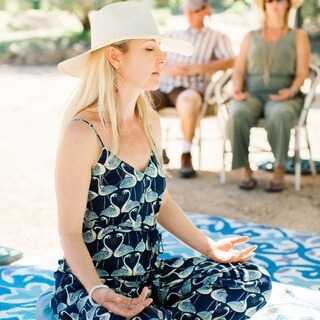
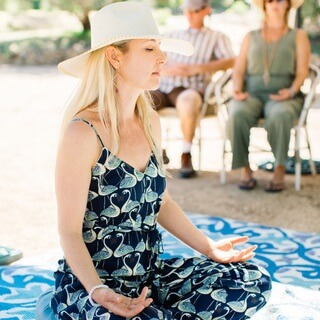
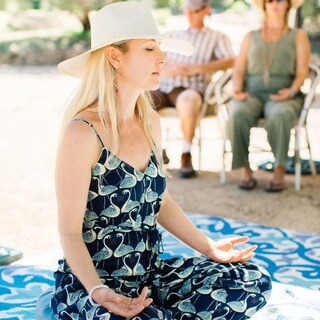
We can do walking meditation.
It's one of the core meditation practices,
And it's a beautiful practice of recovery.
Because if you think about what's happening every single time you take a step is you're falling,
And there's a little bit of a trust that your body will catch you,
And then you land not far off from the little snail that I did.
And what is happening in that space between the snail things,
Little snail squirts,
Is the snail is squirting a little bit of this like mucus stuff so it can slide,
So it can float,
So it can fall.
And we do that as we walk,
But we also do that in our recovery spaces.
So we're gonna start today with the very brave and scary walking meditation.
And it's really,
Really,
Really a beautiful practice.
We're gonna be little snails doing it,
And I'll guide you through,
And then we'll come back to our seated practice.
And through all of it,
I'll use Erin's frame here,
Because it's a good frame of center open,
Non-self values and compassion.
It's good.
Okay,
Let's stand up.
So the first part,
Before you can learn to walk,
If you're a child,
Before you learn to walk,
And we're gonna create a space.
If you can move your chairs in so we can walk around.
We just need a circle,
Really,
Kind of,
Ish.
Before you learn to walk,
You have to learn how to stand.
Yeah?
It's the first thing you learned.
You had to get up,
And somehow we got ourselves up.
We didn't even know that we did it,
But we did.
And one way to learn to stand is to find our center.
You know,
When you're standing,
You're not standing like this.
You're not standing like this.
You're centered over your spine.
So we can find our center over our own bodies by rocking forward,
Rocking back,
Finding the four corners of our feet,
Finding our center,
Which is right below our navel,
Pressing our feet into the ground,
The crown of our head up to the sky,
And our shoulders drop,
And we stand.
This is mountain pose.
In core power,
We like to do mountain like this.
But in traditional mountain pose,
We're just palms open,
Centered.
And then notice that it may be even harder to find your center when you close your eyes,
Or it's easier to find your center when you close your eyes,
But just how closing your eyes shifts your attention inward to your center.
And then can you find your center with your own breath?
And then we're open.
So we're open-hearted.
We loosen up a little bit.
We're just open like in our energy field.
We open our eyes.
And you know,
We're not gonna do,
Actually,
We're not gonna do this in a circle.
I think a better way to do it is find one spot that you're gonna walk to,
Because this is really good practice of walking to nowhere.
So find one spot that you're gonna walk to that's a few feet away,
And then you're gonna find a,
And then you're gonna come back to this spot.
This is gonna be your meditation,
Because all day long,
We're walking to nowhere.
We're really going to nowhere.
All we are is here.
So you may notice in your walking meditation,
You may wanna get to your spot quickly,
But there's no reason to get to your spot quickly.
Right?
It's just a spot.
And what we're gonna do is we're gonna allow,
We're gonna lift up our foot,
And we're gonna feel what it feels like to balance.
And then we're gonna fall a little bit and land in our other foot.
And then we lift up our foot and feel what it feels like to balance.
And it's ridiculously slow.
And we fall a little bit.
And as you practice your walking meditation,
We can also practice this sort of no-self mind,
Because there's a self that's got all sorts of stories going on about this,
And the person next to you,
And how fast you're going,
And if you're doing it right.
But can you bring your awareness to just the pure sensation of the walk?
And when you hit your spot,
You turn around,
And pay attention to the transition of turning around.
Transitions are just as important as moving forward.
Do you quickly turn around?
Or can you make your transition as intentional as your walk?
And then get really deeply curious about this experience.
So non-self,
It doesn't really matter.
You don't matter so much.
And then we can add to our walk our values.
So how do you want to walk?
Do you wanna walk with compassion,
Presence,
Maybe a little bit of looseness,
Kindness,
Openness,
Creativity,
Openness?
What are the qualities that you wanna bring to this walk,
And can you demonstrate it with your walk?
And if you need to speed up,
Because that demonstrates your values,
You can speed it up.
If you wanna turn it into a hop,
You can turn it into a hop,
But we're just practicing embodying those values as we walk.
And I'm gonna be quiet for just a little bit.
And then here's the next challenge.
As we've been walking,
We've been focusing on our own selves,
Oftentimes our own little focus point.
Can you look up and see many humans walking slowly?
Or just use your periphery to notice all of us walking in this open,
Compassionate way.
And then walking gently on this earth,
We find our seat.
And can you,
With the same intention,
Sit down in the same way that you were walking?
And you may hate it,
Or you may like it.
That's part of the practice,
Too.
Just to notice your own response,
Your own aversions,
Your own clinging.
So you can allow the energy of that movement now to just settle.
Finding your center in your seat in the same way that we found our center while standing.
One way to find your center is by following your breath.
But another way to find your center is to connect with what is around you,
Sitting at the center of sound,
Sitting at the center of other humans alive and breathing.
Breathing.
And then sitting at the center of your own heart.
As if you could view this experience from your heart,
Your consciousness sitting at the center of your heart.
And this is the first part of your recovery practice is to know how to find your center in the spin of it all.
You're practicing how to find your center right now with your breath,
With your direct experience,
And with your awareness sitting in the seat of your center of your heart.
And the next part of your recovery is to open.
So you could almost imagine opening the window of the back of your heart and the window of the front of your heart,
Letting some air in and letting yourself out so that every experience that comes to you comes as a wave,
It crests and it falls,
A sound comes and it goes,
A thought arises and leaves,
A feeling visits and leaves,
And you're open to this field.
So there's no effort in paying attention.
It's effortless openness.
It's just opening and letting go.
It's that glide of the snail.
Relaxing into the glide and letting whatever friction,
Story,
Thought,
Sound,
Sensation pop up,
Stay as long as it wants and leave.
You're just open.
And what you are opening to or you're entering into is this bigger you or we.
So there's a small you that's making commentary.
I like this or I don't like this or this is gonna happen next or what about that or still is in the walk or there's a small you that's got a whole lot to say.
There's a bigger you.
It doesn't have much to say at all.
It's just here.
And when you sit in this bigger you,
The recovery space is effortless,
Ease,
Nothing to do,
No problem to solve.
Nowhere to go.
And this bigger you in this space,
This effortless presence also has things and ways of being that resonate with your highest energy.
May it be to be of service or to be love.
It's filled with that,
Your deepest values.
And then finally,
This recovery space is a space of healing.
A space of compassion and compassion being a willingness to be open to,
Present with things that are hard inside of us,
Things that are hard inside of other people,
Things that are hard about this world,
This planet.
So we start with choosing one of those things,
Something inside of you that's hard,
That maybe needs some recovery.
Or you could choose another person that you know is struggling,
That is in recovery.
Or you can choose something on our planet,
Something,
A community,
A country,
An animal ecosystem that is in need of recovery.
Choose something,
Just one thing.
So we begin by making contact with that thing,
Feeling,
Breathing with that thing,
Opening your heart to that thing,
Letting yourself experience the suffering of that thing.
And then the second part of compassion is offering this wish,
This desire to be helpful,
To be of service.
Even if only my service is just something small,
Which is to include you in my meditation this morning.
That's enough.
So may you be well,
May I be one with you,
May you be free from suffering,
May you be at peace.
And I'm gonna close with another poem.
I read you a poem a couple of weeks ago.
It's another one of them in the morning.
Part of my recovery is writing in the morning and I write on an object in the room that I just see.
And this one was a poem about recovery and sitting on my couch were my running shoes.
So today my recovery is an old pair of tennies,
Unlaced,
Battered,
Worn too much at the toe.
I probably need a fresh pair.
They've lost their bounce.
Running the same route a hundred,
Maybe a thousand times,
Worn out.
The pavement is hard and the road silent.
Recovery has no fans.
No bystanders cheering you on.
The dog walkers don't know about the fall you had last week,
The ache in your hip,
The effort it takes to get up again.
Some days recovery is stopping right there,
Taking off your shoes and lying knees up on the side of the road.
But just for today,
My recovery is lacing up,
Having faith I'll get a second wind,
Knowing that we'll be a downhill.
Today,
Recovery is choosing to double knot,
Head out,
Trusting in the open road.