Hello and thank you to this beginning meditation basic series.
If this is your very first step into meditation.
I'm so happy that you're here.
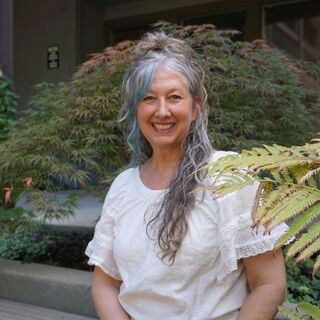
I am Colleen Fletcher.
And this is my personal favorite.
Fifty-fifty!
Think 55 years I've been meditating on a personal level.
So things have changed a lot,
But I'm really glad that you're here with me.
And one of the things I've learned is that before we even close our eyes,
We have to talk about the where.
Because you have to make up.
Your mind of where you want to be for your meditation.
So many people think that you have to have just this perfect like Himalayan cave or the absolute best retreat for this.
And really,
You can be anywhere.
You can be on a mountaintop.
Yes,
You can be in a cave.
You can be by the ocean.
You can be in your bedroom.
You can be anywhere that works for you.
It's just a place that you know that you can feel relatively safe with it,
Safe in the fact that you won't have interruptions.
So I suggest turning your phone off,
Turn off any alarms.
Anything like that.
So what we're going to do today is set up different spaces,
Whether you're indoors or whether you're outdoors on a chair.
Or on the floor.
And the goal isn't to find the place where the world stops moving.
It's to find a place.
Where you invited,
Where you are invited to be still.
It's that stillness within.
That shifts everything.
Outside of you.
All right,
So indoors.
We're going to start there.
I look for a corner of any room that feels clear.
You know,
You can plop a pillow down and sit up against the wall,
Anything like that.
It can be the side of your bed.
Although I don't often recommend in your bed to meditate,
Sometimes that's the only place that can happen though,
Where you close your bedroom door and you're just in that space.
Too many other things happen in the bed,
So I think it's important,
If you can,
To try and not be there.
But it could just be your favorite armchair.
It could be that you lean up against the bed,
Put a pillow on the ground,
And lean up against your bed for a little bit of support.
So if you're sitting on the floor like that,
Use a firm pillow or you can even fold up a blanket or a towel.
And the idea with this is to get your hips above your ankles and your feet.
It's a little bit easier on your hips.
And this really allows for your spine to have this to not.
Rigidly straight.
But this straight,
Comfortable,
At ease posture.
So pretty much you keep your bum and your hips above your feet.
Okay,
So if you're using a chair.
Choose one where you can rest your feet.
Firmly on the ground.
And try to sit.
Not leaning forward,
But slightly.
You're still going to want to be on top of your sits bones.
Those are the bones in your bum.
You want to be on top of those and have just this gentle curve.
Of where your hips are placed.
I dunno.
It's a time to really feel with all of these,
To feel how your spine is supported.
And again,
Not all hunchy and not so rigid,
Just upright and supported.
You really want to feel that connection between your feet and the floor.
As this is a big part of.
Feeling that connection of being grounded as well.
Now,
If you're lucky enough to meditate outdoors,
You can be on a porch.
I have a lovely backyard.
I'm out there meditating often.
Um,
Even if you just have a porch and you're in an apartment,
Or sometimes even just opening a window will help to bring in enough fresh air that you can get just into a different spot for yourself.
If you are outside,
There is that natural white noise of the world.
Outdoors,
Nature is really noisy.
So there's a lot with that.
And your space is so much divided.
It's defined.
By the elements.
And the elements being if it's winter time and you're outside,
You might want to coat another blanket over you as well.
I highly recommend if you are open to meditating outdoors,
Then try it in all as many different seasons as you can.
You're going to want to feel the air on your skin.
If you're sitting on the grass,
Notice that unevenness.
Of everything beneath you.
You can also take a chair outside and kick your shoes off.
Oh my gosh,
Kick your shoes off and like get your toes into the grass or the soil wherever you are.
Now,
Wherever you are,
Indoors,
Outdoors.
Physically adjust.
You're going to want to settle your weight.
You're going to want to roll your shoulders back.
You can lift them up to your ears and then allow them to drop.
And what you notice here is when I lift them,
They're dropping.
I'm not pulling them down.
I'm lifting them up and allowing them to drop.
You can then pull your jaw into that.
And that just really helps to release tension all through your neck,
Front and back,
Shoulders,
Which then helps to alleviate your spine even more.
Very,
Very simple things to do with this.
Just lift them.
Allow them to drop.
Okay.
Now.
That we have.
Just this very,
Very first connection with it.
Let's spend the next few moments arriving into the spot that you have chosen.
Gently soften your gaze or close your eyes.
Acknowledge the space.
It's your sacred,
Personal space.
It's your boundary for the next few minutes.
And by choosing this spot,
You're telling your nervous system.
In this square foot of the earth,
I am safe.
In this moment,
I am right where I am meant to be.
Taking a deep breath in through your nose.
And a slow sighing breath out through the mouth.
Notice the sounds in your environment.
Simply let them be a part of the landscape of your perfect space.
Taking another breath in through your nose.
And allowing it to release through your mouth.
Gentle sigh out.
In this space.
Is now your home base.
And slowly opening your eyes.
And maybe you have just a moment,
Just a moment of peace with this.
Just with your inhalation and your exhalation.
Next,
We're going to return to talk about the how.
So we're going to add more layers onto this beginning series.
This is going to be the geometry of posture.
And how to keep your body comfortable for longer periods.
Take one more breath.
To seal this intention.
And when you're ready.
Come back to your full awareness.
And I will see you in part two.