So today we are doing a practice that is going to support you through the months of winter.
So we'll be working with the water element and the bladder and the kidney meridians and the correlating organs.
So for this practice you will need,
I've got a bolster here,
So if you've got bolsters or blocks at home.
Grab hold of those.
If you don't have those that's okay,
Just grab some rolled up blankets,
Rolled up towels or the cushions.
Off your couch or even the pillows off your bed.
Whatever you've got laying around you can totally improvise for this.
So once you've gathered everything that you need,
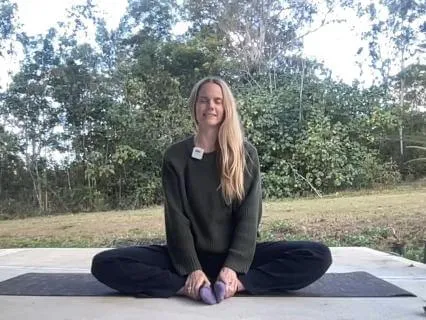
Let's come into a comfortable seated position to start.
And closing those eyes down.
And we're just taking some time here to fully arrive here in the space.
In your practice.
In your body and in this present moment.
Releasing the day that you've had so far and choosing now to be here and to be present.
Sitting up nice and tall so you're anchoring your sitting bones to the earth as you rise tall.
Crown-reaching sky wood so you've got that beautiful long spine where the energy can flow freely.
And just do a little bit of a scan through your body from head to toe,
Noticing how the body is feeling.
And there's no judgment here,
We're just observing and gathering that feedback from the body.
If you come across any points of tension or even pain in the body.
Start to invite your breath into these spaces and inviting a little bit more softness and openness here.
Move your awareness now from the body to your breath.
And notice the way in which your breath is flowing through your body.
Feel the breath as it glides in and out of your nostrils.
Feel the rise and fall of your chest and your belly with your breath.
And maybe you can start to breathe a little bit deeper.
A little bit fuller.
Let's draw a breath in through the nose,
Feel your entire torso expand.
With a long,
Smooth exhale,
Feel the torso gently contract.
Moving through that again,
Breathing in through your nose,
Drawing in life force energy.
Exhaling to release and let go of anything that's no longer serving you.
Let it all go with your breath.
Continue here with this beautiful full breath,
Inhaling.
Exhaling.
Breathing now in your own rhythm.
Let's take five more of these breaths together.
And after you've taken your last round of breath,
Allow your breath to settle back to its natural rhythm,
Noticing how you feel.
And this sacred slow time of winter is your opportunity to slow down a little bit,
To go inward.
To rest,
To restore.
And knowing that when you do,
It provides you with more.
Nourishment.
It provides you with a solid foundation so that when you emerge into spring you do so from a place of fullness.
Giving yourself this opportunity throughout this practice today to do just that,
To rest,
To restore,
To nourish and nurture yourself.
Let's blink open the eyes when you're ready just for a moment so I can show you this little acupressure point that we'll do before our first Yin Po.
So if you can come down to kind of like right in the center,
Like the ball of your.
.
.
We're gonna take the kidney one.
Point.
Also known as the bubbling well or the bubbling spring.
So if you can find that point.
And just bring your thumbs into this space.
You might close your eyes down again.
So you're applying gentle but firm.
Pressure here and we'll take a few moments here to breathe.
To ground.
It's a very grounding.
Point.
It's the beginning of the kidney meridian.
We'll be working with both the kidney and the bladder meridians and organs today.
Inviting in this nourishment for the kidney channel.
The kidney organs.
Just a few more moments here.
Start to gently release that point now,
Just noticing how you feel.
And when you feel ready,
You can blink open your eyes,
Coming back into the space.
And let's come into our first pose for today.
We'll take Balasana,
Which is Child's Pose.
So it's up to you if you would like to prop yourself for this pose or if you simply want to fold down onto your mat.
So see what you feel called to do today.
I'm going to use my bolster.
So you want your knees.
Quite wide.
Toes touching hips to heels or working towards the heels.
If you struggle to get the hips to the heels and it feels uncomfortable you can pop the a blanket or something here for a little bit of extra support.
Grabbing your bolster or your.
.
.
Props if you're using them and we'll come to fold forward here.
So folding all the way down either to your.
.
.
Prop or down to your mat.
Now you can turn your head to either one side or the other,
Or you can keep the head centered.
See what feels better for you.
Arms resting gently beside you.
Have a wriggle around here and get nice and comfortable in your pose.
Once you've found where you need to be,
We're going to close the eyes down and fall into stillness.
So here in our first yin pose we find ourselves in child's pose and I often like to start my practice or my classes with this pose because of its grounding and nourishing and restorative quality.
So this is a pose you'll find in Many styles of yoga that is used as a resting pose.
So really give yourself the opportunity now to do just that,
To rest.
Grounding down through all of the parts of your body that are in contact with the mat.
Start to soften out through your neck and your shoulders and your jaw.
Soften your belly so you can start to breathe deeply down into your belly.
Breathing out into your back and side ribs,
Feeling that entire.
Torso area,
Expand on the inhale and gently contract as you exhale.
So we've got.
.
.
Some beautiful flexion here of the spine.
So as we fold here,
We're beginning to Bring that nourishment into the bladder.
Meridian?
That runs through the entire back of your body.
And you'll start to hopefully feel your hips your lower back softening and opening here.
Sometimes in our busy modern world,
In our busy full lives we can.
.
.
Really struggled to slow down and it can actually feel a little bit better.
Confronting certainly can feel uncomfortable.
If you are indeed used to having momentum in your life.
So if you are sensing some discomfort as you hold this first pose,
Our child's pose,
Just know that It's all part of the process and really give yourself permission now to have this time to go slower.
To go deeper and to go inward.
Now if you do have your head turned to one side,
Please just gently lift your head,
Turn your head over to the other way and then settle back into your pose.
Once again,
Just to keep the neck nice and balanced,
Notice how you feel if there's any subtle shifts.
Now that the head's facing in the opposite direction.
Settle back into your pose.
Stay present,
Keep your breath flowing.
I'm leaving you here for the next couple of moments to be in your own space and your own energy before we.
.
.
Transition out of the pose.
Let's take five more breaths here together,
Breathing in through the nose.
And out through the nose.
Let's take one more final breath here together.
And let's prepare to come out of the pose now.
As you inhale,
Slowly,
Slowly start to uncoil your spine,
Lifting the head,
Walking your fingertips back.
And we'll take.
.
.
Some integration time now,
So if you can find a comfortable seat in there.
Position.
Close your eyes once more and take some time to notice how you feel after that first yin pose.
One more breath here.
And when you feel ready coming back into the space and we'll come into our next pose we're coming into Supta Baddha Konasana,
Which is our reclining butterfly pose.
Now again it's up to you if you'd like to use the prop.
You can lay flat on your mat if that feels good for you.
I'm going to lay over my bolster so you might choose to do the same.
Remember you can use Any other props that you have at home you can use your pillows or whatever you've got laying around.
So we're going to come to lay down over the prop if you're using one or straight down onto your mat.
And we're pulling the soles of the feet together,
The knees come out wide.
Now if you've got yoga blocks at home or maybe some big cushions,
What you can also do is pop those underneath your knees.
If you find that this is a little bit too strong of an opening for those hips.
Now the closer your feet are to the body.
The stronger the hip opening is going to feel.
So if it does feel too strong,
What you can do is press the feet away.
And that will just lighten that release a little bit more for you.
Find where you'd like your arms to be,
So they could be beside you,
They might be overhead.
You might bring the hands to face,
Palms down over the body.
Just tune in and see what feels good for you.
Once you're there,
Closing the eyes down again and becoming still in the body.
And when we become still in the body.
.
.
Helps us to cultivate more stillness in the mind.
Helps you to go deeper within yourself.
So here we are in a bit of a backbending pose or a heart opening pose.
So the first pose we did,
Child's pose,
We were bowing to the earth and now here we are opening our heart up towards the sky.
So just observing that shift in the energy.
Bring your awareness down to your hips.
You'll likely feel this quite strongly through the inner hip,
So through that groin.
Area and if you can sense that you're holding on to tension here which can be a common experience.
See if you can allow the tension to.
.
.
Soften a little.
You might also feel it too through the outsides of the hips,
So just observing what is present for you.
Allowing the knees to fall wider with the exhale.
And the hips can be quite a common tension point in the body.
We can hold a lot of tension here and we can also hold a lot of emotions in the hip space.
So if you ever are doing your deep hip opening postures and you notice that there's emotion starting to arise for you,
Please know that this is normal and it is welcome.
We want the emotions to be flowing here.
So the focus here.
With the knees wide is on the kidney meridian.
So the kidney meridians run through the inner seams of your legs and then come up through the front of the body.
So we can set the intention here of nourishing the kidney meridians.
And your kidney organs which are at the lower back.
You can also feel here that your heart is nice and open.
Breathing into the hips,
Breathing into your belly,
Breathing up into your heart space and allowing your heart to be open and receptive here.
Once again,
Stay present.
Stay present with your breath and your body and your energy as I leave you here,
Just for the next few moments to be in your own space before we transition out of the pose.
Let's take five more breaths here.
Last breath.
And we'll prepare to come out of the pose now.
So you might like to bring your hands to the outside of your.
.
.
Thighs,
Just so you can draw the knees.
Towards one another and you might take a little pause.
When you feel ready,
Rolling on up into your seated pose.
Keep the eyes closed if you can.
Taking some time to rebound here.
So in between each of our yin poses we always take what's known as a rebound and this is our opportunity for integration.
So once again,
Observe how you feel here after that last pose.
One more breath.
Inhaling to blink open your eyes,
Coming back.
Let's come into our next pose.
So we'll take our Sphinx pose.
So again,
It's up to you if you want to prop yourself here.
I like to put the.
.
.
Bolster underneath my heart centre,
So you might like to follow me and set up that way as well.
If you have blocks or some cushions,
Pillows,
You might also like to prop your third eye.
So see how you go.
Okay,
So let's come over onto our tummy this time.
And as I mentioned I like to pop the bolster underneath my heart space so you might do that as well.
You can certainly.
.
.
Not use the prop here if you don't need it.
We won't hold this month for quite as long either.
Set up as you need to,
So you've got your legs extended behind you,
Forearms are out in front of you here.
And we'll keep the gaze down towards the mat before closing the eyes.
As I said,
If you want some extra support here,
You can let the head fold down a bit onto the support of a block or another prop.
So see how you go.
Once you find where you need to be,
We're going to close those eyes down,
Falling into stillness.
So this pose is a little bit more dynamic,
Isn't it?
A little bit more active.
And you can sense here that the arms,
The upper body is working quite a bit.
And that's wonderful.
But here in this pose,
What I'd like us to focus on is The kidneys,
The kidney organ,
So the kidneys are located at your lower back.
So as you breathe.
Setting the intention,
So directing your awareness and your attention and intention to flow towards the kidneys at your lower back.
And the color that is associated with the water element.
And the kidneys is this really beautiful,
Deep color.
Dark blue.
So as you breathe,
You might even visualize this dark.
Blue light that's flowing through the breath down into the low back where your kidneys are and nourishing and healing your kidneys.
A little bit longer to go here,
So keep breathing.
Keep breathing this healing blue light down into your kidneys,
Into your lower back.
Let's take five more breaths here.
Last breath.
We'll prepare to come out of our pose now,
So using your inhale you might like to Press yourself up and back into child's pose where we started our practice or otherwise find your seated posture.
Wherever you are,
You're going to have the eyes closed.
And again,
We're taking our integration time here,
So observing.
How you feel after that sphinx pose.
One more breath where you are.
Inhale to come back into the space if you were down in child's pose slowly rolling yourself up We'll come into our next pose now.
So for this one,
We're coming to lay down onto the mat and you just want to keep your props handy.
So either your yoga bolster or blocks or whatever else you're using,
Just keep them handy as we come and lay down onto our mat.
And let's just take a little moment's rest here before we come into our next pose,
Allowing the back of your body to settle.
Let's reconnect back in with your breath.
Okay,
So from here we're coming into a supported bridge pose now.
So this is where you'll need to use your prop of choice.
So if you haven't already,
Let's bend the knees.
We'll start to walk the feet backwards towards your body.
Turn the heels out slightly,
Tuck your shoulder blades under.
And then when you feel ready.
We'll press through the feet enough so you can lift your hips up and slide your prop of choice to rest at the sacrum at the base of your spine.
Now it should feel quite comfortable so if it doesn't you might just need to play around with the positioning of your props.
So here we are in bridge pose,
So you can either have the arms beside you,
Overhead,
Again you might bring palms down over the belly,
Just tune in and see what feels good for you.
I want to show you one more option.
Here just in case you'd like to take it.
So the option is to go onto canoe,
Which is a little bit of a different pose.
So that's just where you extend your legs long out in front of you.
You could stretch the arms long as well if you wanted to.
So it is a bit of a different pose.
It is a little bit stronger for most people.
So maybe you could try it out.
If it doesn't work for you,
Please just come back into your bridge pose.
So when you've found where you.
.
.
Want to be,
Close the eyes down once again.
Here allowing the back of your body to relax.
Be heavy as the front of your body is light and open and receptive.
In this pose once again we are bringing our focus and intention down to the kidneys at the lower back once more so you can feel here that the prop that you're using is just got a little gentle massage for the lower back and the kidneys as it rests against your prop.
We've also got the adrenal glands that live just above the kidneys as well.
The kidneys are the store,
The home for the Jing,
And the Jing is our vital essence that we are born with.
Upon conception.
I like to think of it as a reservoir.
Of energy,
And this space can become depleted.
As we age and as we move through our life and in particular if our lifestyle is not conducive to nourishing us and supporting us in the best possible way,
This life force,
This life essence can become depleted at a faster rate.
And so this is a really nice opportunity for us to nourish the kidneys and the adrenals.
And giving ourselves permission again to rest,
To slow down,
To just be present.
You might even take some time here for the next couple of moments as you hold this pose to reflect on.
Your lifestyle that you have currently and being honest with yourself.
About whether it is conducive to Supporting the most vital health for you,
And if it is.
.
.
In the most alignment for you.
And perhaps there's some changes that you might like to implement over this winter season for you to.
.
.
Feel the most nourished and supported that you can.
So take that time now for the next few moments to.
.
.
Just be with yourself.
Let's take five more breaths here in our bridge pose.
Now if you've got your legs extended out in canoe or your arms extended out,
Let's draw everything back to the centre.
And we use the inhale to press through the feet,
Lift your hips up enough just to slide your prop out of the way.
Slowly lower the hips down,
Maybe knock the knees together just to give your lower back the opportunity to settle.
And again,
Let's take our time for.
.
.
Integration here,
Noticing how you feel after that last pose.
And when you feel ready,
Let's hug our knees into the chest or take a little roll from side to side,
Or you might even draw circles,
Roll around in a circle.
And then come back in the other direction.
That should feel like a beautiful massage for the lower back and for your kidney.
We'll just finish with a little.
.
.
Gentle twist side to side.
So you might hold on one side for a few breaths and then switch.
Or you might flow from side to side and see how you feel.
We're just releasing out our lower back after that last pose.
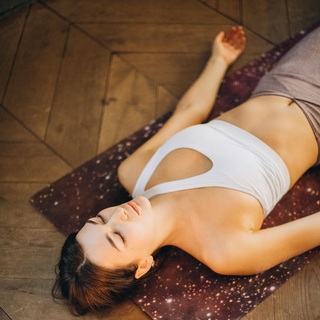
And we're preparing now to come into Shavasana,
Which is our final pose of rest.
So if there's any props or blankets,
Pillows,
Eye pillows that you want to gather for your Shavasana,
Please take that time now.
It's quite nice to pop the bolster or some cushions under your knee.
So you're laying flat on your mat,
Legs out in front,
Arms beside you.
Eyes gently closed.
Let's do a little bit of a scan through your body from head to toe,
Noticing.
.
.
If you're holding on to any residual tension and if you find that you are can you allow this tension to slowly dissolve.
Allow the weight of your body to melt down towards the earth.
Allow your breath to become soft and gentle and flowy.
This is your time now to rest,
To integrate.
After your practice.
So really allow yourself now to fall into a deep state of relaxation and healing.
Very,
Very softly and gently we're beginning to draw the awareness back.
If you would like to stay longer in your Shavasana,
Please take that time to do so now.
And if you're ready to come back very slowly,
Starting to deepen your breath a little bit here.
Breathing into the entire length of your body.
Wriggling out through fingers and toes.
Maybe stretching out through your arms and your legs.
Bending your knees,
We'll gently roll out to your right hand side and pause there for a moment.
Only when you feel ready,
Slowly roll up into your favourite seated position,
Keeping the eyes closed if you can.
Drawing your hands into Anjali Mudra,
Prayer position at the heart,
As you bow your head down in reverence for your heart.
As we close together,
We practice gratitude for the blessings in our life.
Wishing you a nourishing day.
Slow and tender winter season ahead.
Thank you for joining me for our practice together.
Namaste.