So what a blessing that we have,
You know,
Have some,
That the Buddha has passed down these teachings and also the practice.
I know for myself,
When I first started to meditate,
It was such,
In a way,
Quite a shock to see what my mind was doing,
To actually kind of turn back the attention back to this own mind and see like,
Oh my goodness,
You know,
Full of criticism and judgment and desire and confusion.
And then there would be these moments of where it would all just drop away,
Just for little glimpses in the meditation,
Where it would just drop away and there was just peace.
And this,
And that was for me,
Like,
It was like most delicious,
You know,
Like,
Oh,
This is,
This is possible.
We don't have to be tyrannized by our minds.
And so first of all,
I,
You know,
It was,
It was,
I was seeking that through meditation.
And then,
You know,
As we deepen the practice,
You realize like,
Well,
Meditation is part of it and how we're living is part of it and how we're,
How,
How I'm actually relating to the situations that arise and the people who I'm with and the,
The,
The environment I'm in,
You know,
It's how,
How I actually relate to that is a huge part of the path.
And the meditation is also a huge part.
The meditation is like a,
A deeply transformative part of the,
Of the path.
And then there's the sort of more of the nitty gritty of how we're living in the world.
And you know,
It can take some time to even,
Even see sometimes what our mind is doing,
Because we're in it,
You know,
We're in that,
We've done it for years.
It's what we grew up in and it's what we've been doing.
The tendencies and the habits of the mind can just be so normal to us that we don't even notice that we're operating from a place of criticism.
For example,
I know people who are more perfectionist oriented,
I'm not so much that way myself,
But those who have that perfectionist streak,
You know,
That it can be really inspiring and beautiful to see.
And then,
But there's an age,
You know,
Where it goes too far.
And then it's just this kind of relentless expectation for what is imperfect to become perfect.
So everything is perfectly imperfect.
It's all,
It's all flux,
It's all in a state of flux.
Things are changing all the time.
And you know,
Nothing,
That this idea of perfection is,
The way we think of perfection is not real.
This idea of things coming to a perfect,
You know,
The perfect relationship,
The perfect meditation,
The perfect life,
You know,
It's,
Perfection is being present with change.
It's knowing the constant changing nature of things.
That's perfection.
It's not in fixing something in a certain way.
So if you have that leaning of,
You know,
Wanting things to be a certain way and trying to keep them that way,
You might notice that in doing that,
Dukkha arises,
It gets,
It gets stressful because you can't sustain it.
It's not sustainable.
So we might enjoy a little moment of perfection here and there and things exactly the way we think they should be here and there,
And then it changes.
So the perfection is being okay with,
With that changing nature of things,
To be interested in it,
To be present with it and letting go.
So the critical mind,
What it wants to kind of get everything lined up and the way it should be and,
And life generally doesn't comply too well with that way of doing things.
Or you may be very in a,
Like a greed type,
I'm sort of a little bit more that way myself,
You know,
Always wanting something nice,
Something different,
Something new,
Something beautiful,
Something delightful,
Wanting everything to be,
Everyone to be friends and everything to be easy,
You know,
Let's make it nice.
And then for the greed type,
You know,
It's like,
It's an endless,
It's an endless search.
You're always wanting more.
It's never quite enough.
It's never long enough.
It's never good enough.
It's never,
Or it's,
Or it's good,
But you want another one or the next thing,
You know,
That's,
That's the,
The nature of greed,
Always looking for something else,
Something better,
Something more.
And so the,
The thought of freedom to bring to a greedy mind is thoughts of letting go.
Thoughts of renunciation is sometimes it's translated that way.
It sounds a little severe renunciation,
But thoughts of letting go.
You know,
When the mind is filled with wanting,
Just to bring in the thought,
What if I were to just let go,
What if I were to just let go of that wanting and be present and curious and interested in how things are right now,
Instead,
Turn towards things as they are instead of always wanting something more.
And if you are a greed type,
You might notice,
You know,
That even when you get what you want,
The greed sort of blurs the mind.
So you get what you want,
Then you're not quite there when it's happening,
Because you,
Because the mind is still in that mode of more and more and more.
So then,
And then it's,
Then it's over.
And then it's like,
Oh,
Hang on a minute.
I missed it.
You know,
It can be like that.
So getting to know,
Getting to know the mind,
Getting to know the nature of your mind and really well,
You know,
Not being embarrassed,
Not being embarrassed,
Like,
Oh,
I wish I shouldn't really be greedy because I'm a Buddhist,
You know,
Greed arises in the unenlightened mind.
Aversion arises in the unenlightened mind.
Confusion arises in the unenlightened mind.
That's how it is.
It's not personal,
Actually.
It's just those,
Those,
Those qualities,
Poisons,
Tendencies,
Whatever you want to call them,
They'll come in until we've freed the mind completely,
As Tisa is pointing to.
We can,
There is the possibility to free the mind,
But we have to understand the trap that we create for ourselves through habitual thinking,
Through particular ways of thinking that we've been conditioned in.
So some of the conditioning is what we came in with,
Our tendencies,
And some of it is the environment we've grown up in or that we're in now that shapes it.
So we have to kind of get to know,
Get to know our mind and not be afraid to see what we might not want to see.
So it's really important not to take it all too personally and not to be too upset about any of it,
You know,
It's like all kinds of stuff can go on in the mind.
And then we just need to know it and guide it in the right direction.
So if you agree type,
It's thoughts of letting go.
And if you're an ill will type,
Always seeing what's wrong and criticizing and judging,
Then the thought of freedom is thoughts of kindness,
Metta,
Thoughts of benevolence.
So that's like a softening and accepting kindness,
Befriending things as they are instead of always wanting them to be otherwise.
And you know,
Basically things are as they are,
Things are as they are,
And then we want it like this or we don't want it like that.
So we create complexity,
We make it more complicated than it needs to be.
Things are as they are.
And then we can,
What we do have agency over,
We can't make the world right.
We can't,
You know,
We can't even,
You know,
Change somebody we care about to be the way we think they should be,
Even if it's like trying to guide them in the right direction.
We can't always,
You know,
You can lay out the conditions for that to happen,
But you can't make it happen.
So you know,
We can't control the world to be the way we think it should be,
But we can guide and understand our own minds.
So you know,
Controlling the mind isn't the way either.
Sometimes we do need to sort of take the reins and pull it in a different direction if it's going off the rails,
If we're going off the rails,
But often it's just about listening and understanding.
We need to understand our mind more.
We need to understand where is this coming from?
What's underneath this wanting and not wanting?
And then there's confusion also,
Confusion,
You need to develop clarity.
The third thought,
Like unhelpful thought is the thoughts of harm,
Thoughts of wishing,
Thoughts of harmfulness,
Wishing harm on others.
And this can come about when,
You know,
When we're afraid or when we feel we really want to get our way and we're not getting our way.
Often fear is underneath thoughts of harm.
It can be fear.
It could also be a kind of greed.
It can also be like wanting to dominate,
Wanting to have control.
I think it's not so often a strong quality in the people who turn up with meditation teachings,
But it's definitely out there in the world,
The wish to dominate and control and have things one's own way.
And then when that isn't happening,
Then we want to crush,
Get rid of.
So just noticing,
Oh,
It can be that we have harmful thoughts towards ourselves.
You know,
We're not,
We haven't accepted ourselves as we are.
We don't,
There's not enough love there for this,
This imperfect being that we live with every day.
So getting to know,
You know,
If you have those thoughts,
Harmful thoughts,
Wishing harm on oneself or on others,
Really be aware that that's,
It's in itself is harmful.
It's going to harm you.
And if you're not careful,
It can harm others.
So you don't want to go that route.
That's the route to endless suffering.
So getting to know those thoughts,
If they arise in you and finding a way of restraining this,
A restraint.
So you're not going to do any harm and then transforming those thoughts,
Care,
You know,
Listening,
Understanding,
Expanding your view to accommodate a broader picture.
So we need to use our discernment to see what's actually going on here.
And then also to see,
Well,
How to,
How's the skillful response to this?
And you know,
I think the precepts are also very,
Very important.
The five precepts,
Very important support for the practice.
And they stop us from doing harm.
So that they're also very,
Very important.
You know,
They saw us from doing harm to ourselves through ourselves and others,
You know,
Lying and abstaining from lying,
Abstaining from killing,
Abstaining from sex with conduct,
Abstaining from stealing,
Abstaining from getting drunk,
Stoned,
You know,
Getting inebriated where we don't really know what we're doing.
So then we're taking care of this being.
And it can take a while,
You know,
Not everybody,
Maybe not everyone on the call is living by those yet.
It took me a while to align with them from my life before.
And it really is a supportive framework for the practice.
And it stops us from hurting ourselves and hurting others.
It's kind of a noble and uplifting practice to keep the precepts.
So yeah,
So there are many ways that we can use thought in a careless way.
And then from thought comes speech and action.
And then we start finding ourselves doing things and saying things that we regret.
And that as part of the training,
That's what happens.
First of all,
We want to get clear,
Like what do we want to do?
Do I want to cultivate the path?
Do I want to cultivate right thought?
Do I want to change the way that the habits of this being change the course,
The direction of this life to a more direction that leads to freedom?
And if the answer is yes,
Then,
You know,
Then we start training,
We start paying attention to the way that our thoughts are going.
And understanding,
So I noticed there are certain things that I'll fall into again and again.
And it might be that things are going well,
And everything's okay,
And then suddenly,
Boom,
Fall into this like a pit,
You know.
And I'll be in this pit,
And it's very,
Very believable.
It's like there'll be stories of,
You know.
I mean,
I get my stories of something along the lines,
It's a line,
You know,
It's something along the lines of,
The world would be a better place if you weren't in it.
So that's my little line,
That's my Mara that comes up.
The world would be a better place if you weren't in it.
And it's amazing how believable it can be when it comes up.
So as I say,
I want to laugh,
Because it's kind of like,
I know that that's complete rubbish.
But when it comes up,
It's like,
Oh,
That's true.
And then I can start to see all these,
Put together all these little stories that make that real.
Or even like,
Oh,
A look of a horror would be much better if I wasn't here,
I should just move on,
You know,
These little things.
And then they can be very believable for a little while,
Not for too long.
And then I start to reflect,
You know,
So they can be the stories if you just go with the old patterning.
It's very early patterning,
It's something that was conditioned,
And I know the story.
So it's kind of,
It's in the spotlight.
So it's like Mara is seen,
You could say,
I can see the conditioning.
But then there'll be,
You know,
When there isn't profitable awareness,
They'll be dropping into that.
And then the stories that support that,
That thought.
And then at some point,
There's like,
Hang on a minute,
Is this really true?
Is that real?
And then in investigating it,
It's like,
There's no substance to that,
It's not real.
And it might take a little while.
But one can pull apart those stories,
And you might have a line that is your line,
That,
You know,
Some people have,
That I'm not good enough.
Or a lot of people have actually,
And that might be for different reasons.
It might be like,
I'm not smart,
I'm not intelligent enough,
Or I'm not strong enough,
Or I'm,
You know,
Whatever it might be.
There's all sorts of things that we think that we put together that tell us that we're not enough.
But the thing is,
We're here like this.
We have manifested like this right now.
So what's,
How can we be,
How can it be wrong?
It is like this.
And this morning,
We were just reflecting on how this body and mind is part of nature.
And we take it very,
Very personally.
And this is one of the things that Buddha's pointing us to,
Like,
When we take this process of body-mind personally,
There is suffering.
Suffering arises.
Because it's not really personal.
It's a process that we have some agency over,
We can guide it.
But our body is doing its thing.
I can't tell it what to do.
It's doing its thing.
I can move it around a bit and do,
You know,
Feel it the right things and exercise and breathe good air and that kind of stuff.
But basically,
It's this incredible complex process of nature doing what it's doing.
And then the mind,
The mind also has,
The nature of the mind is to think and to get busy with thoughts.
That is the nature of the mind.
But what we can do is we can guide the thoughts in a direction that leads to freedom and away from more and more suffering.
And so it's said that when the Buddha was,
You know,
In those days leading up to his enlightenment,
He recognized that his thoughts would go into two directions.
So thoughts of desire,
Thoughts of ill will and thoughts of harm.
And then there are thoughts of letting go,
Thoughts of kindness and thoughts of care,
Compassion.
And that they would sort of go in this direction or that direction.
And then that one had a choice.
If there's a tension,
There's a choice in which way we let our thoughts go.
So I think it's often underestimated the power of thought,
How deeply that influences our life,
The way we let our thoughts take over and the way we get pushed around by our thoughts.
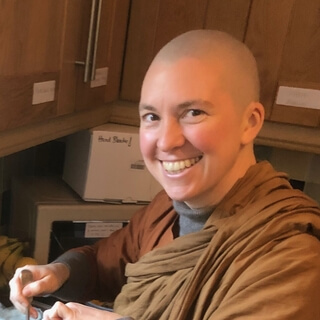
And I've noticed living as a nun,
I meet many people and many good people.
And when I say good people,
I don't mean like absolutely perfect,
You never do anything wrong.
In fact,
I don't think I've ever met anyone like that.
But good people,
People with goodness in their hearts.
And often those people are saying to me,
Oh,
You know,
I'm so bad because of this or I can't do because of that.
And often people fall into those places where things are not well.
You know,
There's some sense of not well in oneself.
And so we can do something about that,
Each of us.
We can't change another person's mind,
We can help guide people,
But we can change our own mind.
So whether it's greed and creating stories of more,
More,
More,
Or whether it's a strong idea of who and what we are,
Or whether it's,
Whether our thoughts are thoughts of criticism and putting down ourselves or others,
If once we know that we can,
We can change those thoughts,
We can do something about it.
And part of it is in daily life and part of it is in our meditation practice.
So in meditation,
We can develop the qualities of letting go,
We can develop the qualities of metta,
Beautiful quality,
We can develop the quality of compassion.
You know,
These are qualities we can develop not just in the thoughts,
But also in the heart and in the mind.
There's a mood,
There's an energy.
And even the best people,
The kindest people,
The most generous people I've known drop into those places.
So,
You know,
You have to take care.
I'm just going to read this beautiful poem,
It's Mitra.
This poem has been coming to me like a mantra,
Actually,
We've been having some retreat time here.
And I'd find this poem coming up like a mantra just going through my mind.
And it's Mitra,
Friend.
Full of trust you left home and soon learn to walk the path.
Making yourself a friend to everyone and making everyone a friend.
When the whole world is your friend,
Fear will find no place to call home.
And when you make the mind your friend,
You'll know what trust really means.
Listen,
I have followed this path of friendship to its end.
And I can say with absolute certainty,
It will lead you home.
So I love that,
I love the whole poem actually,
But I love that line.
When you make the mind your friend,
You'll know what trust really means.
So when I first read this poem,
I felt like,
Oh,
It's far from my life.
I didn't feel like my first leaving home,
As a teenager,
It wasn't full of trust.
And I didn't make the world my friend and everybody wasn't my friend.
I was kind of,
It wasn't like that.
And so I felt like,
Oh,
I can't really relate to that poem.
But then as time went by,
I started to reflect on it more.
It started to come to me actually,
Like a mantra.
And there was a second leaving home when I ordained.
And that really was full of trust,
Leaving home,
Going forth full of trust.
And it was making a friend to everyone and gradually making a friend to my own mind.
And when we make the mind our friend,
There's a place to rest.
Doesn't matter what's going on.
Doesn't matter what thoughts are arising,
Actually,
If we've really got to know our mind the way it is,
The tendencies it has.
And we've guided it as best we can in the right direction.
So there are some things that we can change.
There are some things that will change through cultivation.
And there are some things that may just keep popping up.
And that's what I've come to accept with this mind,
That there are some things that will just keep popping up.
Because the conditioning is so old and so part of this personality.
And think about the Buddha,
Who is that fully enlightened Buddha,
Which is so far from what any of us are.
We're just like little,
Just the very,
Very beginnings,
Learning that the Buddha,
Mara still came to the Buddha throughout his life and would try to whisper in his ear to pull him off track.
And the Buddha would still,
Even right before he died,
Would have to say,
I know you,
Mara.
So that's our work too.
We have to learn to say,
I know you,
Mara.
I know that thought that that's not me.
It's not mine.
It doesn't belong here.
It's not real.
And then if we can do that,
We can relax.
We can trust.
We can feel safe where we are.
And the safety isn't because we're living in a barricaded house where nothing can get in.
It's because we're occupying this space with clarity and awareness and kindness.
So when those unwelcome thoughts arise,
These intrusive thoughts arise,
We know them.
And even if they take over for a little while,
Sooner or later we recognize it and then we patiently,
Kindly escort them out and replace them with care,
With kindness,
With letting go.
So it's a practice.
And it's a beautiful practice.
And it's sometimes a little scary because we do have to meet the whole gamut that's in there.
And so developing this quality of awareness and developing a meditation practice,
And particularly developing awareness and kindness,
Metta,
Is very,
Very important.
And having that framework of support of the sila of ethics,
These are really,
Really important.
And they will support us.
And as metta says,
I have followed this path of friendship to its end.
So she's an awakened one.
And I can say with absolute certainty,
It will lead you home.
Home is that place of safety,
That place of rest,
Place of freedom.
So I just want to offer that today.