So,
Hi everybody,
It's really nice for you to join us in this virtual space.
For most people who've never meditated,
One of the myths that are going around about meditation is that the goal is to clear our minds completely.
And that's not the case.
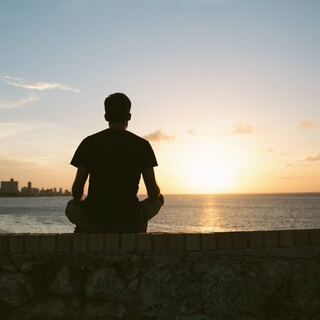
I think that one of the many metaphors that can help us access a better understanding of what meditation can do for us would be closer to using the analogy of the sea.
So you can imagine that the surface of the ocean is often moved with waves,
Even when the sea is quiet.
It could be a motor boat is going to suddenly just derail what looks like a mirror-like sea or a lake.
But the thing is,
Regardless of what happens at the surface,
Deep down,
There's great stillness.
And so in meditation,
We learn to watch or observe and become intimate,
Actually,
With what happens at the surface,
But without attachment to it,
And ideally letting it go.
And that helps bring a sense of calm and relaxation.
And so if you find yourself,
For example,
Yawning during our time together,
It's a good sign.
Although I'm hoping you're going to stay awake.
R But before we get started,
The one thing that you'll notice is that in mindfulness,
You could almost imagine this is like a workout.
So one part of you is going to want to try and relax,
Let your mind become more quiet.
And then you're going to become too relaxed,
Perhaps.
But sometimes we then suddenly relax too much,
And you may feel a bit sleepy or a bit dull.
And in that moment,
You want to try and bring a certain commitment,
Almost like a brightness and just say,
And recommit to being present and observing the experience of the present moment.
And I'm going to invite you guys to take a comfortable seat.
Before we get started,
Let's talk about posture for a second.
So we sit in meditation for two reasons.
We want to feel comfortable and energized,
Right?
The goal is to relax,
But not fall asleep.
When you look at how you're seated in this moment,
Make sure to arrange yourself on your seat so that you have this feeling of comfort.
You want to feel held.
You want to be able to have a tall spine.
And it is possible that throughout the course of the practice,
You may slump down a little bit and that's okay.
But we want to get started feeling awake.
Often people talk about a dignified posture.
So this is something that you can invite in this moment.
So I like to start all of my meditations with inviting you to take a few deep breaths in and out to sort of purge any stale energy and invite a freshness before we go and practice this inward exploration.
So I'm going to invite you to exhale all of your air and take a deep breath in through the nose and exhale through the mouth with a big sigh.
Breathing in through the nose,
Perhaps take a tiny bit more breath,
Sip another piece of air and release.
And another deep,
Deep breath in and let out a big sigh out.
So take a moment to settle where you are.
And before we start,
I'd like to invite you to make an intention for our practice together.
So it could be an intention of being absolutely present,
Fully awake,
Fully aware.
It could be an intention of kindness and non-judgment,
Not being hard on yourself if you find the process of mindfulness a difficult one.
Or it could be an intention of openness to whatever experience you are going to be having this evening.
And once you've inquired around this intention and settled on yours,
Perhaps you want to bring a hand at your heart to sort of seal it.
And I'm going to invite you to ask yourself,
How am I doing right now?
You can also ask your body,
How are you doing?
And it's with this sense of inner exploration and inquiry that we'll get started.
And I'd like to have us do a meditation where we are practicing an element of rest,
Finding some form of a home in our actual experience.
And so,
As you may know,
It's commonly done.
We choose an object of awareness and we rest our attention on it.
And then when our attention wanders off,
Which will always happen,
We see if we can let go and come back.
And we do so without bringing judgment or blame.
We just notice and let go of whatever our mind has moved on to,
Coming back to settling our attention on the object chosen.
And that home base this evening,
I will make the breath.
So making that central object,
The feeling,
The sensations of the breath.
So first get a sense of your breath right now.
Perhaps you want to first try to feel a sense of your breath coming in and out of your nostrils.
The actual sensations of the breath is always present for us.
It's available to you wherever you are,
Whether you're online somewhere or at home in your car.
And if for any reasons the breath doesn't feel like the right anchor for you this evening,
Because it feels a little bit difficult,
You can choose to rest your attention on something else.
You can also feel the sounds around you.
And sometimes it happens if we feel anxious,
Or perhaps when we have a cold,
Maybe more difficult to rest on the sensations of the breath.
And that's okay.
And so I'm going to guide you to explore your breath.
So feeling around the nose and the nostrils,
Perhaps noticing if the air is a little bit cooler when you breathe in and warmer as an exhale coming out of the nostrils.
And then you can also explore how the breath feels in and around your upper chest,
Around the lungs and the heart center.
And this is just a normal,
Natural breath.
You don't have to try and make it deeper,
Or you don't have to try and make it different in any way.
And perhaps explore how it feels around the abdomen,
Around the belly.
And I'm going to invite you to find and choose the spot where the breath is the clearest,
Or perhaps even the sweetest.
So find that place.
Keeping your attention there and just rest.
And you can imagine that your attention is like a flashlight.
And you're focusing your attention,
Your full,
Bright attention on whichever spot you've chosen as where you feel the breath the strongest.
And you may notice that as soon as you start putting your attention on your breath,
It starts becoming a little bit different when it's observed.
And that's okay,
But letting this moment be as natural a breathing process as you make it.
So just observing,
Feeling,
Sensing.
In mindfulness,
We like to bring a curious attention to exploring the feelings of our body or when we do mindfulness of feelings or feeling tones or the contents of the mind,
It's a similar outlook.
Maybe exploring what this next breath feels like,
Or even this next one.
And so without concern,
If your mind goes off somewhere,
Just notice and bring it right back to feeling your breath in that sweet spot,
That home base.
And if you notice that your mind is wandering and that it's difficult to relax and to concentrate,
That's completely okay.
Mindfulness is a process,
The process of noticing when we've gone away and recommitting.
And sometimes to ease the process,
You can also use a sort of a quiet mental note,
Like saying in,
Out,
Or arising and falling.
So with every breath in,
You go in,
Out,
And that helps support the awareness of the breath.
But if you choose to use that,
Make it very quiet,
Very,
Very quiet.
So your attention is really feeling the breath one breath at a time.
And if you find yourself perhaps mentally leaning forward to the next breath or the one after that,
Settle back.
Let the breath come to you.
As you'll notice,
You're breathing anyway.
All you need to do is feel it.
Let the breath come to you and feel it.
And if you find yourself getting a little bit tired,
Too relaxed,
Your mind becomes a little bit foggy,
Making that commitment and find clarity and recommit that attention that or perhaps reconnecting with the mantra in,
Out,
To pay attention to the full cycle of your breath.
And if something comes by in your mind that feels very strong and that you get lost in thought and perhaps wrapped up in a fantasy or you start falling asleep,
Don't worry about it.
Remember,
The most important moment in the whole process is the next moment after you've been gone,
After you've gone off somewhere.
You gently begin again,
Bringing your attention back to the feeling of the breath.
And so we let go and we begin again.
Doctors will wonder,
That is what they do.
But this evening,
You're practicing concentration.
You're becoming intimate with the sensations of the breath.
And as one of my teachers always says,
The breath is the language of the nervous system.
So getting to know your breath,
Being with it is getting to know yourself.
And so letting yourself really concentrate,
Recommit your attention.
There's nothing else to do,
Nothing else to figure out,
Just finding a quality of rest on the sensations of the breath as they are happening anyway.
Nothing to change,
Nothing to manufacture,
Modify.
But resting your mind on the feeling of the breath as your body is resting on your cushion,
On your seat.
As this meditation is coming to a close,
I am going to quote from the writer Simon Vail,
Who said,
Attention is the rarest and purest form of generosity.
And in this meditation,
You committed your whole attention on exploring and resting on the feelings of the breath.
So before you open your eyes,
Perhaps reconnect with the feeling or the intention that you had at the start of our practice together.
Check as well with your state.
How are you feeling right now?
Has anything shifted?
And I'm going to invite you to take a breath in and out to seal practice together.
So first breathing out your air and taking a deep breath in through the nose and a big sigh out.
Namaste.
Thank you.