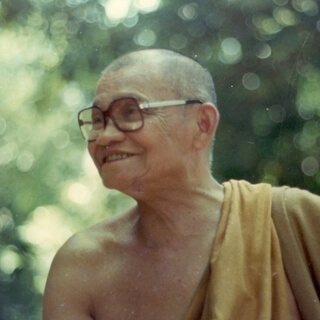
A Gift of Dharma A Dharma Talk by Venerable Ajahn Chah Translated by Teneser Abhiku A public talk given on October 10,
1977,
Addressed to the parents of a monk who had come from France to visit their son.
So now,
There's not been enough time,
Too little time.
You've been visiting for many days now,
And we haven't had the chance to talk,
To ask questions.
Because here,
At Wat Nong Ba Phong,
There've been many visitors,
Both day and night.
So we haven't had the opportunity to talk.
Thetanue's parents have come to visit from Paris for several days now,
Staying three nights at Wat Ba Phong and three nights at Wat Pa Nanachat.
And in two days,
You're going to leave.
So I'd like to take the opportunity to tell you how glad I am that you made the effort to come to Wat Nong Ba Phong,
And that you've had the chance to visit with your son,
The monk.
I'm glad for you,
But I don't have any gifts to give you.
There are already lots of material things and whatnot in Paris,
Lots of material things,
But there's not much Dharma to nourish people's hearts and bring them peace.
There's not much at all.
From what I observed when I was there,
All I could see were things to stir up the heart and give it trouble all the time.
From what I observed,
Paris seems to be very advanced in terms of all kinds of material things that are central objects—sights,
Sounds,
Smells,
Tastes,
Tactile sensations and ideas—that act as temptations for people who are unfamiliar with the Dharma,
Getting them all stirred up.
So now I'd like to give a gift of Dharma that you can put into practice in Paris after you leave Wat Nong Ba Phong and Wat Ba Nanachat.
The Dharma is a condition that can cut through and reduce the problems and difficulties in the human heart,
Reducing them,
Reducing them until they're gone.
This condition is called Dharma.
So you should train yourself in this Dharma in your daily life.
When any preoccupation strikes and disturbs the mind,
You can then solve the problem.
You can resolve it.
And that's because problems of this sort—everyone,
Whether here in Thailand,
Abroad,
Everywhere—if you don't know how to solve this problem,
It's normal that you suffer.
When this sort of problem arises,
The way to solve it is discernment—building discernment,
Training discernment,
Making discernment arise from within our heart.
As for the path of practice,
It's nothing far away.
It's right within you,
In your body and mind.
It's the same whether you're Thai or from abroad.
The body and mind are what stir up trouble.
But the body and mind can bring peace.
Actually,
The mind is already at normalcy.
It's like rainwater—water that's normally clear,
Pure,
And clean.
But if you put green or yellow dye into it,
It turns green or yellow.
It's the same with the mind.
If you meet up with a preoccupation you like,
The heart feels good and at ease.
If it meets up with a preoccupation you don't like,
It feels dis-ease.
It gets murky,
Like water that turns yellow when mixed with yellow dye,
Black when mixed with black dye,
Green when mixed with green dye.
It keeps changing its color.
But actually,
The water that's yellow or green,
Its normalcy is that it's clear and clean.
The normalcy of the mind is like rainwater.
It's a mind that's clear and clean.
It's a mind whose normalcy isn't stirred up and troubled.
The reason it's stirred up and troubled is because it takes after its preoccupations.
It falls for its preoccupations.
To put it so that you'll see this clearly,
Right now we're sitting in a forest that's quiet,
Like a leaf.
A leaf.
If there's no breeze blowing,
It's still,
Quiet.
If a breeze blows,
It flutters in line with the breeze.
The same with the mind.
If it makes contact with a preoccupation,
It flutters in line with the preoccupation.
The more it's ignorant of the Dharma,
The more you keep letting it run loose in line with its moods.
If the mood is happy,
You let it run loose.
If the mood is unhappy,
You let it run loose,
And it keeps getting stirred up to the point where people have nervous breakdowns because they don't know what's going on.
They let things run loose in line with their moods.
They don't know how to care for their minds.
When the mind has no one to care for it,
It's like a person with no parents to care for it.
A destitute person.
A destitute person has no refuge,
A person who lacks a refuge suffers.
The same with the mind.
If it lacks training in making its views right,
It's put to all sorts of difficulties.
So the practice of bringing the mind to peace is called,
In Buddhism,
Doing kamatana.
Kamatana.
Tana means foundation.
Karma is the work we have to do.
One part of this is the body,
One part is the mind.
That's all there is.
These two things.
The body is Rupa Dhamma,
A physical condition.
It has a shape you can see with your eyes.
The mind is Nama Dhamma,
A mental phenomenon that doesn't have a shape.
You can't see it with your eyes,
But it's there.
In ordinary language,
We call these things body and mind.
The body you can see with your physical eyes,
The mind you can see with your inner eye,
The eye of the mind.
They're just these two things,
But they're all stirred up.
So the practice of training the mind,
The gift that I'm giving you today,
Is simply doing this kamatana.
I'm giving it to you to train the mind.
Use this mind to contemplate this body.
Use this mind to contemplate this body.
What is the mind?
The mind isn't,
Is,
Anything.
But through our suppositions,
We say it's an awareness.
It's always aware of receiving preoccupations.
What's aware of receiving preoccupations we call mind.
Whatever is aware,
That's called the mind.
It's aware of preoccupations and moods,
Sometimes happy,
Sometimes painful,
Moods of gladness,
Moods of sadness.
Whatever takes on the burden of being aware of these things is called the mind.
The mind is right here,
Right now.
While I'm talking to you,
The mind is aware of what I'm saying.
When the sounds come into the ear,
The mind is aware of what I'm saying.
Whatever's there,
It's aware of it.
What's aware,
That's called the mind.
The mind has no body,
No shape.
It's simply what's aware and nothing else.
That's called the mind.
The mind,
If we teach it to have right views,
Won't have any problems.
It'll be at its ease.
The mind will be the mind.
The preoccupations will be preoccupations.
Preoccupations won't be the mind.
The mind won't be its preoccupations.
We contemplate the mind and its preoccupations so that we'll clearly see in our awareness that the mind receives and is aware of preoccupations that come passing in.
These two things meet and give rise to an awareness in the mind,
Good,
Bad,
Hot,
Cold,
All kinds of things.
If we don't have the discernment to straighten things out,
The problems that come about in this way will pull the mind into a turmoil.
To do kamatana is to give the mind a foundation.
The in and out breath is our foundation.
Take this,
The breath coming in,
The breath going out,
As the object of your meditation.
Familiarize yourself with it.
There are lots of other meditation objects,
But they can cause difficulties.
It's better to stay with the breath.
The breath has been the crown of all meditation objects from time immemorial.
You sit and meditate.
When you have the chance,
You sit and meditate.
Put your right hand on top of your left hand,
Your right leg on top of your left leg,
And sit up straight.
Think to yourself,
Right now I'm going to put aside all my burdens.
I won't concern myself with anything else.
Let it go.
Whatever responsibilities you have,
All your many responsibilities,
Let them go for the time being.
Teach your mind,
Right now I'm going to keep track of the breath.
I'll be alert to one thing only,
The breath.
Then breathe in,
Breathe out.
When you focus on the breath,
Don't make it long,
Don't make it short,
Don't make it light,
Don't make it heavy.
Let it be just right,
Just right.
Mindfulness is the ability to keep this in mind.
Alertness is the awareness that comes from the mind.
Let it know that the breath is going out.
Let it know that the breath is coming in,
At ease.
You don't have to think about this or that or anything at all.
Just be aware in the present that right now my only duty is to focus on the breath.
I don't have any duty to think about anything else.
Then focus just on the breath going out,
The breath coming in.
Focus your mindfulness to keep track of this.
Make your alertness be aware that right now you have a breath.
At first,
When the breath comes in,
The beginning of the breath is at the tip of the nose.
The middle of the breath is at the heart.
The end of the breath is at the navel.
When you breathe out,
The beginning of the breath is at the navel.
The middle of the breath is at the heart.
And the end of the breath is at the tip of the nose.
Feel it in this way.
The beginning of the breath,
One,
Nose,
Two,
Heart,
Three,
Navel.
And one,
Navel,
Two,
Heart,
Three,
Nose.
Focus on these three stages and let all your concerns fade away.
You don't have to think of anything else.
Focus on the breath.
Focus on in.
Always knowing the beginning of the breath,
The middle of the breath,
The end of the breath.
The beginning of the breath,
The middle of the breath,
The end of the breath.
Perhaps the mind may think of something.
It'll bring up the breath as its preoccupation.
It'll evaluate the breath,
Contemplate it,
Staying involved with its preoccupation,
Keeping this up continually.
Knowing the beginning of the breath,
Knowing the middle of the breath,
Knowing the end of the breath.
When you keep doing this,
Tenchitta muduta,
The heart will be malleable.
Kaya muduta,
The body will be malleable.
Its tightness and stiffness gradually disappears.
The body will become light.
The mind will gather together.
The breath will grow more gentle and refined.
Mindfulness and alertness will coalesce with the mind.
Keep doing this until the mind quiets down,
Grows still,
Becomes one.
One.
The mind rests with the breath.
It won't separate out anywhere else.
At ease.
No disturbance.
It knows the beginning of the breath,
The middle of the breath,
The end of the breath.
When you know this,
Stay focused on it at all times.
When the mind is quiet,
You can focus just on the end point and the beginning point of the breath.
You don't have to follow it down into the body.
In other words,
Stay just at the tip of the nose.
The breath goes out,
The breath comes in,
Goes out,
Comes in.
But you don't have to follow it down.
When you do this,
It's called making the mind comfortable,
At peace.
When the mind is at peace,
Let it stop and stay right there.
It stops and stays with one preoccupation.
The mind is one.
It stays with a single preoccupation.
The in and out breath at all times.
This is called making the mind quiet and making it give rise to discernment.
This is the beginning,
The foundation of doing kamatana.
Try to do this every day,
Every day,
Wherever you are.
At home,
In your car,
In your boat,
Sitting,
Lying down.
You have mindfulness and alertness and charge at all times.
This is called meditation,
Bhavana.
There are many types of meditation and they can be done in all four postures,
Not only while you're sitting.
You can do them while standing,
Sitting,
Walking,
Lying down.
All that's asked is that your mindfulness be always focused on knowing.
At this moment,
What are the characteristics of the mind?
What mood is it in?
Happy?
Pain?
Stirred up?
At peace?
Observe it in this way.
In other words,
Know what's right and wrong in your mind at all times.
This is called making the mind quiet.
When the mind is quiet,
Discernment will arise.
Dissermant will know.
Dissermant will see.
When the mind is quiet,
Use the quiet mind to contemplate.
Contemplate what?
It's kamatana,
Your body from the head down to the toes,
From the toes up to the head.
Use the quiet mind to keep contemplating back and forth.
Look at the hair of the head,
The hair of the body,
Nails,
Teeth,
And skin as your kamatana.
See that all bodies have earth,
Water,
Fire,
And wind.
These four groups are called kamatana.
They're called properties,
The earth property,
The water property,
The fire property,
The wind property.
When they come together,
We call them a human being,
A living being.
But the Buddha said to see them just as properties.
The parts of the body that are solid are earth,
The earth property.
The liquid parts that circulate in the body are called the water property.
The breath that flows up and down is called the wind property.
And the heat and warmth in the body is called the fire property.
A person,
When analyzed,
Has only these four things,
Earth,
Water,
Fire,
Wind.
There's no being,
No human being.
There's nothing.
No Thai,
No Westerner,
No Cambodian,
No Vietnamese,
No Lao.
No body.
There's just earth,
Water,
Fire,
And wind.
But we suppose these things into being a person,
A living being.
But actually,
You'll come to see that there's nothing at all to this earth,
Water,
Fire,
And wind that we call a human being.
They're composed of inconstancy,
Stress,
And not self.
They're not for sure.
They keep cycling around and changing.
They don't stay in place.
Even our body isn't for sure.
It keeps moving around,
Changing.
The hair of the head changes.
The hair of the body changes.
Skin changes.
Everything keeps changing.
Even the heart is the same way.
It's not ourself.
It's not us.
It's not him or her.
It can think all kinds of things.
Sometimes it can think of committing suicide.
Sometimes it can think pleasant thoughts.
Sometimes it can think painful thoughts.
All kinds of things.
It's not for sure.
If you don't have any discernment,
You believe it.
This one mind that can keep lying to you,
Sad,
Happy,
All mixed up together.
This is what we mean when we say that the mind isn't for sure.
The body isn't for sure.
In short,
They're both inconstant,
Both stressful,
Both not self.
The Buddha said that these things aren't a being,
Aren't a person,
Aren't ourself,
Aren't us or anyone else.
They're properties.
That's all.
Earth,
Water,
Fire and wind.
This is contemplation.
Use the mind to contemplate until it sees clearly all the way down.
When it sees clearly all the way down,
The clinging that teaches us that we're beautiful,
Good,
Bad,
Unhappy,
Right,
Whatever,
Gets uprooted,
Removed.
You see everything as one and the same thing.
Human beings,
Animals.
Westerners are one and the same with Thais.
Thais,
One and the same with Westerners.
Everything.
It's all properties.
Earth,
Water,
Fire,
Wind.
When the mind sees in this way,
It uproots every clinging out of itself.
When you contemplate and see inconstancy,
Stress and not self,
That there's no us,
No being,
You give rise to a sense of chastened dismay.
You uproot your clings,
Uproot your clings.
You don't have to cling to anything at all as you or yourself or anyone else.
When the mind sees in this way,
It gives rise to disenchantment,
Dispassion.
In other words,
When it sees everything as inconstant,
Stressful and not self,
It stops.
It becomes dharma.
Passion,
Aversion and delusion keep wasting away,
Wasting away until nothing is left but dharma,
This mind.
That's all there is.
This is what's meant by doing kamatana.
So I give this to you to take and contemplate.
Study it every day in your everyday life.
Even though you have received these teachings from Wat Nambapong or Wat Bhananachat,
They're an heirloom that's been passed down.
I advise you,
As do all the monks,
The Ajans and your son,
The monk,
To take this gift of dharma and contemplate it.
Your heart will be at ease.
It won't be troubled anymore.
It'll be at peace.
If the body is disturbed,
Don't worry about it.
Make sure the mind isn't disturbed.
If people in the world are disturbed,
We are not disturbed along with them.
Even though there may be a lot of disturbance in your foreign land,
You don't have to be disturbed,
Because your mind has seen.
It's dharma.
This is a good path,
A correct path.
So remember it and contemplate it.