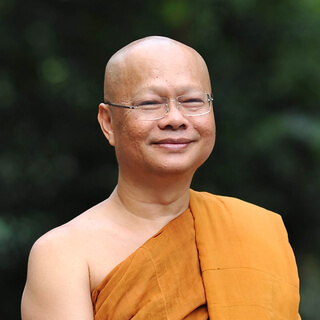
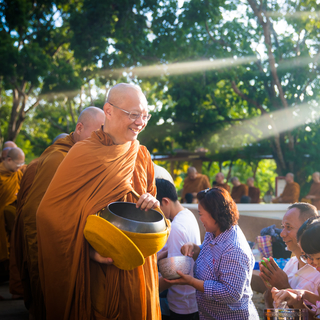
A group of American meditation teachers and practitioners once came to Wat Mabjan,
And one of them asked Ajahn Anand the following question.
She said,
What impresses me with the teachings of Ajahn Chah and his disciples is the emphasis on relinquishing,
On letting go and non-attachment.
I find this very helpful and work with it in my practice.
I also have many friends back in America who use the non-dual approach,
Where it's more a case of not picking things up in the first place,
Of not having anything to let go of.
They can speak disparagingly of my way of practice.
Even though I think there's some very important truth in their approach,
I've resisted it,
And I was wondering if Ajahn had any thoughts about these two approaches.
And Ajahn Anand responded by saying that,
For all practitioners,
The goal is gaining freedom from suffering.
And in order to reach this liberation,
We have to let go of absolutely everything.
Our minds must release their clinging to all physical and mental things.
Even this mind,
No matter how perfect and brimming with mindfulness and wisdom it may be,
This too we must put down.
We don't allow anything to become ours.
It's here that wisdom arises in its fullest,
And the heart becomes entirely free from suffering.
In some traditions,
Their teaching goes straight to this point.
They teach that letting go of everything is the quickest way,
The shortest and the best of all the paths.
But actually,
We have a similar teaching in our tradition.
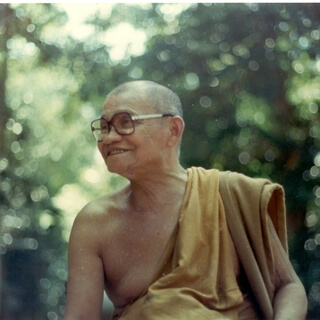
There was one time a university student approached Ajahn Chah and asked him,
If I want to get the quickest results from the practice,
What should I do?
And Ajahn Chah responded,
If you want the fastest way,
Don't do anything.
As I was listening,
I wondered,
How are you supposed to let go if you don't do anything?
That's impossible.
Because I couldn't do it myself.
I still had a whole load of problems that I was trying to work through and resolve.
But that's what he said.
If you want the quickest route,
Don't do anything.
And that was his final word on the matter.
It seemed like he was giving an offhanded,
Flippant answer because the question wasn't sincere.
But he also responded with truth.
Not doing anything means letting go.
And there's a question that naturally flows from this.
Are you able to do it?
Suppose someone were to come and instruct,
Don't cling to anything.
Just put everything down and you'll find freedom from suffering.
But what if our hearts can't do that?
And when we can't do it,
How should we proceed to get to the point where we can do it?
We need to start at the beginning.
If we're stingy and really attached to material things,
Then we learn to give and be generous first.
If our words and deeds aren't restrained or composed,
We take up the precepts first.
If we've never practiced meditation,
We don't know what it's like,
We come and sit in meditation.
We cultivate mindfulness and samadhi until they're full.
Then we contemplate in a manner that gives rise to wisdom.
And we'll be able to let things go,
A little bit at a time.
Whatever mental impressions come up,
Be they pleasant or painful,
We just carry on investigating them.
Time arises,
The mind gets more settled,
And we let go of more and more.
In the end,
We let go of everything.
But at the beginning,
We need to train first.
And we just carry on with this,
Bit by bit,
Step by step.
Both of these paths are correct.
They say to let go of everything,
And that's right.
But if we can't do it,
Then how do we proceed?
Does that make sense?
Then she said,
Thank you.
That was very helpful.
The path of relinquishment is such a practical approach,
But the other way seems like it's just theory.
It may be a very good theory,
But it's just thought.
And Ajahn responded,
Simply carry on letting go,
Bit by bit.
Whatever your friends say,
Don't argue with them.
Just take it as another opportunity to let go.
Where you live,
There's a lot of information,
Right?
We've got the Sri Lankan tradition,
And there are Tibetan monks.
Maybe you've been to Burma.
There are all these different paths of practice being taught.
When we hear about them,
It's possible that we become unsure of our way of practice.
But we must be careful here.
We contemplate,
And then we let go.
Really,
The whole lot is contained within this path of sila,
Morality,
Samadhi,
The collectiveness of mind,
And bhaññā,
Wisdom.
So just walk this way.
When wisdom arises,
There's letting go.
And it all becomes one thing at this point.
It all belongs to the Buddha,
So there's no need to go and separate it out.
It doesn't matter which tradition teaches what method,
They all fall within the same path.
But it's natural for us to be uncertain.
All of the ancient generations of practitioners had their doubts.
The generation of teachers that I went to study with had their doubts too.
But they were uncertain and still carried on with the practice all the same.
This is how they put an end to their doubts.
This is how we will be done with our doubts.
If I were to tell you,
Just stop doubting,
Get rid of all your uncertainty,
You'd probably just keep on doubting.
And that's okay.
Hold to this path that Ajahn Chah laid out,
And in no long time you'll find out for yourself.
You'll know for yourself.