Coming to your breath,
Just notice how your breath feels.
Taking a few.
Deep long breaths in through the nose.
And out the mouth,
Exhale,
Let it go.
Two more like that.
Deep inhale through the nose.
And exhale through the mouth,
Let it go.
Last one.
And exhale through the mouth Okay now continue breathing deeply.
And just allow the body to breathe naturally.
So if in and out of the nose.
Doesn't feel comfortable.
Breathe in through the nose and out the mouth.
Making sure you're Inhales are deep.
And exhales are long.
Now bring your awareness to your body.
Just noticing how your body feels today.
Scanning from the crown of your head all the way down to your toes.
Noticing if there's any part of your body that's maybe a little tight or sore.
That may need a little bit more love during the practice.
Just being mindful of that.
If something I say during practice doesn't feel right for you,
Please don't do it.
Come out of the pose.
And just take a resting posture that works for you.
And then join us when you're ready.
During yin,
We wanna make sure that we're not holding pain or discomfort.
At any point.
Maybe a dull aching feeling as we hold poses and that's okay.
But just listening to your body,
Making sure that.
.
.
It's never uncomfortable Take a deep breath in.
And a long breath out.
So our first pose that.
.
.
We're not going to hold for too long.
A toe stretch so as you sit in kneeling You're just going to.
.
.
Come up onto your knees and just tuck your toes under and you can use your hands.
To tuck all your toes and be your pinky as well.
Just sitting back.
So this is a big stretch on your toes,
The bottom of the feet.
And very uncomfortable for me.
So you can adjust your block if you need to and bring it to a higher height.
Or bring a pillow under between your thigh and your legs if that feels good.
So just taking a few moments to find this pose and feeling the stretch in your toes,
Back in the bottom of the feet.
Then just coming to a seat,
Bringing your hands somewhere on your legs.
Softening your shoulders down your back.
And then notice if you're starting to clench your jaw or frown a little bit because of how uncomfortable this feels and unnatural.
We don't usually sit like this.
And we don't feel the stretch in the bottom of the feet.
And if at any point this becomes too much,
You can come back to kneeling.
Coming to the tops of the feet.
I'm trying to hold this for about 30 more seconds if you can.
Softening your gaze,
Your jaw,
Your forehead,
Breathing deeply.
You're gonna take a deep breath in.
And a long breath out.
Good one more inhale And exhale slowly.
Start to come forward.
Bring your hands down.
And just bring gently the bottom of your feet down on the mat.
And maybe tap the tops of the feet to the mat.
Just letting that go.
All right.
Then come back to sitting in a kneeling position.
So just coming to sitting down with the tops of the feet down.
And just notice the release you feel in your feet.
This should feel really good after sitting like that for a minute or so.
Good.
Now from here,
We're going to move into an ankle stretch.
So sitting in the kneeling position,
You're just going to start to lean back.
Until you feel a stretch in your ankles.
So you may be able to go pretty far.
You may be able to start to lift your knees up.
And just stop where it feels enough.
So for me.
.
.
This feels.
.
.
Like my edge.
And I'm going to back out a little bit.
So when you find your edge,
Just back out a little bit so the pose feels comfortable and you can hold the pose for a few minutes.
So we're going to stay here for about a minute and a half.
When you find your edge Just come to stillness.
Just breathing.
Deeply And see if you can sand your breath.
To that area in your body where you feel the pose.
Notice if there's any part of your body that you're holding on to that you can soften and let go of.
Just a little bit.
Take a deep breath in.
And a long breath out.
Slowly start to come back.
Center coming to your seat and then it may feel good to come to tabletop.
Maybe tuck your toes under,
Maybe tap your feet.
Whatever feels good to kind of come to a release here.
And then coming to a seat after this one.
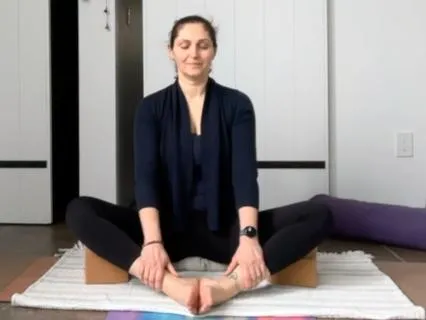
So we're going to come to a seated butterfly.
So you may want to grab pillow or cushion to sit on.
And you may want to grab your blocks if you have them or pillows to bring under.
Your knees.
So just bringing the soles of the feet together and you can walk your feet.
Further apart from you and when you find kind of where your seat is you can bring your blocks or your pillows under your thighs just so you don't have to hold your legs up just allowing that to release and we're just going to start to massage our feet so whatever that feels whatever feels good for you and just giving yourself a foot massage just rubbing maybe starting from the arches and bringing some pressure with your thumbs to the arches of the feet and maybe rubbing the ankles or the heels a little bit Just giving some love to your feet.
Um our feet hold us up and carry us throughout the day.
We don't really pay that much attention to them.
So just giving yourself a little foot rub.
So feeling the stretch in your inner thighs as you sit here.
And just notice if maybe you can start to open up your knees a little bit more.
So lowering your blocks a little bit.
And just pausing here to.
Rub your feet for a little bit longer if that feels good.
If this does not feel comfortable or soothing,
Just staying in stillness,
Holding your ankles or your feet.
I'm just pausing here.
We're not going to fold forward.
We're just feeling this stretch.
On the inside of your thighs.
And maybe rubbing the feet a little bit.
Good.
And then when you've had enough,
Just come to stillness,
Grabbing your ankles,
Sitting tall,
Soften your gaze or close your eyes.
Pausing here for a breath or two.
You Take a deep breath in.
Exhale all the air out.
Slowly start to bring your hands to the outside of the knees.
And just bringing your feet,
Walk your feet close to you.
Give yourself a nice little hug.
Maybe bringing your forehead to your knees.
Good.
And from here,
We're going to move into a tabletop position.
Just moving your props away,
Coming into a tabletop position.
Bringing your wrists under your shoulders,
Knees right underneath your hips.
And.
We're going to move through some cat-cows with our breath.
If you need to pad your knees here or keep your toes tucked,
If that feels better in your knees,
Do that.
Otherwise,
Spread your fingers wide.
You're looking straight down.
Pull your belly towards your spine.
And then moving slowly with our breath.
So inhale.
Drop your belly.
Open up your heart.
Look up.
Exhale to round your back,
Tuck your tail,
Look down.
Two more.
Inhale.
Drop your belly.
Open up your heart.
Exhale to round your back,
Tuck your tail,
Look down.
One more inhale,
Cow pose.
And exhale to cat.
Come back to table.
From here,
You're going to extend the right leg back,
Keeping the toes tucked on the mat.
Just rocking gently front and back.
Just feeling the stretch in your ankle,
In the back of your leg.
Your hamstring,
You may feel it in your wrists and shoulders.
Just making sure there's no pain or discomfort.
And then from here you're going to start to walk your right foot towards the left side.
So just walking your foot towards the left.
And you're going to look over your left shoulder towards your toes.
So feeling the stretch.
The outside of your right leg.
On.
Right sides of the body.
D button.
And a long breath out we're going to hold this for a few breaths slowly come back to center and then from here we're going to step the right foot forward so coming into dragon pose which is Kind of like lizards.
So you can keep your foot.
Just on the right side of the mat.
Or you can walk your foot forward a little bit if that feels good.
Just making sure that the back knee is comfortable.
So you can bring your hands to the inside.
Or you can keep them on either side of the front foot.
Whatever feels good in your body.
So you should be feeling this on the top of the left thigh.
So you can maybe tuck the back toes and walk them back a little bit.
Walk your knee back a little bit.
Front knee is right over your ankle so to start we're going to keep the right knee over your ankle And just pausing here so you can bring your hands.
To block on the inside or either side of the foot.
Or you can bring your hands to the top of the thigh.
So whatever feels comfortable,
Just find a pose that you can hold for.
A few minutes.
So we're going to be here for About 3 minutes.
So just make sure that you find a spot where you can feel this pose on top of The last thigh.
Maybe.
The right thigh and there's no pain so you can hold this pose and when you find it Just coming to stillness.
Soften your jaw,
Soften your forehead.
Soften your gaze or close your eyes if that feels good.
You can light your head.
Hang.
I'm just gently holding it up Breathing deeply.
Notice as you hold this pose for time if the sensations are starting to get stronger.
And.
.
.
See if you can.
.
.
Allow your mind to focus on your breath.
About a minute left.
Just breathing,
Breathing deeply.
Take a deep breath in.
Long breath out.
One more inhale.
And exhale.
Good.
Slowly stretch two.
Come back.
If your hands are on your thighs,
Bring them to either side of the front foot.
And from here,
We're going to move into splits.
So if splits are in your body and you can do the splits,
We're going to move there.
If,
Like me,
You're not able to do the splits,
We're just going to come to half splits.
And then just figure out where you can place a block or just hold up where you're feeling the stretch in the back of your right leg so your right hamstring and you can have a generous bend in the front knee.
Just allowing your hands to rest on either side of your leg.
And you can walk your foot forward a little bit.
Walk the back knee back a little bit.
As long as you're feeling this pose in the back of your leg.
And as long as it's not.
Sharp pain,
Pinching.
You're doing the pose.
And make sure if you can and if you have props available to use props.
Another way you can use a prop is if you have bolster you can bring a block down and bring a bolster on top of a block and just allow your leg to rest on the bolster and this may feel a little bit different a little bit better just a little bit more supportive And,
Um,
You can keep your front foot,
Your right foot flexed or you can just allow your foot to be soft.
You may notice that if you flex your foot it feels a little bit more supportive and comforting and that's because When you flex your foot you're using your muscles and in yin what we want to do is eventually stop using the muscles to hold us up.
Allow gravity to just pull our body down.
So this already feels like a lot for me.
We're not going to hold this for too long.
But just notice if.
.
.
Any thoughts or emotions or feelings start to come up.
Notice if this pose is starting to affect your breath.
If maybe you're starting to feel angry or upset.
And know that all of these feelings are completely normal.
And if you're in full splits and you're not.
Feeling anything,
That's completely okay as well.
That's just your body and everybody's different.
Taking a few more deep long breaths.
And continuing to bring the mind back to the breath.
Take a deep breath in.
And a long breath out.
Get slowly,
Really mindfully.
Start to walk your feet closer.
Start to remove the props move really slowly and gently so you don't pull anything or hurt anything come back to tabletop and you can pause here.
Or if it feels good,
You can tuck your toes and gently,
Slowly moving to downward dog.
This is a really good.
Counter pose and you can maybe bend one knee and then the other just allowing the effects of that pose to slowly disappear in your body.
Maybe rocking your hips from side to side.
Good.
You may notice that.
Your right leg feels a little bit longer and you can bring your heel down to the mat and on the other side you're not able to do that.
So we're going to move to the second side.
And get the same stretch on the second side.
Don't worry about it.
Come back to your knees if you're in down dog.
You can bring your knees as wide as the mat.
Big toes together and just move into child's pose for a few breaths.
So we're not going to hold this for too long.
We're just coming to child's pose allowing.
Your head to rest somewhere,
Either on the mat,
Maybe on a block or a pillow.
Allowing your arms to be soft.
And just resting.
And just notice what's coming up for you as you breathe here notice if Maybe you're starting to.
.
.
Look back at the poses we did and Judge yourself for your body.
Maybe you're starting to think about.
.
.
How we have to do all of that on the other side and you're anticipating.
The challenge.
When you notice any thoughts,
Feelings,
Emotions come up,
Just allow yourself to come back to your breath.
Take a deep breath in.
And a long breath out.
And slowly come to your hands and knees,
Coming to tabletop position,
Wrists under shoulders,
Knees right underneath your hips,
Moving through.
Three rounds of cat-cows again.
So inhale,
Drop your belly,
Open up your heart,
Look up.
Exhale to round your back tuck your tail look down Slowly inhale to cow pose.
And exhale to cat.
One last time,
Inhale.
And exhale Good.
Coming back to center,
Pausing at center in tabletop.
Pull your belly towards your spine and this time you're going to extend the left leg back.
Just keeping the toes tucked on the mat,
Just gonna rock back and forth a few times,
Just noticing how this feels in your left ankle.
In the back of your leg.
Maybe in your wrists,
Your shoulders.
Good.
And then from here,
Keeping the toes on the mat,
You're just going to slide your toes towards the right side.
So it's coming to this stretch on the left side of the body,
Left side of the leg.
And if it feels good in your neck,
You can look over your right shoulder,
Just looking at your left toes here.
Just breathing deeply.
Good.
Slowly come back to center.
We're just going to step the left foot forward coming into our lunge and moving into dragon pose.
So maybe tucking the right toes and walking your knee back.
Maybe grabbing any pops you need for this pose.
And making sure your front knee is over your ankle.
You can walk your foot towards the left side if that feels better or keep it in center.
The inside.
If it feels good to keep it at center,
You can bring your hands to either side of the front foot on blocks or on the mat.
So just walking your back knee back as much as it feels right.
And.
.
.
I'm just going to slide forward because I want my knee to be on the blanket,
Making sure to pad your knee.
If you need to And then just as long as you feel this pose on top of your right thigh,
And maybe.
.
.
Your left hip and the outer edge of the left thigh.
You're doing the pose.
So don't worry about what it looks like.
Don't worry how deep you can go.
Just notice where your edge is where you're feeling the pose.
And then come to stillness.
Making sure your shoulders,
Your neck,
Your head are comfortable.
Just notice if there's any part of your body that you're holding on to that you can soften and let go of just a little bit more.
Just breathing here.
Feeling the stretch.
In your thighs,
In your hips.
Holding this one for about three minutes.
I'm just finding stillness.
And coming to your breath.
You If your mind's starting to wander,
Just gently,
Kindly bring your awareness back to your breath.
Take a deep breath in.
And a long breath out.
One more inhale.
And exhale Now slowly start to bring your hips back We're going to get ready for our splits pose.
So again,
Just on this side,
Grabbing any props,
Anything you need,
And just really slowly and mindfully moving into the pose.
Taking your time.
And really feeling.
The pose on this side.
So this side.
Will most likely feel different than the first.
So just making sure that.
Wherever you go,
You're not feeling any pain or discomfort.
Maybe walking your back knee back a little bit,
Walking your left foot forward.
Just see if you can soften your foot a little bit letting go of the tension in the muscles.
And being really mindful of your hamstring,
Not pulling anything.
There should never be any sharp pain or discomfort.
And when you find your pose.
Just come to stillness.
Finding stillness.
Just breathing into the pose.
Not holding this for too long.
So just see if you can.
Keep your awareness on your breath.
Notice the voices in your head maybe coming up.
Maybe thoughts or feelings.
Notice if you're.
.
.
Bringing any tension to the muscles in your face or clenching your jaw.
See if you can allow yourself to soften and let go.
If at any point the pose becomes too much,
You can just come out of the pose.
We have about 30 seconds left.
Take a deep breath in.
And a long breath out.
One more inhale.
And exhale.
Okay,
Really slowly,
Gently.
Start to come out of the pose.
It doesn't have to look graceful.
Just make sure that you're moving mindfully and slowly.
And moving the props away,
You can.
Stay in tabletop or if it feels good,
You can touch your toes.
Push your hips up and back.
Downward facing dog.
It.
Bend one knee and then the other.
Just notice.
This release.
And it should feel really comfortable.
And feeling really good to let go.
Of that tension building up.
Now when you've had enough,
Just come down to your knees.
Bring your knees as wide as the mat.
Big toes together.
And then push your hips back towards your heels.
Coming to child's pose.
Good,
You can.
.
.
Keep your arms in front of you.
You can walk your hands back,
Maybe beside your legs.
Or between your legs just letting your shoulders Come down,
Allowing your forehead to rest.
Somewhere.
You may want to use a bolster and just come onto a bolster in child's pose.
Just pausing here for a few breaths.
Not holding this for too long.
Allowing the memory of the last few poses to Move away.
Letting that go And coming back to this moment right here,
Right now.
Slowly start to Come onto your hands and knees.
And swap your knees forward,
Cross your ankles and come to a seat with your legs extended forward.
So we're just going to come to.
.
.
A seated forward fold with the legs.
Extend it in front So.
.
.
First thing,
You can sit on top of a pillow or a cushion just to tilt your hips forward a little bit.
And then you may need a pillow or bolster,
Rolled up blanket.
To maybe bring under your knees.
As you fold forward.
So we don't want to keep the legs completely straight.
Again,
Keeping the legs straight means we're using the muscles.
So we don't want to do that in yin.
What we want to do is allow the muscles to relax so we can stretch the deeper tissues coming into our ligaments,
The fascia.
So find your kind of bent knees and if you don't have a bolster or any props,
That's completely okay.
You can just bend your knees.
Then when you're ready,
Start to round your back and just fold forward.
So don't worry about keeping the spine long.
You're just going to fold forward over your legs.
Allow your head to be heavy.
You may be able to bring your head to your legs.
Or maybe using props to allow your forehead to rest on something.
And again,
Taking a few moments to really.
.
.
Settle into this pose.
So don't worry about what it looks like.
You can be creative with your props.
Allow your hands to rest somewhere beside your legs.
Make sure you're not holding up your head,
Your neck,
Your shoulders.
Let go.
So notice where you're holding the pose.
Maybe you're flexing your feet.
Maybe you're clenching your jaw.
And then notice The sensations.
Behind your legs.
So just notice if you feel something there.
And as long as it's not pain or discomfort,
If you're feeling a dull,
Achy,
Gentle pulling of your hamstring That's exactly where you want to be.
And if you're more flexible.
You may not need the bolster.
You may be able to go lower.
Than I am.
Just listening to your own body.
So notice where your body feels comfortable.
And when you find that pose,
Just stay in stillness.
Pausing and allowing your mind to settle.
On your breath.
This is a 4th fold.
And four folds are usually a symbol of moving inward.
And reflection.
So you may notice that as we hold this.
We're going to hold this for about five minutes so it's a bit longer.
You may notice that thoughts emotions feelings start to come up for you If you don't,
That's completely okay.
And if you do,
That's completely normal.
Notice then.
Acknowledge them.
And see if you can set them aside for now and bring your awareness back to your breath.
You may notice that The sensations in your legs.
Maybe in your lower back.
They're becoming a little bit more intense Just making sure it's not painful.
Making sure it's still.
A feeling that you can hold.
You may notice that at this point in the posture,
You're able to maybe go a little bit deeper.
Maybe you can Adjust your props a little bit,
Maybe fold a little bit closer to your legs.
If you want to try it,
Do that now.
Make adjustments if you need.
And then come back to stillness.
And if you make adjustments and they don't feel good.
Thanks really kindly.
Without judgment,
Let's come back to where you were before.
Take a deep breath in.
Long breath out.
One more like that.
Deep inhale.
Full and complete exhale.
Slowly start to come out of the pole.
Yourself up.
Being really mindful.
Moving your props away.
And just gently maybe.
.
.
Hands behind you,
Tapping your knees,
Bending one knee and then the other.
And then bring your feet to the mat,
Bending your knees.
Bring your feet mat distance apart.
And just gently windshield wiper your knees from side to side.
Moving slowly.
And continuing to breathe deeply.
It.
Bring your feet close to you.
Hug your knees in.
Bring your forehead to your knees.
And just thank your body for.
.
.
Your practice for moving you in and out.
Of all of these different poses on and off the mat.
Slowly start to Come to your back.
So just moving slowly,
Come to your back.
You can hug your knees in.
Gently rocking from side to side.
Okay.
Making circles with your knees in one direction and then the other.
And we're going to get ready for our final posture,
Shavasana.
But if it feels good for you,
We can come to an easy inversion before we do that.
You can just extend your legs.
Towards the ceiling you can have your knees bent as much as you need if you have a block or pillow you may lift your hips up and just bring your block under your hips make sure it's not under your spine so you don't want to put pressure on your spine with the block then lift your legs up so just coming to an easy inversion if you want to bring legs up the wall you have a wall close by that you can bring your legs up the wall you can do that as well And just pausing here for a breath or two coming into an inversion.
Making sure there's no pain in your lower back.
And bending your knees as much as you need.
And then when you're ready,
When you've had enough.
You can start to get ready for Shavasana.
Um,
You can bring a bolster under your knees.
If that helps ground your lower back.
You can bring the bolster.
Under your calf so maybe bringing your ankles on the bolster this may feel good just to lift your legs up it may feel good in your hamstring Maybe bringing a pillow or a folded up blanket under your head.
Good.
Arms by your side.
Legs are wide apart.
Your feet are falling out towards the edges of your mat.
Arms by your side palms face up ground your shoulders Soften your toes and your fingers.
Soften your gaze or close your eyes.
And then scan your body from the crown of your head all the way down to your fingers and your toes.
Just notice if there's any part of your body that you're holding onto.
That you can soften and let go of just a little bit more.
Feel.
Just a little bit more comfortable.
Allow your body to breathe naturally and take in the effects of your practice.
Thank you.
Take a deep breath in.
And a long breath out.
One more,
Just like that.
Deep inhale.
Full and complete exhale,
Let it go.
Slowly start to bring some movement.
Back to your body.
Moving your fingers,
Your toes.
Your wrists,
Your ankles.
Maybe gently rocking your head from side to side.
When you're ready,
Bend one knee and then the other and roll on to your right side in the fetal position using your bottom arm as a pillow.
Fetal pose after corpse pose reminds us that after every ending,
There's a new beginning.
Slowly push yourself up to a comfortable seat,
Sitting with your spine tall.
Your neck straight,
Chin parallel to the mat.
Soften your gaze or close your eyes.
Bring your hands by your side.
Inhale.
Reach your arms all the way up.
Palms touch overhead.
Exhale,
Hands to your heart.
Bow your head to your hands.
And thank yourself for coming to your mat today,
For spending this time for yourself and for your practice.
Bring your thumbs to your third eye,
The space between your eyebrows.
May your thoughts be kind.
Thumbs to your lips.
May your words be caring.
Thumbs to your heart center.
May your heart be filled with love and gratitude.
Thank you for practicing with me today.
Namaste.