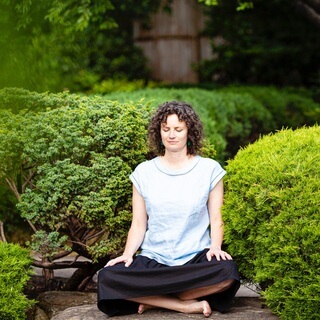
Take a moment just to settle into a comfortable position,
Allowing your back to be relatively straight yet relaxed,
Your hands resting on your lap or on the chair or wherever they're comfortable.
And if you'd like to close your eyes,
Feel free to do so or you might just lower your gaze and just beginning by really noticing how your body is sitting on the chair,
Noticing your posture and just taking a moment or two to see if you can invite in a little more comfort,
Maybe giving your neck a little stretch if it's stiff or your shoulders a roll,
Adjusting your clothing,
Just listening to your body and following what it needs and remembering that you're not trying to get anywhere with this meditation or with any meditation,
Not trying to achieve any special state.
It's not about doing it right or perfecting a technique.
So we can just let go of these usual habits of striving and achieving and pushing ourselves.
Instead the practice is about being curious,
Being open and giving ourself permission to explore our experience and to take some precious time to give your precious attention and energy to yourself.
This form of self-care can increase your self-awareness,
Leading to new insights and new ways of befriending yourself,
Honoring yourself and supporting yourself.
Just noticing again all those points of contact where your body rests on the surfaces below and being really curious to notice how that feels,
That pressure.
Pressure perhaps down the back of your body,
Your back and your backside,
Back of your legs.
Feeling this sense of gravity gently holding you here,
The surface below and the floor and the earth beneath holding you up.
And then just collecting your attention whenever you're ready and letting it gently rest right there at the tip of your nose.
Just beginning to very casually,
With a sense of curiosity,
Notice how it feels as you breathe air in and out of your nostrils.
You might notice that the in-breath is a little cooler than the out-breath as your body warms the air.
And maybe you might like to just silently repeat the mantra to yourself,
Breathing in,
Breathing out,
In,
Out,
Just to help you stay focused on that breath awareness.
And sooner or later you'll probably find that your mind will wander,
Wander away from your breath,
Get distracted by thoughts or memories or imaginations or sounds or sensations or feelings,
All sorts of distractions.
And so when that happens it's okay,
It's part of the meditation.
It doesn't mean you're failing and all there is to do is just whenever you realise that your mind has drifted away,
Just gently bring it back.
Come back to feeling again how the air flows through your nostrils as you breathe in and out.
Very gently escorting your mind back to your breath.
And now see if you can take in your whole breath as best you can,
As if you could follow the air as it flows all the way down and into your body,
Then turns around and flows all the way up and out of your body.
And if it helps,
You can just silently say breathing in,
Breathing out.
And then you might be curious just to notice what else you're aware of,
The sounds of your body sits on the chair and your feet rest on the floor.
Perhaps you can also notice the touch of your clothing against your skin,
Just notice how that feels,
The sound of the motor and the projector,
The sound of the guidance.
And then you might also notice thoughts and feelings,
They too can be witnessed,
Observed.
So let's now see if you can bring to mind a recent irritation,
A recent worry,
Perhaps nothing too intense right now,
Just something you can practice on,
Perhaps something that happened today that was mildly annoying or concerning or upsetting.
Perhaps you had to rush around,
Lots to do or some mild disappointment.
Or maybe you might like to choose a positive experience,
Something good that happened,
Some nice feedback or a nice experience.
So just bringing to mind a recent emotional experience and seeing if you can identify the dominant feeling,
Any subtle emotion involved.
And see if you can just give it a name,
Just mentally name it to tame it,
Whether that was a feeling of irritation or boredom or upset or happiness,
Satisfaction.
Give it a name,
Just mentally name it to tame it,
A feeling of anxiety or irritation,
Sadness,
Happiness,
Whatever it is.
And then ask yourself,
Where do I feel this feeling in my body?
And trust your instinct,
Trust your intuition,
And let your attention just drop down to wherever you feel this feeling in your body,
A feeling of anxiety or irritation,
Sadness,
Happiness,
Whatever it is.
Be curious.
Try not to let your mind think about this process.
And then see if you can relate to this feeling in your body by asking yourself if this feeling of anxiety,
Anger,
Satisfaction,
Whatever it is,
If it had a shape,
What shape would it be?
And again try not to think about these questions but just let your intuition guide you,
Just see what pops up.
If it had a colour,
What colour would this feeling be?
And if it had a texture,
What texture would it be?
And one technique that can be quite helpful if you're dealing with a strong emotion,
An intense emotion,
Is to imagine the opposite and bring that in to help soothe this feeling.
So if you're dealing with a feeling of anxiety or fear or irritation or anger,
Sadness,
See if you can ask yourself,
What would the opposite shape and colour and texture be?
And see if you can introduce that just to help soothe the feeling.
Or perhaps you might just notice the feeling in your body,
So again your mind might want to continue thinking about this situation,
The story that goes with it.
Once again see if you can name the dominant feeling tone,
The dominant emotion underlying the thinking.
Name it to tame it,
Remembering there's no right or wrong,
Just whatever your instinct has to say.
And then ask yourself,
Where do I feel this in my body?
Trying to trace this energy back down into your body,
To the emotional energy.
And perhaps instead of relating to it with a colour and shape,
Just see if you can gently breathe into and out of this feeling in your body.
A sensation in your body might be a tensing,
A bracing,
A contraction,
A feeling of heat rising,
All sorts of emotional feelings in the body.
See if you can just breathe with it and be really curious to observe the sensation,
The feeling.
Does it change over time as you give it your attention?
Can you give it space just to feel the feeling,
Breathe with it,
Observe it and allowing the the sting of the emotion to pass.
Being vigilant to notice when your mind wants to think again,
Try to catch the thinking and name it.
Ah,
Judgment,
Doubt,
Distraction,
Boredom.
Where do I feel that in my body?
And can I just give it space just to feel the feeling,
Breathe with it,
Observe it.
Allowing the sting of the emotion to pass.
So just perhaps taking a few full breaths and just noticing how you are feeling now.
Physically,
Mentally,
Emotionally.
And if you found this practice challenging,
Difficult to understand or get into,
That's so normal.
It's perhaps the first time you've tried this.
But it can be something that with practice can become a new way of managing difficult emotional experiences or overthinking.
So just once again feeling how your body is resting on the chair.
Noticing the different sounds that you can hear.
And just very gradually beginning to reawaken and taking your time to gradually return whenever you're ready.