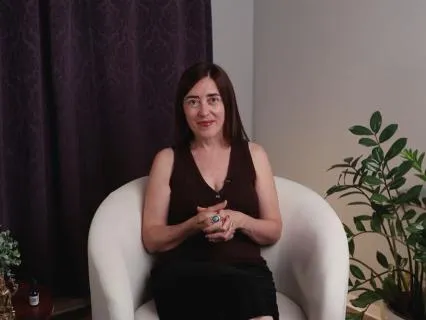
Hi,
I'm Diana Pereira,
Feldenkrais Practitioner,
Somatic Teacher.
Welcome.
Let's begin.
If you've ever had tight shoulders that don't release no matter how much you stretch,
A knot between your shoulder blades that is so wound up that comes back right after a massage or any kind of body work,
Or a body that feels tight all over,
This session is for you.
Because I want to tell you something that surprises people the first time they hear it.
And it's that the tension that you've been holding is probably not a muscle problem at all.
And once you understand what it actually is,
The way you've been trying to fix it starts to make a lot more sense.
Including why it hasn't been working.
Here's the story most of us are told.
A tight muscle is like a rope pulled too taut or a knot that needs to be physically worked out.
And so we stretch it,
We dig into it,
We get it massaged,
We foam roll it.
And sometimes that brings relief for a few hours,
Maybe a day.
And then it comes back.
The same knot,
The same tightness,
In exactly the same place.
It's really frustrating.
If that's been your experience,
I want you to hear this clearly.
It's not because you're doing it wrong or because your body is broken.
It's because the source of the tension is not where you've been looking.
A chronically tight muscle is not for the most part a mechanical problem in the muscle itself.
It's a signal being sent continuously from the nervous system telling that muscle to stay contracted.
The muscle isn't stuck,
It's being held.
And it's being held by the brain.
This is why those knots so often don't show up on scans or MRIs.
When you go to the doctor,
Nothing's wrong.
There's no structural damage to find.
What is happening is neurological.
Pattern running in the nervous system keeping the muscle on even when you're resting,
When you're asleep,
When you're trying to relax.
Let me give you the actual mechanism because understanding it changes everything.
Your muscles are controlled by your nervous system through a kind of feedback loop or feedback circuit.
There is a part of the circuit involving what is called the gamma motor neurons working in a loop with the larger alpha motor neurons that essentially sets the resting tension level of a muscle.
Think of it like a thermostat for muscular tone.
It decides how contracted a muscle should be even at rest.
Here's the key.
The thermostat can get set to high and then stay there.
When we are under chronic stress,
Or we hold a posture over and over,
Or we brace against pain or difficulty for long enough,
The nervous system quietly raises the resting tension of certain muscles and then forgets to lower it again.
Somatic teacher Thomas Hanna had a beautiful name for this.
He called it sensory motor amnesia.
It's a state where we've held a muscle contracted for so long that we literally lost the ability to feel it and consciously release it.
The muscle is working hard,
All the time,
And we can't even sense that it's happening,
Let alone tell it to stop.
This is why telling a chronically tight muscle to just relax doesn't work.
You can't consciously release something you've lost the ability to sense.
The pathway back isn't forced.
Is awareness.
Slowly,
Patiently,
Rebuilding the brain's ability to feel and then to release what it's been unconsciously holding.
There's one more piece worth understanding and it's a fascinating one,
Though I'll be honest with you that the science here is still actively being explored.
Your muscles don't sit in your body like dry components in a machine.
They are wrapped and connected by something called fascia,
A conscious web of connective tissue that runs through your entire body,
Linking everything to everything else.
And woven through that fascia is something researchers have been paying fresh attention recently.
The interstitium.
Vasa is the connective tissue itself,
It's the webbing.
The interstitium refers to the fluid field spaces within and around the tissue.
The moving water and the tiny channels it flows through.
One is the structure,
The other is the fluid filled space running through it.
Here's what's relevant for us.
And that's well supported by the science.
This tissue is alive and it depends on movement.
The body's own motion,
The flexing of muscles,
The rhythm of breath,
Is part of what keeps fluid moving through it and keeps it supple.
When we stop moving or when we hold the same braced patterns for years,
The tissue tends to stiffen and lose some of that glide.
Which points to something important.
It's not stretching harder what gives the living tissue healthy.
It's movement.
Varied,
Gentle,
Regular movement.
The kind of movement we are about to do.
So now we can put it all together.
Chronic tension is mostly the nervous system holding a muscle contracted below the level of your awareness.
And the tissue surrounding that muscle is healthiest,
Not through force,
But through movement.
This is exactly why stretching and digging so often fail.
They treat the muscle like a mechanical object when the real conversation needs to happen with the nervous system.
And that is why this slow,
Curious,
Attention-rich movement of somatic work is so successful.
When you move slowly enough to actually feel what a muscle is doing,
When you bring awareness back to a place that had gone quiet,
You begin to reverse that sensory motor amnesia.
You restore the brain's ability to sense the muscle.
And with it,
The ability to release it.
Not by forcing.
By feeling.
That is what today's practice offers.
Not a stretch,
A conversation.
Between your attention and your nervous system.
This invites your muscles to finally sit down what they've been holding.
Let's practice.
We're going to begin by lying down on the floor.
If you can,
Lengthen your legs.
If it's too hard for you to do this,
Put something under your knees so you can make them long.
Release your arms to the sides of your body.
And begin by taking a moment to observe as you lie down.
Any area that feels habitually tight.
For you,
Maybe your legs or your abdomen.
The lower back,
The shoulders.
Whatever you notice,
Allow it.
To be part of what you witness right now,
Without changing it,
Without judging it,
Without making a story around why this is or for how long.
Simply notice it.
And then observe the movement of your breath.
See where the breath moves.
How big is it?
Does it feel good to breathe?
Is it challenging?
Do you even notice it?
Now begin to explore.
The gentle contraction of the area that feels habitually tight.
Let's say,
Your feet.
Contrast the toes a little more,
Flex your ankles or if it's your shoulders,
Raise the shoulders slightly,
Contract the muscle around the shoulder blades.
Bring a little more tension,
Not a lot.
Just increase the tension that you sense.
Tiny bit.
Hold it there.
And then slowly begin to release it.
Gently.
Without force.
Release it until you can't release it any longer,
Even if it's an inch or half.
Then gently contract it again,
Bringing in maybe a visual,
Something that you can imagine.
Contracting and tightening.
Winding up,
You're supporting the contraction that is there And then gently,
Slowly.
Allowing an image of release.
Expansion,
Perhaps melting.
See if you can use your breath for this.
Perhaps you want to contract whatever area you're noticing tension in and hold your breath a little bit.
Couple seconds.
And then gently release.
If you can use your hands,
For example,
To hold the area.
Let's say upper back,
The area of the shoulders.
Trapezius.
You can use your hand to hold that area that typically holds tension by itself.
Or if you have tension on your legs and you can squeeze with your legs the area where you hold the most tension,
Your abdomen.
Using your hands to support to pick up the slack.
As we think of it sometimes.
And then as you're holding.
Beginning to introduce tiny movements,
Maybe moving the shoulder a little forward and back or a little up and down.
Moving your leg a little sideways.
You're holding on to the muscular tension with your hands.
In this case,
If you can.
Maybe looking for the tiniest little circle that you can make in that area.
Doesn't have to be for too long.
Maybe you want to reverse the direction of that circle.
And as you move in a gentle way,
Your breath is free all the time.
This is different than holding and releasing.
Here we are holding and while we hold we are introducing a small gentle movement.
With the free breath.
And then let go completely,
Put your hands down.
Lengthen your legs and arms make that area long again whatever you're holding is now long and pray to rest on the floor.
Doing movements,
You're resting,
You're letting your nervous system observe the differences,
Integrate what is happening.
Not in a rush.
You can close your eyes,
Look for sensations that are interesting to you or new.
Anywhere that feels good in your body.
And then one more time,
Observe the area of your body where you feel tension.
Hold it.
A little bit,
Contract it even more.
And then very slowly begin to release it.
A lot slower,
Thinking now of the connective tissue.
The structure of the fascia.
Interwoven through your whole body.
And the interstitium,
The watery element,
The fluid moving through the fascia.
Like mycelium.
The webbing.
That we know exist.
In nature,
Under trees,
Mushrooms.
Of feeling now into those spaces as you release.
Allowing your mind to support more and more expansion.
Interconnection.
Now rest again,
Spread your legs and arms,
Observe.
Noticing in his shift Any differences?
And giving yourself this idea that next time you are going to reach for something,
Grab something perhaps make an effort with your arms,
With your legs,
You're going to pay attention to how much you're tensing up to begin with.
How much is actually needed.
Can you live somewhere in between?
The actual high tone of your musculature that might be habitual.
Might have become automatic in this new chosen state where you can expand,
Relax,
Releasing some of that tension.
And feeling more of that glide,
That space,
That fluid quality that can live also inside your tissue.
Notice now the area that you started with.
And see if there's a little more space there.
A little more sensation.
If a place were from numb or vague to something that you can feel.
Notice that that shift,
However small,
It's not because you forced anything or you stretched anything or you pushed anything.
It came because you taught it to remember,
You allowed it to remember.
That it had forgotten that it was holding.
And once muscle and brain begin to work together.
And a muscle the brain can finally feel is a muscle that the brain can finally release.
This is why this approach lasts in a way that stretching and digging don't.
You are not chasing the symptom.
You are changing the signal.
Thank you for being here with me today.
Take a moment before you move on to the next thing and let what just happened settle.
I am so grateful to practice with you and I look forward to seeing you in the next video.
In the meantime,
So much love.