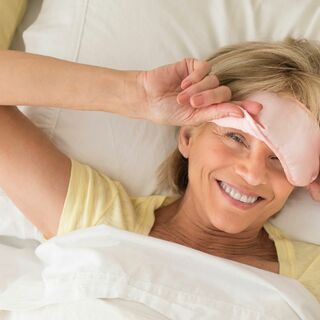
So please take a moment to lie on your back and make yourself comfortable.
Spread your arms along the sides of your body,
Make your legs long.
If you have any jewelry on your wrists or fingers please remove bracelets or rings,
Watches,
Also belts or glasses.
Just be as comfortable as you can without any distraction.
Please take a breath,
Observe the movement of the air inside your lungs and your organs,
Your belly.
How much can you detect of the movement of the breath?
Observe the position that you've chosen to place your arms and now bring your palms in the direction of the ceiling so your arms are long and your hands are as if you were about to receive something.
And see that even though you are resting your fingers are curled a little bit,
They are a little bit folded or bent.
Your hand in resting position is not completely flat.
So now make your hand completely flat as if you're lengthening your fingers and having the back of your palm have more contact and observe the difference in tension,
The difference in muscular effort to keep your hand in this way and then let it rest again.
So remove the contact of your fingers,
The back of the hand and just let the hand rest softly.
And now make the distance between your fingertips a little smaller so instead of going away from each other stretching and reaching out for the floor they come a little closer together.
So your palms are up towards the ceiling and you're bringing the fingertips in the direction of one another as if your palm was closing a little bit or folding.
You're thinking of bringing the finger pads together but you don't really have to touch the fingers but you're just bringing them closer together.
You can imagine you have a little marble in the palm of your hand and you want to cup it.
You want to close the space inside your hand bringing your fingertips together and then spread them out again and let the fingers return to their natural resting state.
If it's more comfortable for you,
You can keep your knees bent for the length of the movements and then when you rest you can lengthen the legs again.
Now return to this idea of the movement of the hands closing,
Bringing the fingertips together and then extending again separating the space between the fingers.
And imagine that the hand is taking the shape of a flower bell or round shape of a bell or bell flower.
See if this is a useful image for you.
The fingers coming together,
Coming away.
Now the next time that you do this just bring the index finger and the thumb together and then separate them.
And then the second finger and the thumb in a way and then the ring finger and the thumb and then the pinky finger.
And then back to the ring finger and the middle finger and the index.
And just see if it's easier to do this on one hand than it is on the other.
What are you paying more attention to the point of contact between each finger or the middle of the hand,
The part that is folding?
Please rest for a moment.
Next time you decide to continue moving bring the index and the thumbs together in both hands and allow the thumb to draw a little circle around the pad of the index,
The first pad of the index finger where your nail is.
So the thumb is drawing a little circle around the shape of the finger pad.
And see which direction are you going with.
See if both hands are going in the same direction say clockwise or they're going in opposite directions.
And please breathe as you do this keeping yourself soft everywhere.
You can bend your knees or keep the legs long but continue breathing.
Don't hold your breath because you're doing these tiny movements with your hands.
And now reverse the relationship.
So instead of being the thumb is the index that is drawing circles around the thumb print.
Make sure your teeth are soft and not clenched so there's a little space between your jaws.
And see again what is easier if to make the circles with the thumbs on the index or to make the circles with the index on the thumbs.
And go as slowly as you can to begin with.
And now leave this and take a little rest.
Follow the contact of your body along the floor and the sense of your musculature in your face,
Your ribs,
The musculature around your ribs and your sternum,
Your shoulder blades,
The lower back.
And when you return to the movement move down now to the middle finger and do the same thing.
Initially draw circles with your thumbs around the pad of the finger.
Maybe explore the different sensations that you can detect when you go in the same direction with both thumbs.
Say both of them making circles to the right.
Or when you go in opposite directions.
And become interested in the movement throughout your arm.
In other words see if by moving your fingers in this gentle,
Slow,
Circular way you can sense any movement on your arm,
The forearm,
The upper arm,
Your collarbones.
Please make your breathing free and uninterrupted.
Now reverse the relationship so is the middle finger drawing circles around the thumb pads.
And again explore the difference between going in the same direction or going in opposite directions.
Make this exploration fun for you.
Take it as a little game or discovery of your coordination.
And if at some point it becomes frustrating or too challenging you can always take a rest and sense and feel the state of your musculature and thinking and feeling throughout yourself.
When you're ready you can move on to the next finger,
The ring finger.
Doing the same thing and observing if you can reduce the effort.
So when your thumb is doing circles around the pad of the ring finger you can do it in a very gentle,
Smooth way.
So you're looking for the quality more than how many circles or how fast.
Almost as if the thumb was moving by itself.
Gentle,
Sensing the movement through the hand,
The wrist,
The forearm.
And observing which is the best place where you want to leave your hand on the floor so this is easier.
So if you have the hands on the edge of the pinky or the back of the hand with the palm up may make a difference on your sensation.
So you're always looking to reduce the effort.
Looking for maximum efficiency with the least amount of work.
Now reverse the relationship.
Make the circles on your thumbs with the ring finger and observe how different it is for your ring finger to make circles compared to say the index finger.
Which of your fingers seems more knowledgeable or skilled at making circles around the thumb.
And make sure to cover the whole surface of the thumb pad so the circle is not tiny tiny but it's a little bit larger.
Leave it,
Take a little rest,
Sense the softness of your palms.
Maybe turn them down towards the floor and up again and see if there's something about this movement of rotation that feels good and soothing.
So you're taking the palms down towards the floor and then up towards the ceiling again.
Just a couple times to rest the hands.
Softening them.
And when you're ready you can go about the pinky and make circles on the pad of the pinky finger with the thumbs.
Again in the same direction or in opposite direction and see if you're more skilled with one hand than you are with the other at working the circles around the pinky pads.
And if the other fingers are moving though you're not intending to moving them.
Then take all of this information as just observations that you can make about your habits,
The level of effort or habitual contraction that you carry.
Not to be judgmental or to try to change anything but just to observe.
Keep your breathing free,
Your teeth soft and spaced between them so the upper jaw and the lower jaw aren't tight.
And now explore for a moment making circles with your pinkies on the surface of the thumb pad and see if this is easy for you to do or if it's extremely challenging on one hand.
And if it becomes difficult,
Slow it down a bit more and breathe more into it.
And rest as much as you want.
Now leave your hands quiet for a moment.
Spread the palm so all the fingers are open,
Resting.
None of them are touching.
And imagine that you're bringing these fingers together again like you did before as if they were the petals of a flower closing and then opening.
See it in your mind.
Imagine with your mind's eye the shape of this flower,
The color.
As if you could see in a video the fast opening and closing of a flower,
Some process that would take hours.
You would see it on a time lapse video.
Not necessarily fast but as it would unfold instead of sitting and watching this flower for hours.
So now imagine this on your hands and then begin to move in that way slowly as if your fingers coming together were the closing petals of this flower.
And then open again to the sun.
And do it a few times.
And shift your attention from the fingers coming together and coming apart to the space in between inside the palm that is folding and closing and then opening and widening.
And then you can do it with less and less effort and see if you can become really soft.
If you can let the hands open and close gently instead of forcefully.
And then one more time just touch one finger with the thumb at a time,
The index and then the middle finger and then the ring finger and see if something about this movement now it's easier or smoother compared with the first time you did it.
Please leave it,
Rest.
You can rest on your side,
You can rest on your back.
Just take a break.
Now for this next movement you're going to need space along the sides of your body so you can lift your arms and keeping them on the ground place them so they are a continuation of your shoulder.
So they're not in a diagonal but they're more or less on a perpendicular line to your spine.
Spread out in this way and sense the contact of your shoulder blades.
And bend your knees and keep your feet on the ground.
Now with your palms up make a note of the line of your arms from the shoulder blades all the way to the fingers.
And let the hand curl a little bit,
Not completely as you were doing a moment ago but just so the fingers are soft and they're not tense and long but just a little bit curled.
And now begin to take the right palm down towards the floor and then turn it up again.
As if you were dropping something onto the ground and then lifting the hand again.
And do it so it's long and in contact as much as possible.
You don't have to lift the arm or create any sort of effort.
It's more about you can imagine the fingernails trying to get closer to the floor and then lifting away again.
So it's a rotation of the whole arm that starts from the hand.
And when the hand is down you can sense the change in your forearm bones.
Turning and maybe the upper arm,
The shoulder blade.
And when the hand is up there's a different alignment of this bone structure.
Now do the same with the left hand.
Keep the right arm quiet for a moment and explore this movement on the left side.
Just take the palm from being up and oriented to the ceiling to being down and closer to the floor.
And as much as you can leave the arm resting.
So it's not lifted or tense.
It's just a passive arm movement that is created by your intention of bringing your fingernails closer to the floor and away from the floor.
And begin to now alternate so when your one palm is up the other one is down.
So they are both arms are moving in opposite directions.
You're turning one palm towards the floor and the other one stays to the ceiling and then the opposite palm goes to the floor.
That's right.
See if this is challenging to do or easy to do.
So let's make this a little easier.
Bring both arms down towards the floor.
So both palms return down to the floor and then open to the ceiling together.
And see that you're breathing and your jaw remains unlocked and see what are you doing with your eyes?
Can you let the eyes follow the movement of the hands?
And rest for a moment.
You can rest with your arms long or bring them down to the sides of your body again.
You can cross them over your chest or put them on your belly.
But no matter what you do with your arms just let them follow the movement of the hands.
But no matter what you do with your arms just sense the quality of your palms and the sensation in your wrists.
If there's any change in the tone of your musculature.
When you return to the movement do again the opposite movement of the palms.
So as one palm rolls down in the direction of the floor getting flatter.
The other one is up and then the opposite.
You can imagine some sort of a ringing movement of a wet rag or towel.
See if you're squeezing water out of a towel.
And just see if you were to look at one of these hands.
Which direction would you look at?
Would you be more interested in looking at the palm that is going up or the palm that is going down?
And maybe explore both possibilities.
Do the movement continuously uninterrupted.
You can bend your knees if you want to.
If it's easier for your lower back.
Also explore the opposite movement where your head is turning the direction of the other palm.
So if you were looking at the palm that comes up away from the floor.
Also try the other variation or possibility.
Feel how your fingers get longer when the palm is down and they curl again coming closer to one another when the palm is up.
Now allow your head to turn to the hand that is palm up.
So you're looking at the hand as it opens and you are looking at the hand as it opens and away from the hand that is palm down with the fingers long.
And as you're looking at this hand that is palm up,
Allow the fingers to come together again.
One at a time first and then all together.
And just looking at your own hand see if it's easier for you to do a little less and be active in the least amount of efforts that you can.
So it's almost as if you were looking at somebody else's hand moving.
So you do less and less and let the hand fold in the middle and maybe making this fold,
This coming together of the inner side of the palm,
The initiation.
So not about touching the fingers but about folding the inner side of the palm and opening the palm.
And opening it again.
Now stop that and keep the hand turned to the palm that is up looking at it but flip the other palm up so both of your arms have palms up and do the movement with the other hand,
The one you're not looking at.
Touching each finger first with the thumb and then bringing all fingers together.
And just see when is it easier for you to do what you want to do,
To reduce the effort,
To move this hand as if it was moved by somebody else,
To pay attention to the folding of the inner palm,
The musculature,
The padding of the palm,
Not so much on the goal of bringing the fingers together.
In other words,
When is it easier for you to be interested in the quality of the movement?
When you're looking at it,
When you're not looking at it.
Please make sure your breathing remains free throughout,
No matter how big the challenge.
And then orient your face and your eyes to the hand that is moving.
So move the hand and let the eyes follow it and see if it's easier for you this way.
To reduce the effort,
To do less,
To breathe as you move.
So you're changing now,
You're exploring the other side and maybe you find the similarity that is easier to do less in this side that you're looking at.
Now leave this,
Take a little rest however you want to.
Close your eyes,
Sense the softness of your hands and your arms,
Your face.
Keep your arms long on the sides of your body if you can.
Now make your arms come again to the continuation of your shoulders and keep your palms up.
And for a moment imagine that you place a little marble on the palm of your right hand.
You're cupping this marble,
Making sure it doesn't fall.
Make it as big and colorful as you want it to be.
And then use your imagination to give this marble a little nudge and to roll it along the inner part of your right arm,
All the way to your elbow.
And then let it rest on your elbow.
And then let it roll from your elbow to the palm,
From the palm to the elbow,
A couple times slowly.
Then take it from the elbow to the shoulder on the right side.
Let it rest there for a moment.
And let it roll again to the elbow,
To the palm,
Back to the elbow,
Back to the shoulder a few times.
And observe the line that the marble traces on your arm.
This long line from your shoulder to your hand.
Now leave this and do it also on the left hand.
So place a marble on the left hand.
Imagine its size and color.
And then take it gently,
Roll it in your imagination towards the left elbow and back to the palm.
A few times slowly.
See if your eyes are tracking the movement of the marble.
And if they're not,
Invite them to.
As you take now the marble from your elbow to your shoulder,
Left shoulder,
Let the eyes follow this direction.
A few times from the shoulder to the elbow,
Back and forth.
And then if you want to,
From the elbow to the palm.
Your eyes are following this marble go away from you,
Along the arm and then come again closer to the elbow,
To the shoulder.
Keep your breathing free and your teeth separated,
Not clenched.
And when you feel curious about this movement,
Take the marble all the way from your left palm to your right palm,
Along all these different joints.
From the hand to the elbow to the shoulder,
Across your collar bones,
Maybe sitting to rest for a moment in the breast bone and then on the other shoulder,
The other elbow,
The other wrist,
The other palm.
And play with this movement for as long as you want to.
Letting the eyes follow the marble,
Letting the motion of the ball in your imagination be soft and continuous.
Letting your breathing support this quality.
When you get happy and satisfied with your exploration,
You can stop and rest and just enjoy the quality of your arms,
Your hands,
Your face,
Your breathing.
Next time you use your hands for typing or holding or caressing,
Just see if you sense a difference in the quality of your touch.