If you wake up with lower back pain.
If your pain gets worse after standing or sitting for long periods of time,
This class is for you.
A lot of people think their lower back pain comes from a slipped disc,
A weak core,
Or a pinched nerve.
And while that might be correct,
One of the biggest drivers of pain is actually the position of your body throughout the day.
So you can see a chiropractor three times a week.
You can do all of my somatic healing movements.
You can take all of the supplements and drink lots of water,
But your body will never be able to heal if you are spending eight hours a day sitting at a desk in bad posture.
So today I want to show you how small changes in how you sit,
Stand and sleep can dramatically reduce daily strain and give your back a chance to finally heal.
The most common sitting position I see is this.
If you have back pain and you sit like this.
This is putting immense stress through your spine,
Discs and joints in your lower back.
Many people already have herniated discs in the lumbar spine.
Create more pressure on the back of the spine and can cause it to herniate out even further.
Causing more pain in the lower back and also more sciatica.
Now let's go through what the ideal sitting position is.
Scoot your butt forwards so that it's not close to the back of the chair.
Feet flat on the sword.
Your lumbar spine should be straight or even have a slight arch in it.
This depends on your anatomy.
From here.
Your shoulder and ear.
Should all be in line with your hair.
Now,
I find that the easiest way to correct our posture is the knees below hips rule.
So when you sit like this,
Especially if you're taller and have longer legs,
Notice how the knees come up higher than the hip.
This encourages your back to take on this rounded position.
Now if we put the knees down.
Arrange them so that they are lower than the.
.
.
This naturally.
Encourages that lumbar spine to come back into a better position.
And then everything else falls into place from here.
Please give yourself some grace if sitting up straight in that position is very difficult for you.
This is extremely normal.
It will take time for your muscles to strengthen enough for you to be able to hold that good sitting position comfortably.
You should either sleep on your back or your side.
Do not sleep on your stomach,
No matter what.
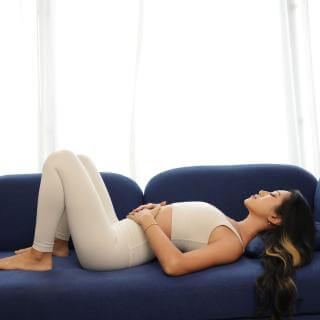
If you prefer to sleep on your back.
You need to be using a thin pillow.
For some people,
They can get away with using even a folded up towel or no towel or pillow at all.
The reason for this is if you use a big fat pillow.
Your neck.
Will be forced into this forwards head position,
Causing a lot of strain through the structures in your neck and the spinal cord.
What we want to do is to sleep with the neck in a neutral position.
And you can see here how my head is about pushed forwards like this from using a pillow that is too big.
Now from here,
It's very important to take the pressure off your lower back.
You need to put a pillow.
Under base.
Your thighs.
This already makes a huge difference in the tension I feel through the lower back.
This is the ideal sleeping posture for back sleepers.
The next is side sleeping.
When you sleep on your side,
You need a thicker,
More supportive pillow.
The rule for sleeping on your side.
Is that if this is your mattress,
Your head should be parallel to the mattress.
A lot of people make the mistake of sleeping on a pillow that is too thin.
So they end up sleeping like this.
And this is obviously going to cause a lot of neck discomfort.
I use the thicker side of my pillow to sit on my side.
So notice how my head is parallel.
To the surface benigmate.
A very common problem with side sleepers is that they'll tend to rotate like this.
1B up in this mountain climber position.
Now this puts a lot of rotation and stress.
Through the lumbar spine.
An easy way to avoid this is by using a pillow in between of these.
This is my favorite.
These are common in Asia and it's called a bolster.
I love these.
Pillows because You can pop it in between your knees.
And then hug it like this.
And it just feels so safe and comfortable.
Sleeping like this.
Prevents you from rolling onto that stomach position.
Notice how their spine is nice and striped.
In a nice neutral position.
For people with broader shoulders and sleep on their side,
I recommend searching for a king-size pillow.
Because you need something thick enough so that your head can remain parallel.
I think a lot of us are guilty of standing like this.
Like this.
Or like this.
I see all of these every single day.
Let's go through what the ideal standing pulse check is.
Let's start with the seat.
Make sure that they are parallel to your front don't let yourself be da footed like this Parallel C.
We wait evenly distributed between them.
These are incredibly important.
A lot of people will lock their knees back.
And notice what happens to my spine when I lock my knees.
It forms this hyperlaidosis arched position.
Knees should be soft.
A very slight bend.
Definitely not locked back.
And this in turn eases the pressure on the spine.
You can see that my spine immediately flattened out going from this From here,
The same rule applies to sitting.
Knees.
Shoulder and ear.
Should all be aligned.
In one straight one.
A lot of people have this forwards posture.
Rounding in through the mid-back,
Complete with that forwards head.
If this is you,
Take a deep breath in.
Roll your shoulders back and down,
Opening out the chest.
And you'll find that your head will naturally come back.
For some people who have been stuck in the forwards head position for a very long time,
You may have to consciously tuck your chin in.
So that your ear comes back into alignment with your shoulder.
Throughout the day start to become aware of how you're standing.
A lot of people don't actually realise that they are leaning on one hand,
That they are locking their knees or coming very far forwards.
I want to reiterate that the goal is not perfection.
Even I catch myself slouching sometimes.
The key here is having awareness of your body.
It's reducing how often your lower back is placed in stressful positions and increasing how often it feels supported.
When your daily positions change,
Your body will rebalance itself over time and your pain patterns will then change too.
This is one of the best and easiest ways to lower baseline levels of pain and create good,
Healthy habits for the future.
I'm Dr.
Kim.
I specialize in helping people heal chronic and persistent pain,
Especially when traditional methods have not worked.
My work focuses on the nervous system.
Gentle somatic movements and meditation to rewire the mind and body into healing itself.
If you know anyone who is struggling with lower back pain,
Please feel free to share my profile with them.
All of this knowledge comes from over 10 years of being a holistic chiropractor,
Working with thousands of people with lower back pain,
Including many chronic cases that were already being lined up for surgery.
As powerful as it can be to change your posture.
Healing chronic lower back pain requires a very specific approach and what I have seen work time and time again.
Is that pain reduces or disappears.
When the deep core muscle.
The psoas muscles and the glutes are addressed in that specific order.
As well as regulating the nervous system.
I've seen people with decades of lower back problems heal their pain using this method.
Thank you so much for practising with me.