What if awakening.
.
.
Didn't require you to become anything.
It didn't need,
Well it doesn't need you to fix yourself.
Or become anything that you're not already.
It doesn't really.
.
.
Even ask you to do anything.
In Zen they have this lovely phrase.
An ordinary person aims to gain something every day.
Whereas a person of the way aims to lose something every day.
So in our everyday normal way of going about things,
We're trying to achieve something,
Become something else.
Learn something new.
But actually in.
.
.
Then the approach is not about arriving something somewhere else it's about arriving right now.
As you are.
So today I wanted to look at the two main approaches to Zen practice that you find out there.
In the Soto School They have the practice of Shikantaza.
Which translates as something like just sitting.
And in the Rinzai school,
Which is what we're part of,
Our particular.
Branches end.
We have the teaching of Zen Master Banke.
Who taught about the unborn,
About resting in the unborn.
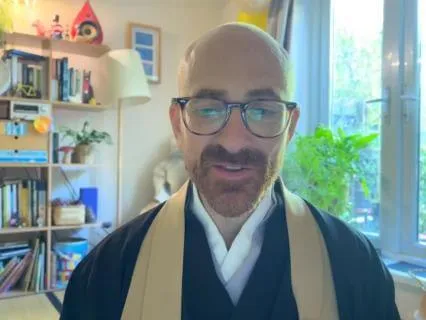
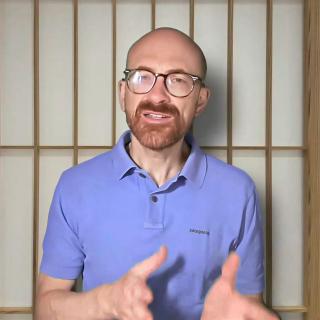
So my name is Mark Kuren-Westmaket,
And if you've been along here before,
It's great to see you back here.
Very welcome.
I'm glad to see you.
And if you haven't been here before,
If you haven't joined in,
Then great you could find us and join in.
This is our regular weekly Dharma slot where we're talking about Zen topics and exploring practice.
So I'm a Zen teacher in the Zenways group.
So our Sangha,
Based mostly in London,
But much more worldwide and online.
People joining from all over the place and including you you guys joining and feeling part of this broader community that we have and we offer practice in different ways.
Here is one of the ways.
Right,
So she can tazz it then.
It literally means nothing but only sitting so za is the word sit to sit we have zazen or zafu it's the same za sitting And particularly in the lineage of Soto,
Which comes from Dogen,
I think pretty much all Soto these days has its root in the teaching of Dogen,
The great Japanese Zen master from the 1200s.
It's very emphasized,
This Shikan Taza.
Just sitting so you sit and that's it really So when you have this teaching about what to do in meditation in the Sota world,
Just sit.
Do nothing else.
Try to do nothing else.
And you think,
Well,
What am I supposed to do?
What do you mean,
Just sitting?
That's just it.
Just sitting.
And it originated from the Chinese origins of the Soto school.
So Soto.
.
.
So and To are the two comes from two Zen masters Tozan and Sozan.
Which were the founding ancestors,
I suppose,
Of Soto Zen.
And they were both Chinese masters.
So back in China,
They had a slightly different pronunciation.
I'm going to do something like the Kaodong school,
Which would have been Soto as it got translated into Japanese.
So the original Chinese Kaodong school,
Soto school,
Were emphasised this,
What they call Mokushō,
Which is silent illumination or kind of silent reflection.
And that was taught by a number of very early Zen masters and it kind of evolved its way through Dogen into what we know now as Shikantaza.
So normally we think of meditation practice as focusing on something.
Maybe when we start.
We're focusing on the breath.
We're focusing on sensation.
We're focusing on sound,
Becoming aware.
Making that the centre of our attention.
Typically,
It's breath,
So we might notice the flow of breath.
Feel the sensations of the.
.
.
Breathing might be counting the breath.
So we've got a focus point for our meditation practice.
But in Shikantaza,
There is no focus point.
And this can be.
.
.
Quite unsettling i suppose or difficult to get the head around.
What am I doing?
I'm not focusing on the breath.
Yeah,
But the breath may be part of your awareness.
So I'm not focusing on sound,
But sound may also be part of awareness.
So we're just being in this openness.
Just sitting,
Allowing.
The moments to unfold,
Allowing life.
To unfold and allowing our experience to be seen and acknowledged.
So there's no goal.
We're not trying to arrive anywhere There was no attempt to reach any particular kind of state.
Just sitting.
And actually when we start to understand it like that,
It is very profound.
Just sitting.
It's unlike anything we do in normal life.
When do we ever just sit?
There's always some kind of pretext or some kind of,
You know,
Attempt to create some kind of state,
Right?
We're trying to relax or go to sleep or listening to music or we're having dinner or,
You know,
We're sitting on the train watching.
Trees go past or listening to music all these kind of things but when do we ever just sit sitting and experiencing.
Allowing what needs to rise.
To do so in its own time.
What needs to be acknowledged and seen to do so?
Some people sometimes call this choiceless awareness.
So we have an awareness,
But we're not choosing to direct it in any particular way.
It's just fully open.
It's simple.
But not.
.
.
Necessarily easy.
Quickly,
In fact,
Shikantasa can become quite challenging.
Because We're sitting in this kind of swirl of nothingness.
Like,
What am I doing?
Well,
I'm not supposed to be doing anything.
Don't do anything.
In fact,
Actually don't do anything is the best instruction.
But then what do I do?
It's so confusing,
Right?
The mind really wants something.
To get hold of right the mind is used to having something to do So then.
.
.
Without the absence of.
.
.
You know,
Formally doing anything,
It starts to latch onto things like Am I doing this right?
Shouldn't something be happening here?
Then,
You know,
More sort of other things like,
Well,
What's for dinner?
I really must meet up with my friends again.
Those kind of thoughts.
Or it could be like,
Oh,
Listen to that.
Or isn't that lovely?
Or isn't that horrible?
Or don't I like that?
All those kind of other things.
So the mind jumps to do something.
And then we're in this swirl of thoughts and judgments and things.
And yet the instruction is to do nothing.
So really it's about allowing.
So none of those things are bad,
You know,
Like we're listening to sound,
We have these thoughts about what we're going to have for dinner or we start judging ourselves.
Am I doing it right?
It's not bad.
It's not good.
When we're just sitting.
We notice these kind of thoughts,
Sensations.
Arise?
We acknowledge them,
Don't push them away,
Don't try to edit them or don't try to judge them in themselves.
And then they just disappear.
They dissolve.
And that's how we just sit without adding anything.
Without engaging.
You know the thing So she can tutter.
Profound practice because it gives the mind nothing to get hold of.
And that's really what it's all about.
There's nothing to get hold of at all here.
And if we do this over time,
We're just open.
In this place of experiencing what needs to be experienced on the outside,
On the inside.
We're opening this space.
In fact,
It's not even an opening,
Right,
Because that's got a kind of element of doing about it.
Is experiencing.
In fact,
Language becomes extremely tricky at this point,
Because language is based in a subject-object-verb kind of way,
Right?
So we've got a me,
And then we've got a doing,
And we've got a that.
So that's the way that language is built.
It's built to encourage us to feel like there's a me.
And there's a doing.
And there's something that we're doing.
But in fact,
If we take out the doing.
And we take out the me then there's no language.
So this becomes very,
Very difficult to talk about it.
But we can.
.
.
Experience it right my challenge is to use language here to describe something which is really languageless.
But if we continue to do this Shikantaza practice over time.
.
.
Then the idea of me sitting,
Me doing nothing,
Me meditating,
Actually begins to just dissolve by itself.
And this me.
.
.
Disappears,
Dissipates.
And what remains is.
.
.
Our true nature.
The nature that is beneath or behind the sense of me doing something.
And then the moment if you like becomes complete.
Like,
There's no lacking,
There's no needing to go anywhere,
Do anything.
It's just beauty.
It's just.
.
.
Perfection,
If you like,
Right here.
So this is the Soto practice of Shikan Taza.
Now we can contrast that with the more Rinzai teaching.
That comes from Zen master Banke.
Now Zen master Rinzai was a Chinese master.
He was alive a long,
Long time ago in early medieval China.
And he ended up with his name being attached to this lineage or branch of Zen,
Just like Soto comes from the teachers Tozan and Sozan.
Then we have the other branch,
Rinzai branch,
Comes from the teacher Rinzai.
And over the years,
These lineages have kind of like.
.
.
Flowed across China into Japan and back to the.
.
.
To the West here in Europe and the US and wherever else you're listening from.
And along the way they kind of pick up you know it kind of flows around a bit right so they pick up different um ways in which The teaching has.
.
.
Been expressed and different techniques which are found to be helpful.
So Zen Master Banke He was alive in the 17th century in Japan,
So much,
Much more recent.
And he actually became probably the most popular Zen master that there's ever been.
He used to hold retreats with thousands of people coming.
And he was very,
Very warmly received and very well respected teacher in Japan at the time.
And he taught the practice of what he called Fusho.
Fushofu means not.
Or un you could say,
And shock means born.
So we translate it as the unborn.
So over the centuries since Dogen and the Soto branch has found its.
.
.
It's sort of rooting within the Dogon's teaching.
The practice of Shikantaza has become very form-based,
You could say.
It's very important that we have the right sitting posture.
Posture is very,
Very important.
How we sit,
Basically.
How we take our place within this.
And then particularly.
.
.
Emphasizing the long hours of sitting.
So just as one example,
In the Soto school,
They typically have periods of meditation 40 minutes long.
Whereas in the Rinzai school they have 25 minutes long.
So the kind of.
.
.
Periods are extended,
Things happen more gradually,
More slowly,
More sort of smoothly,
You could say.
Maybe Rinzai School emphasises kind of short,
Shorter,
Sharper,
A bit more like a dynamic way of working.
Bankai did not emphasize long hours of sitting.
He didn't emphasize a particular posture to do your practice in.
He just said Rest in the unborn.
That's all you need to do,
Just rest in the unborn.
So what is this unborn then?
The unborn is that which was never created.
And can never be destroyed.
It's like the awareness.
.
.
From which things arise.
So my awareness of looking at the camera,
Your awareness of looking at the screen.
Your awareness of sound.
The background from which these things arise now it's not awareness itself because awareness can also be We can have an awareness of our awareness and our awareness also shifts in its way of being.
It kind of like has a coming and going.
But there's something even deeper than that.
He used the analogy of a mirror.
So a mirror is like the unborn and then our experience comes in front of the mirror and is reflected.
So if we rest in the unborn,
We're resting in this.
.
.
Mirror-like awareness where whatever comes in front it's just being seen and acknowledged we don't try to edit it so like a mirror a mirror doesn't decide that this is beautiful this is ugly i'm gonna I'm gonna reflect that,
I'm not gonna reflect that because it's too ugly.
A mirror doesn't decide i'm going to edit that one or distort that one because i just don't think that it's quite right the mirror just reflects right it just simply reflects whatever it comes in front so that is our unborn awareness So as I say,
It's not really exactly the same as awareness because awareness itself has a coming and going.
In it so it's kind of like Yeah,
Again we come up against the limitations of language.
It's like a the clear undisturbed openness which lies underneath all things.
It's the It's the flow of the universe.
And also,
It's none of those things.
As soon as we get caught up in thinking,
Oh,
It's that,
Oh,
It's that,
Then we've got caught.
So he says,
What I call the unborn is the Buddha mind.
This Buddha mind is unborn with a marvellous virtue of illumination and wisdom.
In the unborn,
All things fall right into place and are in perfect harmony.
Now bankei didn't make up this term the unborn in fact the unborn is you can that that term fu sho appears in lots of um teachings dating right back to the buddha so the buddha refers to the unborn and the undying This kind of like.
.
.
Buddha nature,
What underlies all things.
And also Fushot appears as two characters in the Heart Sutra,
Which we chant in our Zen practices,
Unborn,
Not born,
Uncreated,
That kind of thing.
Even the universe in the physics world has a beginning.
And potentially has an end,
Although we don't really quite understand that yet.
So it's not the universe,
Even.
Something deeper or beyond or?
Something like that.
Banke quite famously used the example of background sounds when he was trying to understand or trying to teach the unborn.
He says.
.
.
When I speak,
You can hear the chirping of birds or the sound of a bell.
You don't try to hear them.
They just simply heard.
So the unborn mind simply reflects them.
Without effort.
So right now,
As we're.
.
.
As I'm speaking,
Or later when we'll be doing our meditation practice,
If you hear the sound of a bird outside,
We don't need to jump to it and label it and work out what bird it is.
We're aware of it in the background,
Our awareness.
Acknowledges its presence.
So that's the arising of experience that comes from this openness,
This unborn nature.
And then it recedes back to it again.
So it's also.
.
.
Trap to think that things arise from something.
Like it's not the ocean.
Where a wave comes and disappears back because the ocean itself is a thing.
Again,
It's a close analogy,
But not quite.
The unborn isn't a thing.
So in that sense,
We can't fix it into anything.
It's just the flow.
It's the flow.
It's the non-dual oneness,
The Buddha nature of all things.
So then Banquet says very simply,
Sit or go about your day and when a thought arises like i'm hungry or i'm bored Don't try to stop it.
But don't follow it either.
Let it arise and disappear into the unborn.
Just rest.
In the unborn.
In your Buddha nature.
In your ease if you like.
Okay,
So we have these two approaches then,
Shikantaza and the unborn.
Shikantaza says,
Sit in stillness.
Sit particularly in stillness and allow everything to just arise.
Banquet says,
Well,
Actually,
There's nothing to do here.
You're already free.
Just don't interfere.
That's basically what he's saying.
Just rest into this.
And one can feel a little bit like a long patient kind of unfolding.
And the other one can feel like a very immediate pointing,
Like the unborn is very immediate.
But the problem is we tend to get a bit stuck in different ways with these two approaches,
Right?
So with Shikantaza,
It's very,
Very difficult to do nothing.
The mind very quickly.
Starts to make up things to do.
So we end up trying too hard.
With the unborn.
.
.
It seems very simple.
So then.
It feels like there's nothing to it.
What's there even to do?
There's not.
.
.
There's not even a teaching here,
Is there?
So we think we've found it.
Before we've really explored it.
Now the thing is that they're both really pointing at the same thing.
All of them.
Only points in one direction.
Or maybe from different angles where it's just pointing at the same thing.
It's pointing at being our true nature.
If we sit in Shikantaza.
Just allowing.
Experiencing.
After a while,
The effort falls away and it becomes effortless being.
We're no longer someone trying to sit.
It's not even just sitting,
It's just.
.
.
And then in Banquet's approach,
Resting in the unborn.
We stop interfering.
We're allowing ourselves to be just as we are.
Thoughts come and go.
We don't follow them,
But we're also not shutting them out.
Then we'd be coming to this natural flow.
We become our true nature.
And of course,
Is it Shikantaza?
Are we in the unborn?
The language disappears,
The label disappears and we just.
.
.
Now in the Rinzai Zen approach,
There is also another method of practice which has become quite important,
And that is a koan practice.
So we've spoken a lot before about koans,
What they're for,
And different kinds of koans.
And koans have a much more.
.
.
I'm over here,
I want to get over there,
Kind of.
Direction to them.
And there's also effort.
We have to apply ourselves.
We have to work on kind of.
.
.
Entering this koan.
We have these two sort of.
.
.
Directions,
If you like.
There's the.
I'm over here,
I'm here,
And I want to go over there.
Like,
Enlightenment's over there.
And a koan shows us the path.
So we practice with the koan,
And there's a sense of moving forwards on the path.
And the unborn or the Shikantaza is just about more and more arriving here.
So how do these two fit together?
Actually,
When we practice with our koans.
.
.
We realise that it's not really I'm over here and I'm going over there.
The koan shows us I'm here.
How to get more here.
So we come back to that phrase we said at the beginning,
An ordinary person tries to gain something every day,
Tries to go somewhere,
Achieve something,
Realise something,
Tries to get something which is out there and bring it here.
Whereas a person of the way tries to let something go every day.
Tries to become more here.
More now.
So whether we're doing koans or whether we're doing the fushot unborn or the shikantaza.
The whole direction of it is arriving more and more here.
Taking our place in this moment,
In this body.
In this place as our true self.
There's actually nowhere to go.
Uncovering allowing.
And I find that very,
Very refreshing that we have everything we need,
Of course,
Right here.
There's nothing else we need.
We just need to let go of.
.
.
What kind of restricts us?
So I've got a question here.
Lisa,
Thanks.
Yeah.
So is resting in the unborn similar to Kensho?
Yeah.
So good question,
Isn't it?
Kensho is.
.
.
Kensho literally means to see your true nature.
And often we call it in terms of waking up.
The point which we wake up.
You could say it's more like a realisation.
Now,
Enlightenment has this connotation that out there is enlightenment.
And over here is.
.
.
Silly old me.
I'm trying to get enlightened.
So then I'm reaching out and trying to find something else.
But it's actually,
It's not really the way it goes.
Actually,
The awakening or the realization as a word is much more helpful.
So awakening.
It's like we're asleep.
And we wake up.
Or realization,
It's like we realize what's here already.
So Kensho can.
.
.
Arise whatever whichever of these practices we're doing whether we're doing shikantaza or the unborn or the kohan practice it's like we do the practice or we attempt to do nothing i should say And then over time,
The sense of me attempting to do something or nothing,
Or whatever it is might be,
Kind of like fades or dissolves until this me falls away and then there's the.
.
.
Other falls away and that point there can be a kind of realization suddenly we realize,
Oh,
I am.
The whole universe flowing right here.
I realized there was no separation between me.
And all other things.
I am a flow,
Not a thing.
And that,
I suppose you could say,
Is Kensho.
So it happens within,
And it's like the camera lens shifts.
Nothing actually changes,
Just our perspective changes.
Our view of things change.
So it's kind of realization in a sense.
So yeah,
All these practices can help us to move towards Kensho.
And Kensho can happen multiple times.
We think we've got it.
And then a year later,
Or a few months later,
Ah so that's what it is and we think we've got it again or more and then gradually our understanding of it deepens and broadens and you know integrate I suppose.
So what do they say?
There's a phrase in Japanese,
A little daikon is still a daikon.
Now,
Daikon is a piece of pickle that Japanese people eat with lots of meals.
So the idea is like a little piece of enlightenment or realization is still a realization,
You know,
And it's still important.
Because all that happens then is we just get deeper and broader in that realisation.
Going to invite us all to do a little bit of practice in this shikantaza or unborn in just this moment but before we do if there's any other questions or comments or anything that's been resonating with you please go ahead and just write them down in the chat or the comments Or if you're watching this later on,
Get in touch.
If there's any topics you want to explore,
Cover or look at in future talks,
Just let me know.
Otherwise,
We can prepare ourselves for a bit of sitting meditation.
Zazen,
So ZA sitting,
Zen meditation.
So we're kind of coming into a comfortable,
Upright,
Relaxed posture.
Allowing your eyes to lower.
Feel free to let them close.
Or keep them open.
As you wish.
Turning your attention.
Inside your body.
Noticing how you are.
So we're going to consciously Director attention.
On a couple of things.
To let things stabilize and And then we'll let go of our.
.
.
Focus okay so noticing the feeling of weight in your body connecting with the cushion the floor the chair whatever you're sitting on The feeling of weight.
Noticing any discomforts in your body.
Anything that's feeling a bit uncomfortable,
Maybe even painful,
Aching.
Anything you can just notice and allow not good not bad not trying to change anything just noticing Noticing your breath.
Firstly,
Just noticing that you are breathing.
Noticing the feeling of breathing and where you can feel the movement of your breath.
Noticing whether you feel busy.
Oh,
Carom.
Inside.
Might be on the level of thought Or it might be.
Fidgety sensations.
Buzzing or vibrating in your body.
No good,
No bad.
This is not about the right way or the wrong way,
Just noticing.
And now,
Let's see if we can just let go.
This focus.
It's almost like You open your hands.
Maybe even it helps to physically just open your hands.
Let your attention become.
.
.
Really broad.
Like you're opening a space.
It's a space in which Anything at all can arise and be seen.
And in that space you may notice your body weight.
Discomforts.
The feeling of the breath.
And any manner of sensations and experiences.
But we're not.
Consciously directing our awareness to any of these things.
We're just open.
To this moment.
There's nowhere to go.
There's absolutely no goal here.
We're not trying to get anywhere.
And this can be really hard.
For your brain to wrap itself around.
There is nothing to achieve.
Master Banky.
He just said,
Rest back.
In the unborn.
Doing your very best not to edit anything.
If you feel like you need the toilet.
Allowing that sensation to be there.
If you have a memory of when you were a child.
Allowing that sensation,
That thought to arise.
If you have an itch on your ear.
.
.
Noticing that sensation.
If you feel terribly bored,
Restless.
Acknowledging that.
It's all allowed.
And if we get caught up.
In one of these.
Things that arise we start thinking about other things following a line of thought just as soon as you notice that you got distracted.
In fact the act of noticing brings us back into this openness.
There's nothing we need to do.
Openness.
Simply resting back.
In the unborn.
As we come to the end of our practice time together.
Maybe we could begin swaying the body from side to side.
Take a deeper breath,
If you like.
When you feel ready,
Allowing your eyes to lift.
We offer the merit of our practice today to all beings.
May all beings Be safe.
May they be well.
May they be content and happy.
May they find realization.
Thank you so much for joining today.