Key 16.
Now this is exciting.
Every now and then,
We learn how to do something new that changes everything that came along before.
Since the Wright brothers first heavier-than-air flight,
Humankind have become masters of the sky.
These days at any one time,
Over one million humans are in the skies in one form of aeroplane or other.
A select few lucky astronauts are even orbiting weightless a few hundred miles above the planet.
Most aeroplanes use the same basic principle.
Go fast enough,
With the right amount of forward thrust.
Generate a partial vacuum under your wings,
And you will generate enough lift to annul the force of gravity.
Rockets take the more brute force approach of igniting a controlled explosion at their base to overcome escape velocity.
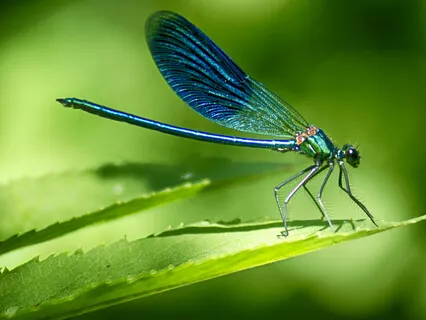
The dragonfly is one of nature's most successful flyers.
With four contra-rotating wings,
It can perform the most amazing aerobatic feats.
It can fly backwards,
Sideways and hover,
Whilst it is also capable of forward flight at over 30 miles an hour.
It also refuels in mid-air by eating mosquitoes on the wing.
It actually spends very little time on the ground.
The dragonfly has been around for over 300 million years,
And some fossil species with one metre-wide wingspans have been found.
A few years ago,
A team at Georgia Tech had a flash of inspiration.
With microelectronics and nanotechnology,
They had the idea to make a robotic dragonfly.
A few years later,
Weighing in at around a standard AAA battery,
They have developed a device that will revolutionise the aviation industry.
At first,
It will be used in surveillance applications,
And in time it will scale up to take heavier payloads.
By mimicking the innate wisdom of nature,
Humankind are entering a very new and exciting phase indeed.