The world’s largest free audio library for everyday wellbeing
Energy & Subtle-Body
The Middle Pillar is a Kabbalistic energy meditation in which you focus on five centres along the body's midline, visualize light, vibrate divine Hebrew names, and circulate that energy through set patterns (Regardie, 1945).
Last Updated
3 Jul 2026
We are still reviewing this page. Our research team checks every technique page for accuracy and evidence quality before final release. Details may change as that review completes. The evidence badge shows our current reading of the published research.
RECOMMENDED DOSE
No direct dose-response literature exists for this technique. This is a conservative introductory range based on general practice conventions for guided visualisation and breath-based meditation, meant to build familiarity with the vibration and imagery without strain. No direct dose evidence; editorial synthesis.
No direct dose-response literature exists for this technique. Once the sequence feels familiar, a modest step up in length and frequency reflects typical meditation practice conventions. No direct dose evidence; editorial synthesis.
No direct dose-response literature exists for this technique. A daily maintenance practice of this length reflects common conventions for established meditation practitioners. No direct dose evidence; editorial synthesis.
Session length
Session length: 5–10 minutes
5
MIN
How long each individual practice session should last from start to finish.
Frequency
Frequency: 3–4 days
3
DAYS
The number of days per week to fit a session into your routine.
Session length
Session length: 10–15 minutes
10
MIN
How long each individual practice session should last from start to finish.
Frequency
Frequency: 5–6 days
5
DAYS
The number of days per week to fit a session into your routine.
Session length
Session length: 15–20 minutes
15
MIN
How long each individual practice session should last from start to finish.
Frequency
Frequency: 7 days
7
DAYS
The number of days per week to fit a session into your routine.
About this card. No direct dose-response research exists for the Middle Pillar technique; the durations and frequencies shown are editorial synthesis drawn from general meditation practice conventions and should be treated as starting points only. These recommendations are not a substitute for personalised guidance from a qualified practitioner.
Quick answers to what people most often ask. Each card links to the deeper section below.
evidence
No controlled trial has tested the Middle Pillar for anxiety, stress, attention, or any bodily outcome, so its benefits rest on Golden Dawn tradition and practitioner reports rather than clinical evidence. The one directly relevant peer-reviewed study examined ritual-magic practitioners on a test of claimed extrasensory perception and found no effect.
Read moregood for
The Middle Pillar suits people already drawn to Western esoteric or Hermetic study, for whom the Kabbalistic imagery and vibrated Hebrew names make the practice meaningful, and anyone wanting a contemplative routine that feels physically active rather than purely still. It is not a treatment for anxiety, trauma, or any diagnosed condition.
Read moresafety
Most healthy adults can practise the Middle Pillar as a low-risk contemplative exercise. People working through trauma, managing acute anxiety, or vulnerable to psychosis should go slowly and keep it alongside professional care, since vivid imagery and vibrated chanting can stir strong emotion or unfamiliar body sensations. Pause if anything feels overwhelming.
Read morehow it works
The Middle Pillar combines held attention on five points along the body's midline, slow vibrated Hebrew names, and directed movement of awareness up and down the body. Anchoring attention on each centre steadies focus, while the long, toned sound hums through the throat and chest, thought to stimulate the vagus nerve, the body's main rest-and-recovery pathway.
Read moreA Western esoteric meditation in which you activate five energy centres along the body's midline, visualizing light and vibrating divine Hebrew names, then circulate that energy through set patterns.
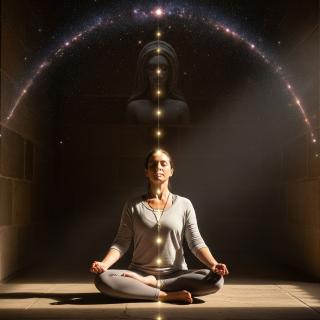
The practitioner activates five centres along the body's central axis, Kether at the crown, Daath at the throat, Tiphareth at the heart, Yesod at the lower abdomen, and Malkuth at the feet, visualizing a sphere of brilliant light at each while vibrating its divine Hebrew name. Once the centres feel active, attention is circulated through set patterns known as the Fountain of Light and the Ribbon, moving awareness up the central column and around the body. Sessions are usually done seated or standing, either self-led or guided.
The Middle Pillar is a Western esoteric, Kabbalistic energy practice, not a yoga chakra meditation or a secular mindfulness technique, though it shares features such as body-directed attention and toned sound. Its five centres correspond to Sephiroth on the Tree of Life rather than to the Hindu chakra system, and its vibrated Hebrew names belong to the Hermetic Golden Dawn lineage. It is a contemplative practice, not a clinical treatment, and the 'pillar' refers to the body's central column of light, not to any physical or architectural structure.
Not to be confused with
Lesser Banishing Ritual of the Pentagram (LBRP)
The LBRP is a Golden Dawn ritual of gesture, drawn pentagrams, and directional invocation, often practiced in the same session as the Middle Pillar. The Middle Pillar is the seated energy exercise itself, focused on activating and circulating light through the body's midline.
Qabalistic Cross
The Qabalistic Cross is a short opening gesture that traces a cross of light on the body and is sometimes used to begin the Middle Pillar. It is a brief preparatory rite, not the full five-centre activation and circulation that make up the Middle Pillar proper.
Kabbalah study (Tree of Life scholarship)
Studying Kabbalah means learning the Tree of Life, the Sephiroth, and their correspondences as a body of thought. The Middle Pillar is an embodied meditation that uses that map in practice, resting attention on centres and vibrating names rather than analysing texts.
"Middle pillar" in engineering and architecture
A structural middle pillar is a load-bearing column between tunnels or openings and has nothing to do with this meditation. The Middle Pillar here is a Kabbalistic energy practice; the shared phrase is a coincidence of naming.
The Middle Pillar works, in the terms its own tradition sets out, by combining held attention, slow vibrated sound, and directed movement of awareness up and down the body. Resting attention on each centre in turn is a form of attentional anchoring, holding the mind on one clear target so it wanders less, which practitioners tend to feel as steadier, quieter focus. The long, toned Hebrew names send a hum through the throat and chest that is thought to stimulate the vagus nerve, the main pathway of the body's rest-and-recovery branch. That last effect is inferred from research on chanting broadly, not measured in the Middle Pillar itself (Regardie, 1945).
Flow, warmth, and a steady top-to-bottom connection along the midline are what practitioners often describe as they deliberately move attention up and down the body's central axis in set patterns called the Fountain of Light and the Ribbon. In the Middle Pillar this directed circulation of attention is a traditional step drawn from Regardie's source text (Regardie, 1945), not an effect that has been measured in clinical research.
As you rest attention on each centre from the crown down to the feet, a felt sense of warmth, energy, or flow along the body's midline tends to build. In the Middle Pillar this is subtle energy awareness, the trained skill of noticing perceived currents in and around the body, and it describes a subjective, traditional experience rather than a physically measured signal.
The long, toned Hebrew names hum through the throat and chest, and practitioners often describe that resonance as grounding, with breathing slowing and the body settling. The vocal vibration is thought to stimulate the vagus nerve, the main pathway of the body's rest-and-recovery system, though the practice itself has not been tested in clinical research (Regardie, 1945).
No study has measured what the Middle Pillar does inside the body, so any physiological account is inferred rather than recorded. In separate research on slow chanting and rhythmic vocalization, sustained toning has been associated with shifts in heart-rate variability, the beat-to-beat change that tracks whether the nervous system is winding up or settling. Practitioners of the Middle Pillar describe a parallel felt shift as breathing slows, the throat and chest buzz gently, and the body grows heavier and calmer. Because that evidence comes from other vocal practices and not this one, these are best read as plausible, practitioner-reported changes rather than confirmed effects (Regardie, 1945).
The evidence is limited: no clinical trial has tested the Middle Pillar for any specific outcome, so the calm, focus, and felt sense of energy people describe come from the Golden Dawn tradition and from practitioner accounts rather than from trials (Regardie, 1945). The single peer-reviewed study in this lineage looked at engaged ritual-magic practitioners and their performance on a test of psi, or claimed extrasensory perception, and found no paranormal or clinical benefit (Laythe et al., 2024). What is not yet supported is any claim that the practice treats anxiety, stress, or another condition: there are no controlled trials, no large samples, and no measured physiological outcomes.
No controlled study has tested the Middle Pillar itself for anxiety, stress, attention, or any bodily outcome, so its benefits rest on historical and experiential sources rather than clinical evidence (Regardie, 1945). The one directly relevant peer-reviewed investigation examined engaged ritual-magic practitioners and their scores on a forced-choice test of psi, or claimed extrasensory perception, and found no paranormal effect; practitioners actually scored below chance (Laythe et al., 2024). Some plausibility for the vibrated-sound element is borrowed from separate research on chanting and heart-rate variability, but that work does not involve this practice, and the available statistics are significance-only rather than full effect-size estimates.
0
Meta-analyses
0
RCTs
0
Systematic reviews
0
Observational
2
Pilot
Studied populations
Outcomes measured
| Outcome | Effect size | 95% CI | N | Comparator | Source |
|---|---|---|---|---|---|
| psi (ESP) test performance | reported significant; p<.01 | — | — | — | Laythe et al., 2024 |
The available research is useful for setting expectations, but it is indirect and thin: a single relevant study, no controlled trials of this practice, and significance-only statistics. Treat the findings as general guidance rather than a promise about any single session, and not a replacement for clinical care.
Trained Transliminals: Exploring Anomalous Experiences and Psi in Magical Practitioners
2024
Finding: This study looked at experienced ritual-magic practitioners, whose core practice blends meditation, visualization, and related mental exercises much like the Middle Pillar. People who reported more porous mental boundaries also reported more unusual or anomalous experiences, but when the same practitioners took a computerized psychic-ability test, they actually scored below chance rather than above it. In plain terms, the study connects this style of practice with certain subjective experiences, but it found no measurable psychic effect and says nothing about calmness, stress, or any health benefit. If you are drawn to the Middle Pillar, treat it as a contemplative and imaginative exercise rather than proof of any paranormal or clinical outcome.
reported significant; p<.01
The Middle Pillar comes from the Hermetic Order of the Golden Dawn and was systematized by Israel Regardie, most notably in his 1945 book of the same name (Regardie, 1945). Its centres map onto the Sephiroth of the Kabbalistic Tree of Life, and vibrating sounds and divine names has deep roots in Western esoteric and occult tradition. These roots help explain the practice's form, the sequential placement of attention along the body's axis and the toned Hebrew names, not its clinical effects.
For most healthy adults, the Middle Pillar is a low-risk contemplative practice. The calm, focus, and felt sense of energy that practitioners describe come from tradition and personal report, not from clinical trials, because the technique itself has not been tested in research (Regardie, 1945). Treat it as a practice to explore rather than a treatment: it can sit alongside professional support for anxiety, trauma, or another health concern, but it should not replace that care. Sustained visualization and vibrated chanting can occasionally stir strong emotion or unfamiliar body sensations, tingling, warmth, or a sense of energy that feels unusual. This is a practice-informed caution drawn from how the technique works rather than a measured adverse effect, so the sensible response is to go slowly and pause if anything feels overwhelming.
A few people should approach the Middle Pillar with extra care. Anyone working through trauma may find that long stretches of inward visualization and body-focused attention surface unprocessed material, feelings or memories that rise up unexpectedly, so shorter sessions and the support of a therapist are wise. That caution comes from clinical experience with inward-attention practices, not from a documented study of this technique. People living with acute anxiety or a vulnerability to psychosis should also proceed gently and keep the practice as a complement to professional care, since vivid imagery and unusual sensory experiences, which this practice deliberately cultivates, can feel destabilising for some.
Long stretches of inward visualization and body-focused attention can surface unprocessed material — feelings or memories that rise up unexpectedly. If you are working through trauma, keep sessions short, move slowly, ground at the feet before you finish, and practise alongside a therapist. This is a practice-informed caution drawn from clinical experience with inward-attention practices, not from a documented study of the Middle Pillar itself.
The vivid imagery and unusual sensory experiences this practice deliberately cultivates can feel destabilising for some people. If you live with acute anxiety or a vulnerability to psychosis, proceed gently, keep sessions brief, and treat the practice as a complement to professional care rather than a replacement. No study has measured adverse effects of the Middle Pillar, so this is a practice-informed caution rather than a documented risk.
Sustained visualization and vibrated chanting can occasionally stir strong emotion or unfamiliar body sensations — tingling, warmth, or a sense of energy that feels unusual. This is drawn from how the technique works rather than a measured adverse effect, so the sensible response is to go slowly and pause if anything feels overwhelming.
The Middle Pillar sits well in a quiet spot where you will not be disturbed, and it tends to be gentlest when you keep sessions short at first so you can notice how it affects you before extending them. Approach it as something to explore at an easy pace, letting breath, voice, and attention stay soft rather than forced, and give yourself room to pause if anything feels like too much.
Sit or lie somewhere quiet where you will not be disturbed, and begin with a brief session of around ten minutes rather than a long one, so you can notice how the practice affects you before extending it.
Let the breath stay slow and easy, and vibrate the names at a comfortable volume so the sound hums softly through the throat and chest rather than straining the voice. The aim is a settling resonance, not force.
Rest awareness at each point along the midline without rushing, letting any warmth, flow, or sense of settling build at its own pace instead of chasing a particular sensation.
If strong emotion, tears, or an unfamiliar body sensation appears, treat it as a cue to soften the practice or pause entirely. There is no benefit in pushing through distress.
Close by bringing attention down to the feet and the support beneath you, and give yourself a few unhurried moments before standing, especially after a longer or deeply relaxing session.
If you are managing trauma, acute anxiety, or another health condition, treat the Middle Pillar as a complement to treatment rather than a substitute, and check in with a qualified professional if the practice consistently unsettles you.
This information is educational and is not medical advice. This practice is not a substitute for professional care and should not replace prescribed medication or treatment for any medical or mental-health condition. If you are managing a health condition or taking medication, talk with a qualified health professional before changing your practice. If you are in distress or crisis, seek professional support.
| Technique | Best for | Use with care | Evidence strength | Distinction |
|---|---|---|---|---|
| Microcosmic Orbit (Taoist qi circulation) | Practitioners drawn to a Taoist or Eastern frame who want to feel energy move in a continuous loop rather than at named Kabbalistic stations. | emerging EVIDENCE | Both practices deliberately circulate attention along the body in set routes and describe the result as energy moving through internal channels. The Microcosmic Orbit follows a loop up the spine and down the front of the body within a Taoist framework of qi, while the Middle Pillar activates five centres along the midline within Hermetic Kabbalah and vibrates Hebrew divine names. Neither has direct clinical trials; both rest on tradition and practitioner report. | |
| Chakra meditation | People who prefer a yogic vocabulary of centres along the spine and want a widely taught, easily found format for energy-centre work. | emerging EVIDENCE | Chakra meditation also rests attention on a series of energy centres and often pairs each with a colour, sound, or quality, but it draws on yogic and Hindu tradition and typically places seven centres along the spine. The Middle Pillar works five centres mapped to the Sephiroth of the Kabbalistic Tree of Life and adds vibrated Hebrew names and set circulation patterns. Both describe subjective energy and neither is clinically tested for the effects attributed to it. | |
| Mantra and chanting meditation | Anyone wanting the grounding, settling feel of sustained toning without adopting an esoteric map or a fixed sequence of body centres. | moderate EVIDENCE | Chanting meditation shares the Middle Pillar's use of sustained vocalization, the long toned sound that hums through the throat and chest and is thought to stimulate the vagus nerve, the main pathway of the body's rest-and-recovery branch. The difference is framing and scope: chanting can stand alone as a secular or devotional practice, while in the Middle Pillar the vibrated Hebrew names sit inside a specific Kabbalistic sequence of centres and circulation. | |
| Body scan meditation | People who want the sequential, head-to-toe attention and relaxation of the Middle Pillar in a plain, non-esoteric form with a wider research base. | moderate EVIDENCE | Body scan meditation moves attention sequentially through the body, much as the Middle Pillar steps from crown to feet, but it is a secular practice that observes ordinary sensation without visualizing light, vibrating names, or circulating energy. The Middle Pillar layers on subtle-energy imagery and vocalization within a Kabbalistic frame, whereas the body scan simply invites you to notice and release what is already there. |
The Middle Pillar is a Kabbalistic energy meditation in which you focus on five centres along the body's midline, visualize light, vibrate divine Hebrew names, and circulate that energy through set patterns (Regardie, 1945). It comes from the Golden Dawn tradition, not from clinical research, so any calm or focus people describe is tradition-based and practitioner-reported.
+
The Middle Pillar is a Western esoteric practice from the Hermetic Order of the Golden Dawn, systematized by Israel Regardie in his 1945 book of the same name (Regardie, 1945). Sitting still, you rest attention on five centres running from the crown down to the feet, picture a sphere of bright light at each, intone the matching Hebrew divine name, and then circulate that energy in set patterns called the Fountain of Light and the Ribbon. The five centres map onto the Sephiroth, the named spheres on the Kabbalistic Tree of Life. It has not been tested in clinical trials, so treat it as a contemplative practice to explore rather than a treatment for any condition.
From Western esoteric tradition. The Middle Pillar comes from the Hermetic Order of the Golden Dawn and was systematized by Israel Regardie, most notably in his 1945 book of the same name (Regardie, 1945).
+
From Western esoteric tradition. The Middle Pillar was drawn from Golden Dawn practice and systematized by Israel Regardie, most fully in his 1945 book The Middle Pillar (Regardie, 1945). Its five centres map onto the Sephiroth of the Kabbalistic Tree of Life, and its use of vibrated sacred sound and divine names has deep roots in Western esoteric and occult tradition. This is historical provenance only; it explains the practice's form rather than demonstrating any clinical effect.
Unproven. No controlled trial has tested the Middle Pillar for calm, focus, or any outcome, so its effects rest on tradition and practitioner report rather than demonstrated efficacy (Regardie, 1945). Many people find it absorbing and settling, but that is not the same as a measured effect.
+
Unproven. The calm, focus, and felt sense of energy people describe come from the Golden Dawn tradition and personal accounts, not from clinical research on the practice itself (Regardie, 1945). The one directly relevant peer-reviewed study looked at engaged ritual-magic practitioners on a test of psi, the claimed ability to perceive information beyond the ordinary senses, and found no paranormal or clinical benefit (Laythe et al., 2024). It is fair to treat the Middle Pillar as a low-risk practice many find meaningful, rather than a treatment shown to work for any condition.
Almost none. No controlled study has tested the Middle Pillar itself for anxiety, stress, attention, or any bodily outcome, so its benefits rest on tradition and practitioner report rather than clinical evidence (Regardie, 1945).
+
Almost none. The Middle Pillar has not been examined in clinical trials, so any reported calm, focus, or felt sense of energy comes from Golden Dawn tradition and personal accounts rather than from measured effects (Regardie, 1945). The one directly relevant peer-reviewed study looked at engaged ritual-magic practitioners on a forced-choice psi task, testing the claimed ability to perceive information beyond the senses, and found no paranormal or clinical benefit (Laythe et al., 2024). Some plausibility for the vibrated-sound element is borrowed from separate chanting and heart-rate-variability research, but that work does not involve this practice.
Likely because sustained toning vibrates the vocal folds, which is thought to stimulate the vagus nerve, the main pathway of the body's rest-and-recovery branch. This mechanism is inferred from chanting research, not measured in the Middle Pillar itself (Regardie, 1945).
+
The most plausible explanation is vocal vagal stimulation: humming a long, resonant name vibrates the throat and chest, and that vibration is thought to activate laryngeal branches of the vagus nerve, the main channel of the body's rest-and-recovery branch of the nervous system. Paired with the slow breathing the practice draws out, this can shift the body toward a settled state that practitioners describe as calming. This mechanism is inferred from separate research on chanting and toning, not measured in the Middle Pillar, which has not been studied in clinical research (Regardie, 1945).
The sensations are real; warmth, tingling, and a felt sense of flow are genuinely experienced, but they are best understood as subjective, practice-developed body awareness rather than a measured energy force. No study has tested what the Middle Pillar does inside the body, so any energetic account is inferred rather than confirmed (Regardie, 1945).
+
The sensations are real as experiences, but the energy itself is not a physiologically validated distinct force. What practitioners feel is closest to interoception, the ordinary sense of internal body signals like warmth or tingling, trained and directed by sustained attention and vibrated sound. In the Kabbalistic tradition these are described as subtle energy moving along the body's midline, but that framing is meaning-system context, not clinical evidence. No controlled study has measured what the practice does in the body, so the felt energy is best read as a real but subjective, practitioner-reported perception rather than a confirmed measurable phenomenon (Regardie, 1945).
Use care. The Middle Pillar is generally low-risk for most healthy adults, but its long stretches of inward visualization and body-focused attention can surface unprocessed material if you have a trauma history. Keep sessions short, go slowly, ground when you finish, and pause if anything feels overwhelming.
+
Use care. No research has tested this practice's safety for people with a trauma history, so this is a practice-informed caution rather than a documented risk. Sustained inward attention and vivid imagery can occasionally bring up difficult feelings or memories, so shorter sessions, a slow pace, and grounding at the close are wise. Treat the Middle Pillar as a complement to professional support, not a substitute, and work alongside a therapist if the practice consistently unsettles you.
For most healthy adults it is unlikely to, but it can. Sustained inward focus and vivid imagery may occasionally feel destabilising if you are managing acute anxiety, so keep sessions short and pair the practice with professional care. This is a practice-informed caution, not a measured effect, because the technique itself is untested (Regardie, 1945).
+
For most healthy adults the Middle Pillar is a low-risk contemplative practice, but sustained visualization and vibrated chanting can occasionally stir strong emotion or unusual body sensations. People living with acute anxiety, a trauma history, or a vulnerability to psychosis may find the vivid imagery and inward attention destabilising, so it helps to go slowly, keep sessions brief, and pause if anything feels overwhelming. This caution is practice-informed and drawn from how the technique works rather than documented, since no study has measured adverse effects of the Middle Pillar; keep it alongside professional care rather than in place of it (Regardie, 1945).
Start short and simple: sit or lie somewhere quiet, then move attention slowly from the crown down to the feet, visualising light and softly toning each name, for around ten minutes before extending. This is tradition- and practitioner-based guidance, not a clinically tested protocol (Regardie, 1945).
+
Begin with a brief first session of roughly ten minutes so you can notice how it affects you before doing more. Keep the breath slow and the vibrated names at a gentle volume, rest attention on each of the five midline centres without rushing, and ground at the feet before you stand. These steps come from the Golden Dawn tradition and practitioner report rather than clinical study, so treat them as a practice to explore, and keep it alongside professional care if you are managing trauma, acute anxiety, or another condition (Regardie, 1945).
The difference is tradition and structure, not effect. The Middle Pillar works five centres mapped to the Sephiroth of the Kabbalistic Tree of Life with vibrated Hebrew names and set circulation patterns, while chakra meditation draws on yogic and Hindu tradition, usually with seven centres along the spine. Both describe subjective energy, and neither has been clinically tested (Regardie, 1945).
+
The difference is the framework and the form, not any proven benefit. The Middle Pillar is a Western esoteric practice from the Golden Dawn: you rest attention on five centres along the body's midline, visualize light, vibrate Hebrew divine names, and circulate energy through set patterns (Regardie, 1945). Chakra meditation comes from yogic and Hindu tradition and typically places seven centres along the spine, often pairing each with a colour or sound. Both work with a subjective, felt sense of energy, and neither has been tested in clinical research, so choose by the tradition and vocabulary that feel meaningful rather than by evidence of effect (Regardie, 1945).
In Kabbalah, the central column of the Tree of Life running down the body's midline; the meditation of the same name activates five centres along that column and circulates light between them.
The named centres or spheres on the Kabbalistic Tree of Life. The Middle Pillar works five of them along the midline, each carrying a distinct quality from the crown down to the feet.
Toning a word or name as a long, resonant sound so it hums through the body. In the Middle Pillar, practitioners vibrate Hebrew divine names at each centre.
A circulation pattern in the Middle Pillar where attention rises up the central column and cascades outward and down the sides of the body, felt as energy flowing over and around you.
A second circulation pattern in the Middle Pillar in which attention spirals around the body, experienced as a band of energy winding from feet to crown.
The trained ability to notice perceived currents, warmth, or flow of energy in and around the body. It is a subjective, practice-developed sense rather than a physically measured signal.
A subjective, interoceptive-style perceptual construct with no controlled physiological validation; distinct from ordinary interoception in that it targets reported non-ordinary energetic phenomena.
The idea that sustained toning or chanting, by vibrating the throat, stimulates the vagus nerve, the main pathway of the body's rest-and-recovery branch, helping the body settle.
Proposed activation of laryngeal vagal afferents via vocal-fold vibration; inferred for the Middle Pillar from adjacent chanting and heart-rate-variability research rather than direct measurement.
The small beat-to-beat variation in heart rhythm that tracks nervous-system state; higher variability generally reflects a calmer, more adaptable rest-and-recovery mode.
A validated autonomic marker; associations with slow or chanted vocalization come from adjacent literature, not from studies of the Middle Pillar itself.
The Hermetic Order of the Golden Dawn, a late-19th-century Western esoteric society whose practices Israel Regardie drew on and systematized, including the Middle Pillar.
Regardie, Israel (1945). The Middle Pillar: The Balance Between Mind and Magic.
Brian Laythe, Natalie Roberts, Gordon White, Damien J. Houran (2024). Trained Transliminals: Exploring Anomalous Experiences and Psi in Magical Practitioners. https://doi.org/10.31275/20243351
Editorially curated. Tracks are not themselves clinically studied; evidence on the page applies to Middle Pillar as a technique.
Beginner content for Middle Pillar

★ 4.9
·
Guided
·
25 min
Steve Nobel
How hard is Middle Pillar?
Middle Pillar stays at 3 because its real burden is the multi-step esoteric ritual structure.
3
Mental Effort
3 / 4
▾Emotional Depth
1 / 4
▾Physical Intensity
1 / 4
▾Prior Knowledge
3 / 4
▾Explore guided sessions to deepen your Middle Pillar technique.