The world’s largest free audio library for everyday wellbeing
Breathwork
Natural Breathing, known in Chinese as Zi Ran Hu Xi, is a Qigong breathwork practice of allowing the breath to settle into its own natural, unforced rhythm without controlling or directing it (Chaitow et al., 2013).
Last Updated
3 Jul 2026
We are still reviewing this page. Our research team checks every technique page for accuracy and evidence quality before final release. Details may change as that review completes. The evidence badge shows our current reading of the published research.
RECOMMENDED DOSE
No direct dose evidence; editorial synthesis. A short few-minute session on most days is a gentle, achievable way to build the habit of settling into your natural breathing rhythm before extending your practice.
Studies of closely related breathing exercises and diaphragmatic breathing in respiratory patients (a systematic review and a monitored practice study) rely on regular, near-daily practice, so a daily rhythm is a reasonable extrapolation. The specific 10-minute session length has no direct dose evidence and is an editorial starting point.
A meta-analysis of breathing exercises in COPD describes sustained, ongoing practice programmes, supporting a consistent daily commitment for established practitioners. The longer 15–20 minute session length is an editorial extension for those who want a deeper practice and is not directly dose-tested for natural breathing.
Session length
Session length: 3–5 minutes
3
MIN
How long each individual practice session should last from start to finish.
Frequency
Frequency: 3–5 days
3
DAYS
The number of days per week to fit a session into your routine.
Session length
Session length: 10 minutes
10
MIN
How long each individual practice session should last from start to finish.
Frequency
Frequency: 5–7 days
5
DAYS
The number of days per week to fit a session into your routine.
Session length
Session length: 15–20 minutes
15
MIN
How long each individual practice session should last from start to finish.
Frequency
Frequency: 7 days
7
DAYS
The number of days per week to fit a session into your routine.
About this card. Direct dose-response data for natural breathing specifically is limited; frequency guidance is extrapolated from closely related breathing-exercise research, while session lengths are conservative editorial starting points. These recommendations are not a substitute for personalised guidance from a qualified practitioner.
Quick answers to what people most often ask. Each card links to the deeper section below.
evidence
Direct research on Natural Breathing is essentially absent; supporting evidence comes from slow and diaphragmatic breathing studied mostly in people with lung disease. A meta-analysis of relaxation techniques in COPD found small improvements in anxiety, and guided breathing patterns slowed respiration and modestly strengthened breathing muscles. Effects on breathlessness and quality of life were inconsistent.
good for
Adults who feel tense, wired, or unable to wind down may benefit from Natural Breathing, especially those who find directive breathwork adds pressure rather than relief. Formal evidence was gathered mostly in people with COPD, so treat it as general settling guidance—not a substitute for care when breathing problems, anxiety, or another condition is significant.
Read moresafety
Most healthy adults can practise Natural Breathing safely, since it asks only that you let the breath settle into its own rhythm rather than force, deepen, or hold it. People with severe COPD or chronic respiratory insufficiency should keep the breath gentle and consult a clinician, because straining the breath can raise effort and worsen breathlessness.
Read morehow it works
Slow, unforced breathing is thought to shift the autonomic nervous system toward its rest-and-recovery branch, letting the body stand down from alertness. Shoulders drop and breathing lengthens on its own, while resting attention on the movement and warmth of each breath gives a busy mind a simple place to land. This mechanism is inferred, not directly measured.
Read moreNatural Breathing (Zi Ran Hu Xi) is a Qigong practice of letting the breath settle into its own unforced rhythm, neither controlling nor directing it (Chaitow et al., 2013).
You sit or stand in relaxed alignment and let the automatic respiratory system move the breath on its own, without counting, deepening, or setting any ratio. Attention rests lightly on the movement, pressure, and warmth of each breath. The practice works both on its own and as the recovery phase between more active Qigong breathing exercises.
Unlike paced or controlled breathwork, which sets a deliberate rhythm or count, Natural Breathing is defined by non-interference: the aim is to stop managing the breath rather than to shape it. Do not confuse it with effortful diaphragmatic or deep-breathing techniques. In severe lung disease, that kind of forced breathing has been shown to increase the work of breathing rather than ease it.
Not to be confused with
Deep or belly breathing
Natural Breathing is not deep breathing. It deliberately avoids deepening, lengthening, or directing the breath; the whole point is to let the autonomic system breathe the body rather than force a fuller breath.
Paced or ratio breathing (box breathing, 4-7-8)
These impose a counted structure on inhale, hold, and exhale, which is the opposite of Natural Breathing. Here there is no count, ratio, or target rhythm to follow; attention simply rests on the breath as it already is.
Active Qigong breathing exercises
Active Qigong exercises deliberately shape and move the breath, whereas Natural Breathing is the unforced recovery phase between them and a practice in its own right. It is the resting state, not another technique to perform.
Natural Breathing is thought to work by letting slow, unforced breathing shift the autonomic nervous system toward parasympathetic activity, the rest-and-recovery branch that lets the body stand down from alertness (Hamasaki, 2020). In the body this tends to feel like the shoulders dropping and breathing lengthening on its own, without you making it happen. Resting attention on the movement and warmth of the breath also gives a busy mind a simple place to land, which practitioners often experience as fewer spiraling thoughts. This mechanism is inferred from research on diaphragmatic breathing broadly, not from trials of Zi Ran Hu Xi specifically, so it is best read as a reasonable hypothesis rather than a measured effect.
You may notice the body settling: the shoulders dropping, breathing slowing on its own, a sense of being allowed to recover rather than stay on guard. Slow, unforced breathing is thought to engage the parasympathetic nervous system, the rest-and-recovery branch that eases the body out of fight-or-flight (Hamasaki, 2020).
The most consistently measured change is a slower breathing rate. When people move from their spontaneous pattern into deliberate diaphragmatic breathing, respiration slows while lung volumes and oxygen saturation rise (Cancelliero-Gaiad et al., 2014), which in the body can feel like the breath lengthening and a little more space opening between each inhale and exhale. The scope is narrow, though: that study measured a guided diaphragmatic pattern in 15 people with COPD and 15 healthy adults, not the unforced natural breathing this practice cultivates, so it points to the direction breath and body may move rather than proving what Zi Ran Hu Xi does. Heart-rate variability, cortisol, and direct measures of nervous-system tone, the markers that would show a calming shift most clearly, have not been measured for this specific technique.
As the body settles, the breath lengthens and a little more room seems to open between each inhale and exhale. That everyday sense of slowing down reflects a lower respiratory rate, the number of breaths you take each minute. In measured studies, breathing rate dropped when people moved from their own spontaneous pattern into deliberate diaphragmatic breathing (Cancelliero-Gaiad et al., 2014).
When breathing feels shallow, effortful, or somehow not quite satisfying, letting it settle can bring a sense of steadier, fuller air exchange, as if the body has more to draw on. In one small study, blood oxygen saturation, meaning how much oxygen the blood is carrying, rose and breathing slowed when people moved from their spontaneous pattern into a deliberate one (Cancelliero-Gaiad et al., 2014), though Natural Breathing lets the breath settle on its own rather than driving it.

As the breath settles on its own, many people feel the body grow steadier and heavier, breathing slow without being pushed, and tension ease. That settling reflects rising parasympathetic tone, the body's rest-and-digest activity. It is inferred from broader diaphragmatic-breathing research rather than measured directly in this practice (Hamasaki, 2020), though a small study did record a slower breathing rate during related deliberate breathing (Cancelliero-Gaiad et al., 2014).
As the breath is allowed to settle into its own unforced rhythm, the shoulders and jaw often release and the body stops bracing itself. That easing reflects the sympathetic nervous system, the body's fight-or-flight branch, standing down; slow, diaphragmatic breathing has been measured to lower breathing rate (Cancelliero-Gaiad et al., 2014) and is thought to reduce sympathetic drive (Hamasaki, 2020).
Limited, indirect evidence supports this practice, with nearly all of it drawn from breathing-exercise research in people with COPD rather than from Zi Ran Hu Xi itself. In that work, relaxation-style breathing produced small improvements in anxiety and low mood (Volpato et al., 2015), and structured breathing exercises modestly strengthened the inspiratory muscles and lengthened walking distance (Yun et al., 2021), (Holland et al., 2012). Effects on breathlessness and overall quality of life were inconsistent from one review to the next (Holland et al., 2012). What is not yet supported: any direct trial of Natural Breathing, and any claim that it treats a diagnosed condition.
That sense of the body settling when you let the breath find its own slow rhythm reflects the parasympathetic nervous system, the body's rest-and-recovery branch, coming forward. Slow, unforced breathing is thought to help engage this calming response, easing tension and steadying the system (Hamasaki, 2020). The evidence here is early and drawn from breathing practices in general rather than from this specific technique.
Most research points to modest benefits, but almost none of it tested this exact practice. A meta-analysis of relaxation techniques in people with COPD found small improvements in anxiety, measured as a Cohen's d of 0.26 versus control conditions, a small effect meaning the average person who practised reported lower anxiety than a little under three-fifths of those who did not (Volpato et al., 2015). Related studies of guided breathing patterns show slower breathing and modest gains in respiratory strength and walking distance (Cancelliero-Gaiad et al., 2014), (Yun et al., 2021). The main limit is directness: this evidence studies breathing exercises broadly in clinical respiratory populations rather than Natural Breathing in general adults, and effects on breathlessness and quality of life were inconsistent across reviews (Holland et al., 2012).
3
Meta-analyses
0
RCTs
0
Systematic reviews
0
Observational
7
Pilot
Studied populations
Acute effects of deep diaphragmatic breathing in COPD patients with chronic respiratory insufficiency
1998
Finding: This small clinical study tracked 25 people with severe chronic lung disease, comparing their normal breathing with deliberate deep belly breathing while monitoring oxygen, carbon dioxide, and breathing effort. Because it focused on patients recovering from a serious flare-up of a specific illness, it tells us how deep breathing behaves in a fragile clinical situation rather than how a healthy person might use it to relax. If you are simply exploring natural breathing for calm or everyday well-being, treat this as background on the physiology involved, not as direct guidance, and check with a doctor before changing your breathing if you have a lung or heart condition.
See full citation in referencesDiaphragmatic breathing reduces efficiency of breathing in patients with chronic obstructive pulmonary disease.
1995
Finding: In a small study of seven people with severe chronic lung disease, deliberately switching to a learned diaphragmatic breathing pattern actually made breathing less efficient than their natural, spontaneous breathing, threw the movement of the chest and belly out of sync, and tended to leave them feeling more short of breath. In other words, forcing a "correct" breathing style is not automatically better, and for some people spontaneous breathing is the more efficient baseline the body has already settled on. Because this looked at only seven patients with advanced lung disease and tested a forced technique rather than relaxed, unforced natural breathing, it is a narrow finding, but a useful reminder that manipulating the breath is not always an improvement.
2.57% efficiency (diaphragmatic) vs 3.35% (natural breathing)
Natural Breathing comes from the Qigong and Taoist tradition, where it expresses the principle of wu wei, or non-doing, applied to the breath: rather than managing respiration, the practitioner allows it to find its own order (Chaitow et al., 2013). It is described as sharing ground with Middendorf's Perceptible Breath, which likewise treats non-interference as the path to healthy breathing. These roots help explain the practice's form, its stillness and its refusal to manipulate the breath, not its clinical effects.
For most healthy adults, Natural Breathing is low-risk, because it asks only that you let the breath settle into its own rhythm rather than force, deepen, or hold it. One practice-informed caution applies to people with significant lung disease: in severe COPD, deliberately deepening or straining the breath can raise the work of breathing, the muscular effort it takes to move air, and worsen breathlessness rather than ease it (Vitacca et al., 1998). If that describes you, keep the breath gentle and unforced, and check with a clinician before trying any effortful breathing technique.
The group who should take the most care is people with severe COPD or chronic respiratory insufficiency. For them, deliberately deepening or straining the breath can increase the effort of breathing and leave them feeling more short of breath rather than more settled (Vitacca et al., 1998). This caution is practice-informed, drawn from small studies of effortful breathing in severe lung disease; the guidance for this group is to keep the breath soft and natural, and to speak with a clinician before attempting any effortful breathing technique.
Natural Breathing itself is gentle, because it asks you only to let the breath settle into its own rhythm rather than force, deepen, or hold it. The caution is about effortful breathing: in severe COPD, deliberately deepening or straining the breath can raise the work of breathing and worsen breathlessness rather than ease it (Vitacca et al., 1998). If you have significant lung disease, keep the breath soft and unforced, and speak with a clinician before trying any effortful breathing technique.
Natural Breathing works best when you approach it as an act of noticing rather than doing, letting your body's automatic rhythm carry on while you simply watch it. A sensible starting format is a short, unforced sit in a comfortably upright posture where the belly and ribs are free to move. If you live with a significant lung condition, keep the breath especially soft and check with a clinician before trying anything effortful.
| Technique | Best for | Use with care | Evidence strength | Distinction |
|---|---|---|---|---|
| Diaphragmatic (deep) breathing | Respiratory rehabilitation and deliberately retraining a shallow, high-chest breathing pattern. | In severe COPD, effortfully deepening the breath raised the work of breathing and worsened breathlessness. | moderate EVIDENCE | Diaphragmatic breathing deliberately deepens and directs the breath into the belly to change the breathing pattern, whereas Natural Breathing does the opposite: it leaves the breath alone and lets the autonomic system set the rhythm. The two can feel very different in the body, one effortful and shaped, the other soft and self-arising. |
| Pilates breathing | Linking breath to core stability and postural control during movement-based exercise. | emerging EVIDENCE | Pilates breathing coordinates the breath with core engagement and postural control as part of a movement method, while Natural Breathing asks for no coordination or shaping at all. One is a tool woven into exercise; the other is a standalone practice of leaving the breath to its own pattern. |
Natural Breathing (Zi Ran Hu Xi) is a Qigong practice of letting the breath settle into its own natural rhythm without controlling, deepening, or directing it (Chaitow et al., 2013). You sit or stand in easy alignment and let the body's automatic breathing carry on by itself.
+
Natural Breathing, known in Chinese as Zi Ran Hu Xi, is a Qigong breathwork practice of letting the breath find its own unforced rhythm rather than steering, counting, or deepening it (Chaitow et al., 2013). It comes from the Qigong and Taoist tradition, where it expresses wu wei, the principle of non-doing, applied to the breath. It works both as a practice in its own right and as the resting phase between more active Qigong breathing exercises. This describes what the practice is and where it comes from, not a claim that it treats or improves any condition.
It is a practice because not-controlling is a deliberate, skilful act rather than passivity. In the Taoist principle of wu wei, or non-doing, you actively allow the autonomic system to breathe the body while your attention rests on breath sensation (Chaitow et al., 2013).
+
It is a practice because leaving the breath alone still asks something active of you. In the Taoist framing of wu wei, the principle of non-doing, and ziran, or naturalness, not-controlling is treated as a deliberate skill: you hold an easy posture, resist the urge to deepen, count, or steer the breath, and instead let respiration find its own rhythm while attention stays on the movement, pressure, and warmth of each breath (Chaitow et al., 2013). This is tradition and meaning-system that explains the form of the practice, not a claim about measured clinical effect.
The Chinese name for Natural Breathing, a Qigong practice of letting the breath settle into its own completely natural rhythm without controlling, deepening, or directing it.
A Taoist principle of non-doing or non-forcing, here applied to the breath: not-controlling is treated as a deliberate, skilful act rather than passivity.
The Taoist idea of naturalness or self-arising order; in this practice it means allowing breathing to return to its own pattern rather than imposing one on it.
A Chinese tradition of coordinated posture, movement, breath, and attention practices for cultivating health and calm, of which Natural Breathing is one foundational form.
Increased activity in the body's rest-and-recovery branch of the nervous system, which shifts physiology away from fight-or-flight; it tends to feel like settling, easing tension, and steadier arousal.
Increased parasympathetic (vagal) tone shifting autonomic balance away from sympathetic dominance; inferred here from broader diaphragmatic-breathing research rather than directly measured for this technique.
The ability to sense and interpret internal body signals such as breath movement, pressure, and temperature; developing it often feels like being more embodied and noticing stress signals earlier.
A deliberate technique of drawing the breath low into the belly using the diaphragm to change the breathing pattern; unlike Natural Breathing, it actively shapes the breath rather than leaving it alone.
A Western somatic breathing tradition associated with Ilse Middendorf that, like Natural Breathing, emphasises sensing the breath and not interfering with it as the path to healthy breathing.
Leon Chaitow, Dinah Bradley, Christopher R. Gilbert (2013). The structure and function of breathing. https://doi.org/10.1016/b978-0-7020-4980-4.00003-4
Cited in: Faq, Roots and tradition, What it is
Michele Vitacca, Enrico Clini, Luca Bianchi, Nicolino Ambrosino (1998). Acute effects of deep diaphragmatic breathing in COPD patients with chronic respiratory insufficiency. https://doi.org/10.1183/09031936.98.11020408
Outcomes measured
| Outcome | Effect size | 95% CI | N | Comparator | Source |
|---|---|---|---|---|---|
| inspiratory muscle strength (PImax) | mean difference = 8.65 | 3.13 to 14.16 | — | — | Yun et al., 2021 |
| 6-minute walk test | mean difference = 27.7 metres | 5.45 to 49.94 | — | — | Yun et al., 2021 |
| anxiety | Cohen's d = 0.26 | 0.10 to 0.42 | — | — | Volpato et al., 2015 |
| depression | Cohen's d = 0.33 | 0.13 to 0.53 | — | — | Volpato et al., 2015 |
| quality of life | Cohen's d = 0.38 | 0.24 to 0.51 | — | — | Volpato et al., 2015 |
| mechanical efficiency of breathing | 2.57% efficiency (diaphragmatic) vs 3.35% (natural breathing) | — | — | natural breathing | Gosselink et al., 1995 |
The research is useful for setting expectations, but study methods and participant groups vary. Treat the findings as general guidance rather than a promise about any single session, and not a replacement for clinical care.
Diaphragmatic Breathing Reduces Efficiency of Breathing in Patients with Chronic Obstructive Pulmonary Disease
1995
Finding: When seven people with severe chronic lung disease were taught to deliberately switch to a forced diaphragmatic breathing pattern, their breathing actually became less efficient than their own natural, spontaneous breathing, their chest and abdomen moved less in sync, and their breathlessness tended to worsen. In other words, effortfully controlling the breath was not an improvement here; the body's own unforced pattern did the job more efficiently. This was a very small study limited to people with serious lung disease, so it doesn't tell us much about healthy practitioners, but it's a useful reminder that manipulating the breath is not automatically better than letting it settle naturally.
See full citation in referencesRelaxation Techniques for People with Chronic Obstructive Pulmonary Disease: A Systematic Review and a Meta-Analysis
2015
Finding: This review pooled 25 randomised trials of relaxation techniques in people living with COPD, a lung condition that often brings breathlessness and real emotional strain, and found small but consistent improvements in anxiety, mood and overall quality of life. In practical terms, adding relaxation practices to standard care appears to help some people feel a little calmer and cope somewhat better, though the gains were modest and the quality of the included studies varied. Keep in mind these findings come from relaxation methods broadly rather than Natural Breathing specifically, and were measured in a clinical COPD population, so they point to a gentle supporting benefit rather than a dramatic one.
Cohen's d = 0.26
Respiratory pattern of diaphragmatic breathing and pilates breathing in COPD subjects
n = 30
Finding: In this small study of 15 people with COPD and 15 healthy adults, switching from spontaneous, everyday breathing to deliberate diaphragmatic breathing raised lung volumes and blood-oxygen saturation while slowing the breathing rate. In practical terms, actively engaging the diaphragm moved more air with each breath and let people breathe more slowly and efficiently than they did when breathing naturally. It is worth being clear about scope here: the "natural breathing" in this study was simply the resting baseline that diaphragmatic breathing was measured against, so these gains reflect the active diaphragmatic pattern rather than natural breathing itself. With only 30 participants and results reported descriptively, this is an early, small comparison rather than definitive proof.
reported narratively
Effects of Diaphragmatic Breathing on Health: A Narrative Review
2020
Finding: This narrative review gathered the current research on slow, diaphragmatic breathing and found that it influences autonomic nervous function, along with the brain and the cardiovascular, respiratory and digestive systems, in ways that point the body toward its calming "rest-and-digest" state. For someone practising unforced, natural breathing, that offers a plausible explanation for why slowing the breath can feel settling. Two caveats matter, though: the review drew on studies of varied and generally modest quality, and it looked at diaphragmatic breathing broadly rather than Natural Breathing specifically, so the findings are best read as evidence for the wider family of breathing practices rather than proof for this technique alone.
See full citation in referencesBreathing exercises for chronic obstructive pulmonary disease
n = 1,233
Finding: This Cochrane review pooled 16 trials of breathing exercises in more than 1,200 people with COPD (a chronic lung condition) and found that four to fifteen weeks of practice helped people walk noticeably farther, with diaphragmatic breathing adding roughly 35 metres to a six-minute walking test compared with no breathing exercises. The gains were similar across pursed-lip, diaphragmatic and yoga-style breathing, which suggests the everyday value here is improved stamina and walking capacity rather than a cure. Notably, the review found no reliable improvement in breathlessness or overall quality of life, so the technique should not be expected to consistently ease those symptoms. Keep in mind that this is broad evidence for breathing exercises in a specific clinical group, not a direct test of Natural Breathing itself, and the underlying studies were of low to moderate quality.
mean difference = 35 metres
Effects of Breathing Exercises in Patients With Chronic Obstructive Pulmonary Disease: Systematic Review and Meta-Analysis
2019
Finding: This review pooled randomised trials of breathing exercises in people with chronic obstructive pulmonary disease (COPD), looking at how the exercises affected breathing efficiency, exercise capacity, breathlessness, and quality of life. Across those trials, structured breathing practice was linked to easier breathing and better day-to-day functioning, though the researchers rated the overall quality of the evidence as only low to moderate. Keep in mind that these studies examined diaphragmatic and clinical breathing techniques in patients with lung disease, not the Qigong Natural Breathing practice itself, so the results are best read as encouraging background rather than direct proof that this specific technique works.
See full citation in referencesHow Breathing Exercises Influence on Respiratory Muscles and Quality of Life among Patients with COPD? A Systematic Review and Meta-Analysis
2021
Finding: This review pooled randomised trials of breathing exercises in people with chronic obstructive pulmonary disease (COPD) and found that regular practice strengthened the muscles used to breathe in and extended how far people could walk in six minutes, by roughly 28 metres on average. The same review found no reliable improvement in overall quality of life, so stronger breathing muscles and better walking endurance did not translate into people feeling broadly better day to day. Keep in mind that this evidence comes from a specific clinical group and from breathing exercises in general, not from the Natural Breathing Qigong technique itself, so it points to what breath training can do rather than proving results for this particular practice.
mean difference = 8.65
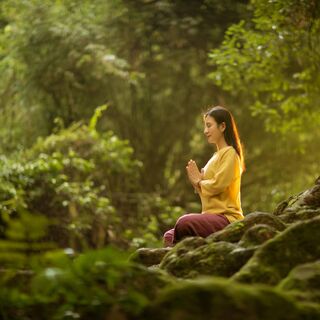
Sit or stand so the spine is comfortably tall and the belly and ribs are free to move, then let the shoulders drop and the face soften.
Do not deepen, slow, count, or hold the breath. The whole point is to let your body's automatic breathing carry on by itself while you simply watch it.
Follow the gentle movement, pressure, and warmth of each breath, and when the mind wanders, return to those sensations without forcing anything.
If you live with significant lung disease, avoid deliberately deepening or straining the breath, since this can raise the effort of breathing and worsen breathlessness in severe COPD {{cite:TECH_179_REF_012}}. Speak with a clinician before trying any effortful technique.
If a settled, heavier, quieter feeling arrives, let it come on its own. If breathing ever starts to feel effortful or you feel light-headed, pause and return to your ordinary breath.
When you finish, take a moment before standing, especially after a longer sit, so the body can reorient gently.
This information is educational and is not medical advice. This practice is not a substitute for professional care and should not replace prescribed medication or treatment for any medical or mental-health condition. If you are managing a health condition or taking medication, talk with a qualified health professional before changing your practice. If you are in distress or crisis, seek professional support.
| Yoga pranayama | People who want a structured, technique-led breath practice and, in COPD, improved walking capacity. | moderate EVIDENCE | Pranayama uses deliberate, often counted breath techniques (lengthened exhales, retentions, alternate-nostril patterns) drawn from yogic tradition, whereas Natural Breathing removes all counting and control. Pranayama actively trains the breath; Natural Breathing actively refrains from training it. |
| Middendorf's Perceptible Breath | People who want the same non-interfering approach in a secular, somatic framing without the Taoist context. | emerging EVIDENCE | Perceptible Breath is a Western somatic practice that, like Natural Breathing, treats non-interference as the route to healthy breathing, sensing rather than steering the breath. The main difference is framing: Perceptible Breath is a secular body-awareness tradition, while Natural Breathing carries the Taoist wu wei worldview. |
Not directly proven. No trial has tested Natural Breathing itself; the calming case rests on indirect research where relaxation-style breathing produced only small anxiety improvements (Volpato et al., 2015), and its parasympathetic, rest-and-recovery effect is an inferred hypothesis rather than a measured result (Hamasaki, 2020).
+
Not directly proven, though it is a reasonable, low-effort way to settle. Direct research on this specific Qigong practice is essentially absent, so the calming case leans on broader breathing-exercise studies conducted mostly in people with COPD (Hamasaki, 2020), (Yun et al., 2021). In that work, relaxation-style breathing produced only small gains in anxiety and mood (Cohen's d of about 0.26, a small effect) (Volpato et al., 2015), and the idea that unforced breathing shifts the body toward its rest-and-recovery state is a hypothesis inferred from diaphragmatic-breathing research, not something measured for Zi Ran Hu Xi. Read it as gentle settling supported indirectly, not a proven or certain calming treatment.
Limited and indirect. No trials have tested Zi Ran Hu Xi itself for anxiety; the closest signal is a meta-analysis of relaxation techniques in people with COPD that found only a small anxiety benefit (Cohen's d = 0.26, a modest average reduction) (Volpato et al., 2015). Treat it as early general guidance, not proof.
+
Limited and indirect. There are no direct trials of Natural Breathing for anxiety, so the evidence is borrowed from broader breathing and relaxation research rather than this specific practice (Hamasaki, 2020). A meta-analysis of relaxation techniques in people with COPD found a small anxiety benefit (Cohen's d = 0.26, a small effect size), but results across reviews were mixed and the participants were a clinical respiratory group, not general adults with anxiety (Volpato et al., 2015), (Yun et al., 2021). Overall the signal is low-to-modest and suggestive, not established proof that it treats anxiety.
Possibly, though this is a hypothesis rather than a proven effect. Slow, unforced breathing is thought to shift the autonomic nervous system toward its rest-and-recovery branch, the parasympathetic system, which is what calming refers to (Hamasaki, 2020).
+
Possibly, though this is a hypothesis rather than a proven effect. The proposed mechanism is that letting the breath settle into a slow, unforced rhythm shifts the autonomic nervous system toward parasympathetic activity, the rest-and-recovery branch that lets the body stand down from alertness (Hamasaki, 2020). That idea is drawn from broader diaphragmatic-breathing research rather than from trials of Zi Ran Hu Xi itself, and calming markers like heart-rate variability or cortisol have not been measured for this specific practice. It is not a treatment for any diagnosed condition.
Because when you stop steering the breath, unforced slow breathing is thought to shift the nervous system toward its rest-and-recovery branch, the parasympathetic system, so the breath lengthens on its own (Hamasaki, 2020). This is a reasonable hypothesis rather than a measured effect for this specific practice.
+
Because letting go of control appears to let the autonomic nervous system settle toward parasympathetic activity, the rest-and-recovery mode that eases alertness, so breathing lengthens without effort (Hamasaki, 2020). Measured slowing has been seen when people shift into deliberate diaphragmatic breathing, where respiration slows while lung volumes and oxygen saturation rise, but that was studied in COPD patients and healthy adults, not Zi Ran Hu Xi itself (Cancelliero-Gaiad et al., 2014). So treat the settling you feel as a plausible mechanism drawn from broader breathing research, not a proven effect of this technique.
Use care. For most healthy adults, Natural Breathing is low risk because it only lets the breath settle on its own. But if you have severe COPD or another significant lung condition, keep the breath gentle and unforced, and check with a clinician before trying any effortful breathing technique (Vitacca et al., 1998).
+
Use care. Natural Breathing itself asks you to leave the breath alone rather than force or deepen it, which keeps it gentle for most people. The specific concern is effortful breathing in significant lung disease: in severe COPD, deliberately deepening or straining the breath has been shown to raise the work of breathing and worsen breathlessness, and to be less mechanically efficient than natural breathing (Vitacca et al., 1998), (Gosselink et al., 1995). If that describes you, keep the breath soft and natural and speak with a clinician before any effortful technique. This is a practice-informed caution, not treatment or a substitute for clinical care.
Sit or stand comfortably tall, then let your breath move on its own without deepening, slowing, counting, or holding it, while resting your attention on the movement, pressure, and warmth of each breath. Ease out slowly when you finish (Chaitow et al., 2013).
+
Find an easy upright posture, let the shoulders and face soften, and allow your body's automatic breathing to carry on by itself while you simply watch it. When the mind wanders, return gently to the breath sensations rather than forcing anything, and take a moment before standing when you finish. If you live with significant lung disease, keep the breath gentle and unforced and check with a clinician before any effortful technique, since deliberately deepening the breath can worsen breathlessness in severe COPD (Chaitow et al., 2013), (Vitacca et al., 1998).
Often very little at first, and that is normal. Many people notice the body growing heavier and steadier, the breath slowing without being pushed, and tension in the shoulders or jaw beginning to ease. Some feel a quiet alertness, others simply a less busy mind.
+
Often very little at first, and that is completely normal for this practice. A first session can feel like little more than sitting still, with the body settling, the breath slowing on its own, and tension in the shoulders or jaw softening. Some people notice a quiet alertness while others just find the mind less busy, and both fit the practice. The settling tends to deepen with repetition rather than arriving all at once, so a low-key first session is not a sign you are doing it wrong.
The key difference is effort. Natural Breathing leaves the breath alone and lets your automatic system set the rhythm, while deep belly, or diaphragmatic, breathing deliberately deepens and directs the breath into the abdomen to reshape the pattern (Chaitow et al., 2013).
+
The key difference is that Natural Breathing does not steer the breath, whereas deep belly breathing does. In Natural Breathing you hold an easy posture and let the autonomic system breathe the body without deepening, counting, or holding, so it feels soft and self-arising (Chaitow et al., 2013). Deep belly breathing, also called diaphragmatic breathing, instead actively draws breath low into the abdomen to change the pattern; worth noting is that in severe COPD this effortful, directed pattern was measured as less mechanically efficient than spontaneous natural breathing, so directing the breath is not automatically better (Gosselink et al., 1995), (Gosselink et al., 1995). Neither approach treats a diagnosed condition.
Cited in: Faq, Research, Use with care, Who should use care
Rik Gosselink, Robert Wagenaar, H.N.A.J. van Rijswijk, A. J. Sargeant, Marc Decramer, Gosselink R A (1995). Diaphragmatic breathing reduces efficiency of breathing in patients with chronic obstructive pulmonary disease.. https://doi.org/10.1164/ajrccm.151.4.7697243
Cited in: Comparison, Faq, Research
Rik Gosselink, Robert Wagenaar, H.N.A.J. van Rijswijk, A. J. Sargeant, Marc Decramer (1995). Diaphragmatic Breathing Reduces Efficiency of Breathing in Patients with Chronic Obstructive Pulmonary Disease. https://doi.org/10.1164/ajrccm/151.4.1136
Cited in: Comparison, Faq, Research
Eleonora Volpato, Paolo Banfi, Sheena Michelle Rogers, Francesco Pagnini (2015). Relaxation Techniques for People with Chronic Obstructive Pulmonary Disease: A Systematic Review and a Meta-Analysis. https://doi.org/10.1155/2015/628365
Karina Maria Cancelliero-Gaiad, Daniela Ike, Camila Bianca Falasco Pantoni, Audrey Borghi‐Silva, Dirceu Costa (2014). Respiratory pattern of diaphragmatic breathing and pilates breathing in COPD subjects. https://doi.org/10.1590/bjpt-rbf.2014.0042
Cited in: Faq, Research, What happens in the body
Hidetaka Hamasaki (2020). Effects of Diaphragmatic Breathing on Health: A Narrative Review. https://doi.org/10.3390/medicines7100065
Cited in: Benefits, Faq, How it works, Research, What happens in the body
Anne E. Holland, Catherine J. Hill, Alice Jones, Christine F. McDonald (2012). Breathing exercises for chronic obstructive pulmonary disease. https://doi.org/10.1002/14651858.cd008250.pub2
Nutsupa Ubolnuar, Anong Tantisuwat, Premtip Thaveeratitham, Somrat Lertmaharit, Chathipat Kruapanich, Witaya Mathiyakom (2019). Effects of Breathing Exercises in Patients With Chronic Obstructive Pulmonary Disease: Systematic Review and Meta-Analysis. https://doi.org/10.5535/arm.2019.43.4.509
Cited in: Research
Ruisheng Yun, Yiwen Bai, Yan Lu, Xubo Wu, Shin‐Da Lee (2021). How Breathing Exercises Influence on Respiratory Muscles and Quality of Life among Patients with COPD? A Systematic Review and Meta-Analysis. https://doi.org/10.1155/2021/1904231
Editorially curated. Tracks are not themselves clinically studied; evidence on the page applies to Natural Breathing as a technique.
Explore guided sessions to deepen your Natural Breathing technique.
Beginner content for Natural Breathing

★ 4.7
·
Guided
·
8 min
Francesca J
How hard is Natural Breathing?
Natural Breathing should sit on the gentlest end of Taoist breathwork because the practice is defined by letting breath happen, not by adding force, sequencing, or strong method structure.
2
Mental Effort
2 / 4
▾Emotional Depth
1 / 4
▾Physical Intensity
1 / 4
▾Prior Knowledge
2 / 4
▾