Hey there everybody,
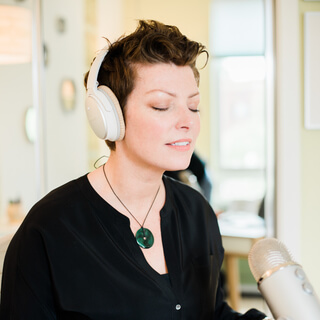
This is Kristen from Teaching Balance and I am here with you with this week's mindfulness meditation practice.
We are now in the month of November,
Which is crazy.
And it just seems pretty right for us to have a theme for November around the idea of gratitude.
It is what I typically do and it really honestly is just because it's on people's minds.
When we have Thanksgiving towards the end of the month,
People are starting to think a little bit more actively about all the things that they have to be grateful for.
And you could frame those as blessings in your life,
Things that are going well,
Even if it's just a positive thing,
Whatever it might be.
We tend to allow ourselves to acknowledge them a little bit more at this time of year because of the holiday of Thanksgiving.
And I also feel like it's a really good time to do it because we are continuing into that sort of winter slide where,
Not that it's a bad thing,
But sometimes our optimism and our view of the world may feel a little less sunny,
I guess you could say.
And so that's why for the specific theme for,
Or I guess you could say invitation for this week,
I wanted to just get a little bit more into that connection between expressing gratitude or blessings or whatever it might be and how that actually has a positive impact on us psychologically.
Now there have been books written about this and the one that I'm specifically thinking of that I'm for my own purposes referencing is called,
I think it's called the Happiness Advantage.
That's what it's called.
And the author's name is Sean Acor,
I think.
A-C-H-O-R.
He has a really good TED Talk.
I've actually also been privileged enough to be on a webinar with him.
He is really just so knowledgeable and also such a dynamic speaker.
And one of his primary,
I guess you could say,
I guess,
Encouragements,
Invitations to people is for all of us to allow ourselves to get into the habit of basically counting our blessings or focusing on the good things.
Now there's a lot to this so I'm going to really just sum it up as succinctly as I can.
As you know,
We are about to sum it up and I'm like,
Let's talk about evolutionary psychology.
But here's the idea.
As a result of our ancestors and evolution,
We have become conditioned physically to scan for threats.
That's just how we are predisposed.
And while we don't necessarily have to worry about scanning for a tiger coming at us to eat us on the savanna like our ancestors may have,
We are still in that physical space where we're constantly scanning for threats,
Problems,
Things to make better,
Things to adjust,
Things to fix.
And we've talked about that in some way.
Because that's our predisposition,
We tend to emphasize and give more mental space,
Real estate to problems,
Challenges,
The things that are upsetting us,
Than we do to the good things.
If it's good,
That's great.
Moving on.
And that's because it's not necessarily,
Of course,
Being predisposed to discount it or not give it the attention and time that is actually psychologically in our best interest.
But it's just what we do.
Okay,
Next.
Moving on.
Let me keep looking for the potential problems.
And so his point in that book,
The Happiness Advantage,
Is by getting into this habitual practice of listing,
Perhaps at the end of your day with your family or with a friend or online,
If that's where it feels most appropriate to you,
Three good things that happen to you.
What that exercise does,
Particularly when it becomes a regular practice,
Is it,
I guess you could say,
Hacks this predisposition to be able to list all the bad things that we naturally would be more easily prone to do.
And instead,
Your mind both consciously,
Because you're making the list,
And also subconsciously,
Because if this is a regular practice,
Now your mind knows that it needs to come up with these things every day down the future,
That it's going to look for them.
And therefore,
It is going to have a positive impact on your outlook.
You will be more predisposed to savor and appreciate and be present to the good things in your life,
Which is actually very nourishing,
To go back to our theme from last month.
And it really does help us to stay in a more positive state of mind,
Which has this very productive positive cycle as it goes forward.
I didn't explain that as well as I would have liked,
But there it is.
Now in this month of gratitude for this particular week,
You guessed it,
I'm going to encourage you if you care to,
To every day just come up with three,
Or if you want to get crazy,
Maybe five good things that happen to you each day.
And they can be very little.
Maybe the hot water heated up faster than usual,
Or maybe the traffic wasn't quite as hideous as it usually is,
Or whatever it might be.
But I think you'll find that as you dig a little deeper,
And they always have to be novel,
They have to be new each day,
It pushes you to really look for the good in your life,
Which is really beneficial to us in so many ways.
So one of the things that's also very good in your life is having a meditation practice.
So let's go ahead and get started.
I'm going to set my timer.
And I think I might weave this in a little bit.
Now if you're just not feeling that,
That's fine.
Just keep doing your regular practice.
That's not a problem.
But I think I want to play with this a little bit.
So we'll be present to our mindful awareness as we always are during our meditation,
But I'm also going to invite you to bring in some thoughts,
And then you'll let them go.
So let's go ahead and get started.
Closing your eyes,
Or lowering your gaze,
Whatever you prefer.
Bringing those deep,
Delicious belly breaths.
And if for some reason deeper breathing is just not quite as accessible to you today,
Remembering that's not a problem.
If you can,
Maybe just elongating each inhale and exhale for a little bit,
Doing what feels most appropriate to you and trusting yourself.
You know the anchors.
You can rest your attention on the breath or the body or sounds.
So I'm not going to prompt you with that.
But instead,
Every couple of minutes I'm going to check in and prompt you with something else.
So let's go ahead and just allow ourselves to settle and rest our awareness in whatever present moment anchor feels easy for you right now.
Core external Bilag file.
.
Letting go of any expectations just allowing yourself to rest in this awareness of how things are right now no matter how they may be so if you care to the first prompt that I'm going to invite you to reflect on is bringing to mind one good thing that has happened to you in the last couple of days if you're fortunate there's probably been many but I want you to notice which one comes to mind right away and for that one that came to mind quickly not evaluating it or comparing it to anything else or deciding if this is the one you should pick just allowing it to pick you I suppose and for a few breaths just allowing yourself to see whatever it was that happened in your mind's eye maybe you waking up after a good night's sleep or a kind word and then after a few breaths going ahead and letting that go coming back once again to either the breath or the body or sounds coming back into that restful self awareness mindful awareness of whatever's happening in this moment you're going to notice that you're going to be feeling a little bit more relaxed and you're going to feel a little bit more relaxed and you're going to feel a little bit more relaxed and once again I'll prompt you to bring to mind a different good thing that has happened to you that you experienced in the past few days seeing what comes to mind right away not judging it as being worthwhile or not and if you're finding it's not quite coming up perhaps lowering your standard of what good exactly means and that could be a much smaller tiny good thing and whatever arises for you with a span of a few breaths allowing yourself to recall that good thing hear whatever sounds occurred picture what you remember happening any other sensory experiences that might be associated with it and after your next inhale and exhale once again letting that go coming back to resting your attention on the breath or body sensations or the sounds inside the room or outside the room once again.
.
.
.
.
And then lastly for this final minute that remains bringing up yet another good thing that you experienced or happened to you in the past few days and I'm going to invite you to really savor that good thing splash around in it so to speak and allow yourself just to bring this mindful awareness to that memory and allow yourself to be very deeply present to it until the final bell.
.
.
.
.
.
.
.
.
.