In this video we'll be doing the marching movement.
So again,
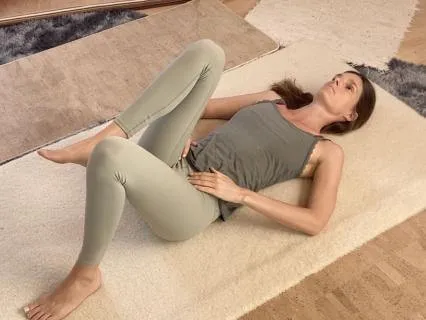
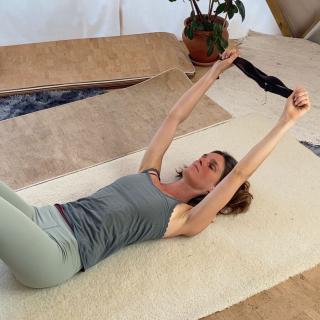
Come lie on your back in this constructive rest position with your knees bent and your feet on the ground.
Give yourself the support you need for your back and your head.
So you can place a pillow below your head if your chin is tilting up.
Or you could place something below your whole torso in your head.
Just soften the pressure for your back.
You can have your arms alongside your body or your hands on your belly.
And then the movement that you're going to make is lift your knee up and bring it in the direction of your chest.
So you can start with the right leg.
You just lift your knee off the ground.
You bend it towards your chest.
And you put it back down again.
And you fully relax.
You totally let go of the movement.
And then you do it again.
And it's not about making a big movement.
Or pushing your knee into your chest.
It's here where you're going to explore the movement of your leg bone in the pelvis.
In a range of movement that does not increase discomfort or pain.
So first,
Can you feel or imagine your leg,
Your femur?
And your pelvis.
And how this femur is moving in your pelvis.
It's the movement that I showed with the skeleton in the introduction video.
And can you sense that in your body?
And then look at whether you're making the movement with just your leg.
Or if you feel that your pelvis is moving as well on the ground.
As you're moving your right leg and putting it back down on the ground allowing it to fully relax Sense your sacrum and your buttocks.
And notice if there's any weight shifting there or not.
And notice what's happening in your belly.
In your shoulders,
Your jaw.
Notice if they're trying to get involved.
If your shoulders are kind of rounding forwards,
Bringing your chin up.
Or whether you feel that your belly is gripping as you make the movement to lift the leg up.
So just feel what else is happening besides the movement of your right leg.
That leg bone.
Thinking about the bone,
Not so much the muscles.
In the pelvis.
And what can you let go of?
Of extra movement that's happening?
To just make that movement more pure.
Or what is your body recruiting to support you in being able to make this movement?
And can you become aware of that and find ways to release that?
Do you feel your back arching?
Or can you keep the support of your back?
Are the connection of your back with the ground the same?
And not by pushing it down or by engaging other muscles to brace it or to hold it in place.
But because it's relaxed.
And it's just not getting involved in the movement.
It stays quiet.
And if you can look in a mirror or record yourself or use Zoom or whatever way where you can see yourself.
You can also place your hands on the pelvis bones,
How I have them here.
And you can either look Or you can feel below your hands.
As you lift up your leg,
Whether there's movement happening there.
So as you can see now,
The weight is shifting.
My left hip is coming up.
And see if you can find support of the ground.
Support through your left foot.
Support through your back.
Through your shoulders with the ground.
And just from a place of relaxation,
Lift up the leg and see what happens.
Allow movement to happen if it wants to.
So if there's a little twist happening,
Then that's fine.
Don't try to prevent it from happening by bracing.
Because then when you brace or when you create tension to fix your pelvis in place.
You're creating more tension and that's a compensation and we're not working on trying to create more compensations.
So that's not our goal.
Because then you're just compensating a compensation,
Which is not helpful.
So just notice what happens.
And if there's movement,
Then that's okay.
And then take a moment to rest.
And in this rest,
Notice if there's any residual tension in your shoulders or in your belly or wherever.
That is softening.
Because sometimes.
.
.
When we're in the movement,
Tiny tensions are building up.
And then as we stop the movement,
We notice how they let go.
So again,
Just become aware of what happens after you stop the movement.
And you can maybe notice that little tension patterns.
That creeped in.
That are now letting go.
And then change legs.
Now bringing the left leg up and lifting it towards the chest.
And then bringing it back down again.
Bringing it up.
Knee towards the chest in a very easy non-forced way and then bringing it down again.
The lower leg can stay fully relaxed so you don't have to.
.
.
Keep your leg at a 90 degree angle.
Or flex your foot or anything.
It's really about the upper leg bone moving in the pelvis.
And can you feel that?
Bringing your awareness to that joint.
Sensing the movement inside of your body.
Of those bones relative to each other.
It's as if there is a rope on your knee that lifts the knee up.
Brings it towards your chest.
Without pushing it all the way in,
We drown your spine.
It's just about sensing the movement and making the movement and then allowing your leg to go down again.
It's not about going into a stretch.
Making a big movement.
And again,
Notice how is the movement on this side.
Is it easier or more difficult?
Is your pelvis moving?
Or is it staying quiet?
Or are you bracing?
In your belly,
In your shoulders,
Your jaw or your face.
So it might be in a very different location where bracing is happening.
Compared to where you're moving,
Which is interesting to notice.
So what's happening?
What can you feel?
Or if you're using a mirror,
What can you see?
Because sometimes it's our natural way of moving.
And that's where we don't feel that it's compensated.
But then when we look at it.
And we see that there's other movement happening.
Then that brings our awareness to the actual compensation that's occurring.
And then finally we can become aware of that.
Which without a mirror it would just be This sense of,
You know,
This is how I move and this feels easy.
And sometimes the uncompensated movement,
Like the pure movement that we're going for now,
Can feel strange because it's new and it's a different way of moving.
So that it feels almost maybe uncomfortable.
Or at least different from what you're used to.
So that's why using a mirror or using a way where you can see yourself move.
Or just even by looking at yourself.
As you're bringing your gaze down.
That can be very helpful in understanding.
What's happening and seeing your movement and seeing if what you think you're doing is actually what's happening or if there's other things happening.
Again,
Noticing if you can feel the support of the ground below.
Allowing your body to rest into that.
Noticing if that maybe shifts anything.
And just bringing your knee up and down.
And noticing what else in your body is happening.
And then take a rest.
Notice if there are any tensions that are letting go.
Or anything else that you can notice after making the movement.
And that could also be a sense of frustration,
Your mind becoming busy with.
.
.
This idea of,
Wow,
There's so much happening and I'm doing it all wrong or I'm doing it all right and it's great.
And I feel good.
So just notice What's happening in your body,
In your mind?
There's no wrong or right.
It's just what is and can you notice that?
Be curious about that and explore that.
And noticing whether what you've done.
Has been useful or not.
How does your body feel after making this movement?
And how is your awareness?
How do your legs feel?
How do your pelvis feel?
How is your awareness?
Of those areas.
Has there been a change?
And maybe there's a change in awareness of your lower back.
And of your belly or other parts of your body.
So even though we've just moved the leg bone in the pelvis,
Notice if there are any other areas in your body that now feel different.