As always,
If anything doesn't work for you,
Something doesn't feel right to you,
Please find a variation,
A modification.
Remember,
This is your practice.
All right,
Let's get started.
We'll be doing some poses,
Just typical yoga poses as well as some movement on the roller.
Just to sort of get some movement or find a good area.
But then when we settle in to hold the pose,
It's going to be around five minutes.
And that's when we get a really good release.
So we're going to get into a pose for the net.
Using the blanket.
So come off of whatever you've been sitting on.
Take one of your blankets.
You can also use a towel if you don't have one of these blankets.
Start in this.
Shape pretty much the width of your mat almost And if there's fringe,
Put it at one end of your mat and start to roll the blanket nice and tightly.
Smoothing out any wrinkles as you go.
It'll feel better once you get there.
And roll it about halfway.
Smoothing it out as you go so that you end up with a rolled blanket.
Something like this,
Just about.
The diameter of the width of your hand.
Now if you have a shorter neck,
You might need to unroll it.
If your neck is longer,
You might need to roll it thicker.
We're going to lay our neck over the rolled blanket.
Head is going to be on the other side.
It may touch the unrolled part.
It might not.
So start with your knees bent.
Lay down on the blanket Keep your knees bent initially.
So once you're.
.
.
Positioned with your neck on the blanket.
Make sure that your shoulders are not on the blanket.
And once your.
.
.
Okay with the pressure and the position.
Straighten one leg and then the other.
And as you do so,
You might feel.
.
.
A stretch or an elongation.
In your neck.
So once your legs are strained,
Relax your feet and legs.
Relax.
Your hip.
Your upper body.
Soften into your shoulders and arms.
Allow your head to be heavy.
You may feel pressure in your neck but there should not be anything sharp.
And we're going to focus on our brow.
You might notice your lower belly gently expanding.
If you would like,
You could place a hand on your lower belly.
And breathe in and out through your nose.
Often when we're holding.
In our body,
Holding tension,
Tightness,
And long-held stress.
It's sort of a.
.
.
Form of control,
We're trying to hold on.
And to counter that and to release the tension,
We need to surrender.
We need to relax and let go.
So as you inhale through your nose,
Just invite that breath to fill your body.
And as you exhale,
A little bit longer than your inhale.
Invite your body to surrender.
Surrender into gravity.
Release into the props beneath you.
Sinking into your mat.
Allow your head and neck.
To sort of melt over that rolled blanket.
Encouraging,
A softening with each exhale.
You might notice your shoulders.
Dripping a little closer towards the mat.
With each exhale,
See if you can notice a little bit of release happening somewhere in your body.
Soften your jaw.
Each exhale You can either breathe through your nose or sigh out your exhale.
And then close your lips to inhale.
And again,
Whenever you want,
Sigh it out.
Encouraging release.
We'll be here for just two minutes.
Few more minutes.
Head is heavy.
Shoulders,
Upper back.
Soft and relaxed.
Surrender into gravity.
And then just a little variation can always just stay here with your head in a neutral position.
Or Take an inhale here.
And as you exhale,
Ever so slightly,
Begin to turn your head.
To the right.
So you might feel a little more pressure to the right side of your cervical spine.
Take a few breaths here.
And on your next inhale,
Slowly bring your head back to center.
And exhale ever so slightly.
Turn your head slightly to your left.
Getting a little more pressure on the left side of your cervical spine.
Breathe here.
Longer exhale.
Slowly on your next inhale,
Bring your head back to center.
Take a few more breaths here.
Take one more nice deep inhale.
And sigh out your exhale.
Let it go.
Come out.
Begin by bending one knee and then the other.
Bend your arms.
Shift your hips slightly to one side.
Keep your head on the blanket.
And roll over to one side for a moment.
And then use your hands and arms,
Press your way back up to a seat.
And pause.
Notice sensation.
Notice if your neck feels a little longer.
Maybe slowly take one ear to loosen your shoulder.
And then back up then over to the other side that feels good So we're going to find a little bit of movement before our next pose.
Take your old blanket and just set it aside and come into table pose.
Hands and knees.
You can have your toes tucked or released,
Whichever you prefer.
Lengthen through your spine.
Crown of your head,
Reaching towards the front of your mat.
Tailbone towards the back of your mat.
And then take a few rounds of Cat Cat.
Inhale arch,
Draw your heart forward into cow.
Exhale round,
Navel to spine for cat.
Move with your breath.
Start the movement from your tailbone.
Notice how your spine feels.
And then come back to neutral.
Pause here.
And then choose a pose.
That you prefer.
Maybe puppy pose.
Or maybe downward facing dog.
Move your hands slightly forward,
Tuck your toes,
And lift your hips up and back for down dog,
Or your variation.
Notice how this pose feels through your upper back,
Shoulders.
You can pedal your feet,
Whatever feels good.
Might bend your knees a little or a lot.
And just remember how this feels.
Then lower your knees and come back to a seat.
Our next pose,
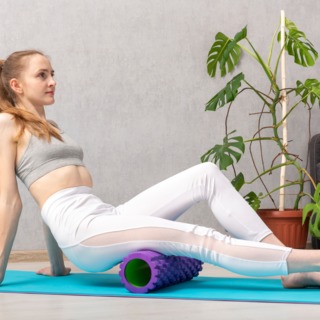
We're going to use the roller and lay on it to encourage our upper back and shoulders and whole spine to relax and release.
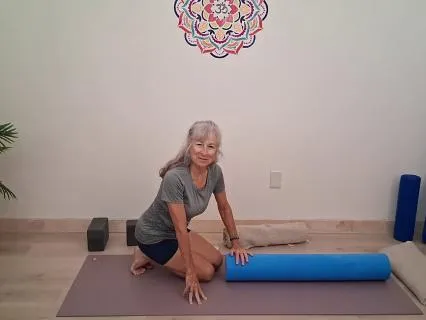
So if you have a long roller,
You can lay completely on it with your sacrum on one end and your head on the other.
If you have a short roller,
You'll want to use a couple blocks.
And then make sure your head and upper body is on the short end of the roller.
So I'll demonstrate that after.
Also,
If you're someone that if you sit on the roller,
And you feel dizzy.
Or just like you don't have enough control of balance.
Wait and do the second option with the blocks and Whether your roller's long or not,
You still might want to use the blocks.
If you have a long roller,
Scoot to the end of your roller so when you're sitting here with your knees bent and your feet wide looking down you can't see the roller.
And then hands on either side.
Start to walk your hands back.
Fingers towards your feet,
Bend your arms.
And then maybe come onto one elbow and then the other.
And make sure your head is on the roller.
You can use your elbows.
Or arms in whatever way makes sense to you.
So just pause here.
If this feels comfortable,
Just pause here while I demonstrate.
The other option.
If this is working for you,
Just get a little extra time.
If you're coming off of the roll or if you're like,
No,
I don't want that.
Just shift your hips off.
So if your roller is short.
Take both blocks.
And place them at the end of the roller.
And you can adjust the blocks whatever distance you need.
So you're going to sit on this block.
And if you need to,
If you're longer,
You might have to move the roller or your block slightly.
Sometimes I like to have that second block.
Right up against the roller.
So it doesn't tend to move as much.
And then again,
Lower yourself down slowly.
Make sure the roller's where you want it.
And that your head and upper back and shoulders are on the roller.
So this is another option.
And it can feel a little more stable.
So either option.
So I'm gonna come back to my long roller.
If you're comfortable there,
Stay there.
So lots of options.
And again,
If you don't have a ruler at all,
Roll one of your blankets nice and tightly all the way and you can lay on that So again,
Coming to the end of the roller,
If you're doing that.
Lower yourself down thoughtfully.
Making sure your spine is pretty much on the roller.
So once you're in position,
Keep your knees bent,
Feet wide.
Reach your arms up to the sky and notice your shoulder blades moving away from the roller.
And then just allow your shoulder blades and shoulders to drip over the roller as you bend your arms.
And extend your arms out.
You can keep your arms wherever they feel comfortable.
To get a better stretch,
Slowly start to move your arms.
Maybe from like a 45 degree.
To like a T-shape.
And notice if you feel a stretch like through your shoulders and pec area.
Maybe into the armpits.
You might move your arms slowly up,
Sort of like doing a snow angel.
And find the spot that you're like,
Oh,
There's a stretch.
And hold.
So if your arms are extended out,
A way to get a little bit deeper stretch is to consciously think of elongating through your arms and hands and fingers.
Like your arms are being pulled in opposite directions.
And then soften into that.
So allow your shoulders and shoulder blades to begin to relax over the roller.
And notice your spine.
String a pearl.
What part of your spine is touching the roller?
What part of your spine is not making contact with the roller.
And see if you can invite space between all your vertebrae.
Lengthening.
And inviting a little bit of a stretch into those shoulders,
The front of the shoulders,
Sort of like the front of your armpit.
Might feel the stress.
And again,
Notice your breath.
Keep your feet wide,
Knees bent for more stability.
Each exhale an opportunity to soften.
Mel.
Over the roller.
With each exhale.
Like your shoulders,
Upper back,
Or soft butt.
Melting over the world.
If you're feeling a release into your shoulders and arms.
You might want to move your arms a little further up.
For another release.
It might just be an inch or so,
Maybe a little bit more.
And then soften there.
I like to have the backs of my hands on the floor.
Invite a little more sense of openness.
Find what feels good to you.
Breathe in through your nose.
Longer exhale either through your nose or your mouth.
Soften.
Surrender into gravity.
Notice if you can invite your shoulders to soften.
A little bit more.
And again,
If you felt a release.
And not so much stretching anymore.
Maybe the arms move a little bit higher.
Making a bigger snow angel.
And one shoulder might feel different than the other.
So maybe one arm moves a little more than the other.
That's okay too.
Arms might be more straight or more bent.
Whatever feels best to you.
Begin to gently deepen your breath.
Sighing out your exhale.
And then maybe start to bend your arms,
Slowly bringing your arms back.
Closer to the roller.
Soften there.
And then bring one hand behind your neck and head.
Lift your head off.
And then hand down beside you,
Shift your hips off the roller.
Or would any way make sense to you to come off your roller.
And slowly press your way up to a seat.
And pause.
Setting your props away so you have room to sit.
And notice what you're feeling.
Notice your upper back and shoulders.
Notice your neck.
Maybe even down your whole spine.
Notice if there's any sense of energy.
Flow of energy.
Expansion.
Open this.
Feel like you can flower.
Drink some water.
Okay,
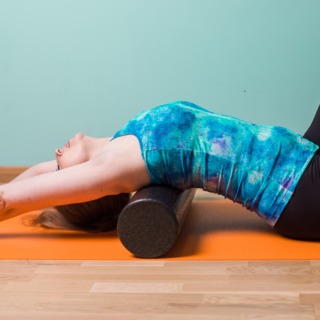
Our next one is going to be getting into the upper back and shoulders with the roller transverse.
Across our map.
You'll probably want a block.
At the end of your mat,
Maybe on the medium setting,
Maybe on the low setting.
And have one of your blankets at the end of your mat.
Either for your arms or for your head if you do one of the other options.
So I'm going to demonstrate a couple different variations you can do.
If you have the roller position sort of behind your heart.
With your arms well above the roller in this area.
Going to get a pretty good stretch And I think that's pretty deep.
If you want more,
You might position the roller a little higher So your arms are barely on the other side of the roller,
And I find that's a little bit deeper.
Depending on the type of roller you have,
Whether it's a soft roller.
Or a smaller diameter roller one might feel better than the other so i'm just going to demonstrate the different options first decide which one you want again we'll start with the knees bent maybe elbows on the roller.
And position it first just about in your mid-bath.
So that your arms and shoulders are well above the roller.
And then one hand behind your head.
Reach your other hand for the block,
Maybe start with it.
On the medium setting.
And.
.
.
Notice how this feels if your arms are in a T shape.
Or goalpost arms with maybe your hands resting on that blanket.
See how this feels.
I think this feels really good.
If you're like,
Oh,
I'm not getting enough.
The other option is to move the roller a little bit higher.
So your shoulders are still above the roller,
But not as much.
Taking the head back,
Maybe you decide to move the block lower.
Getting more into your throat chakra as well.
This can also feel great.
Maybe the arms are above your head again,
Bent or straight.
Resting the back of your hands on that blanket.
Now for me,
This feels almost a little too much in my upper back and shoulders,
Too much for me to hold for five minutes.
But if it's feeling like,
Yeah,
This feels great,
You can stay there.
So I'm going to readjust back to option one.
And once you're in position,
Will be straightening the legs.
If it's too much,
You can always keep your knees bent.
Position the block under your head.
Either medium or low setting and you can change it at any time.
So once you've found your position,
One leg straightens,
Then the other,
You might feel like the roller moves slightly,
That's okay.
Adjust as you need to.
Soften into your shoulders.
So you want your neck here to be fairly neutral.
Or to have a little arch in it like you're opening the front of your throat.
So if you feel like your chin is going too close towards your chest,
You might need to lower the block.
To the medium setting or just use a blanket if you want to go a lot deeper.
Lots of options here.
You may feel pressure on your upper mid back.
And also if the roller is too much,
You can always use your rolled blanket.
Instead of a roller.
Notice your breath.
And invite your body to melt over the roller.
If your arms are above your head,
And you want a little more.
Think of someone pulling your arms.
Away from your shoulders.
Just gently sort of straightening and then relax.
If it's too much,
You can re-bend the arms.
Again,
Maybe one shoulder has an issue,
That arm might be in a different position.
Soften and release with each exhale.
Notice your feet and ankles,
Or they relax.
Invite your legs to soften.
Invite your hips to be heavy and soft.
Envision space between each vertebra.
Invite your upper back to relax and melt.
Over this roller.
If you feel you've begun to find.
Or allow a release.
And you want to go a little deeper.
Option to Position your head a little lower,
Maybe lower the block.
Maybe reach your arms a little further away.
Mind your variation.
You might just stay where you are.
So we're getting compression and elongation.
In this pose to Release the fascia.
Some poses it's just more compression.
Some are more just elongation.
When we can get both.
We're inviting more release.
Elongating through your arms,
Fingertips gently reaching away from your shoulders.
While still being able to soften.
Into the shoulders and upper back.
Take a nice full inhale.
Sigh out your exhale.
If your arms are overhead,
Slowly bending your arms.
Bringing them so the upper arms are on top of the roller for a moment.
Rebend one knee and then the other.
Bring one hand behind your neck.
And as you lift your head,
Support your head with that hand.
And then maybe use your elbows and arms.
In whatever way makes sense to you.
To come back up to a seat.
And pause.
Notice how you feel.
I find that one to be.
.
.
A huge release into the upper back set your roller aside.
Set your block aside.
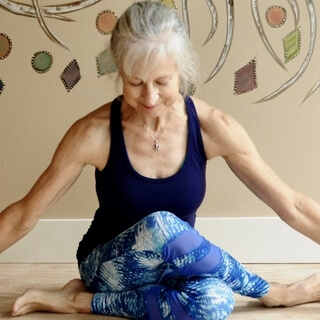
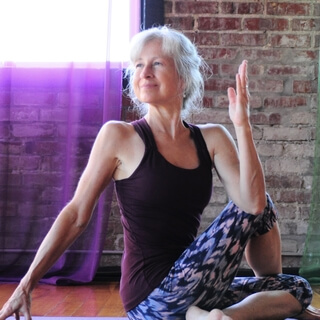
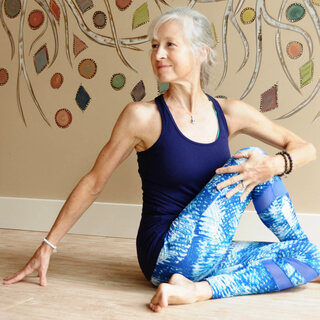
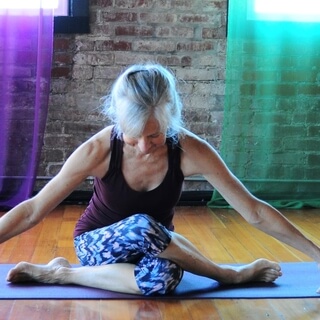
And we're going to come into a seated twist.
Extend your legs out in front of you.
Bend your right knee.
And cross your right foot over your left leg.
Bring your right hands behind you.
And left hand to the outer right knee.
Engage your left leg and ankle so you're pressing through your left heel.
Lengthen through your spine,
And as you exhale,
Twist to your right.
Lengthen the back of your neck.
Gently lift your heart.
You can have your right hands flat on your mat or fingertips.
Inhale to lengthen.
Exhale to twist.
On your next inhale,
Unwind.
We straighten that right leg.
And then we'll do the other side.
Both legs straight to start.
Bend your left knee.
Cross that left foot over your right leg.
Activate that right leg.
Press through that right heel.
Bring your left hand behind you,
Right hand to the outer left leg.
Avoid taking that elbow across because that is going to bring that right shoulder forward.
And we want to invite a sense of openness across the upper chest.
Just bring your right hand to the outer left leg.
Pressing your left knee into the hand and hand against the knee.
Lengthen as you inhale.
Exhale,
Twist to your left.
Looking slightly down so you're lengthening the back of your neck.
Breathe here.
Inhale,
Slowly unwind.
Coming back to center.
We're going to do just a little more movement into the side body.
So sitting in whatever position feels good to you.
Take an inhale.
Reach your left arm up.
And as you exhale,
Come into a side,
Bent over to your right,
Whichever side you're doing.
Lengthening and elongating through that upper arm.
You can look up straight ahead or down to release your neck.
Think of lengthening through that side body rather than how far you're going over to the side.
And you'll come up lengthening through that upper arm as you come up.
Pause.
Notice the difference between each side.
Lengthen Lifting the other arm.
Exhale,
Side bend to the other side.
Keep lengthening through that upper arm.
You can rotate through that wrist or hand or fingers,
Whatever feels good.
Make sure you're still breathing.
You Inhale,
Come back up and lower that arm down.
Notice how you And then come down onto your belly.
Into Sphinx pose for a few moments.
Forearms parallel,
Tops of the toes on the mat.
Elbows just about in line with your shoulders.
Press down into your forearms and hands.
Like you're isometrically trying to pull yourself forward,
Opening your heart.
Lengthen through your spine.
Gaze towards the top of your mat or in between your thumbs so you're lengthening the back of your neck lengthening through your spine and the front of your belly,
From your navel to your throat.
Couple more breaths here.
And then release hands under your shoulders.
Press yourself back up to table.
And come back into that pose you did at the beginning.
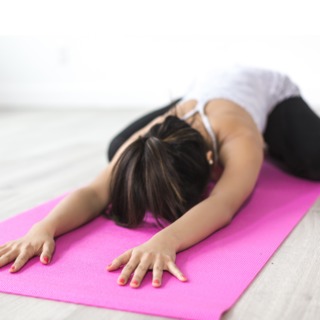
Either child's pose or melting heart pose or downward facing dog.
Bending your knees a little or a lot.
Notice how it feels now.
Notice any differences.
And then thoughtfully come out of that pose.
And make your way into your Shavasana.
Find your variation.
Settle into your final resting pose.
Invite your whole body to be heavy and soft.
Feet and legs,
Relax.
Notice your hip.
And invite your hips to release.
And be happy.
Visualize space between all your vertebrae.
Soften into your shoulders and arms.
Soften your lower belly.
Soften the area around your heart.
And allow your head to be heavy.
Relax and release your jaw.
Soften all the muscles in your face.
Especially around your arms.
And let go.
You Gently bring your awareness.
Back to being on your mat.
Notice your body.
Notice your breath.
And observe your mind.
When you feel ready.
Maybe wiggle fingers,
Toes,
Whatever would delight you.
Eventually,
Bend one knee and then the other and make a slow,
Thoughtful transition over onto one side.
Support your head with your bottom arm or prop.
And pause there.
And then press into your hands and arms and make your way back up to a comfortable seat.
Maybe keeping your eyes closed.
And with appreciation for your awareness.
And your focus.
Bring your hands together at your heart in Anjali Mudra.
The light in me sees and honors the light in each of you.
Namaste.
Thank you.
Notice how you feel.
Drink some water.