Welcome.
Thank you for joining me today for this myofascial release yoga practice.
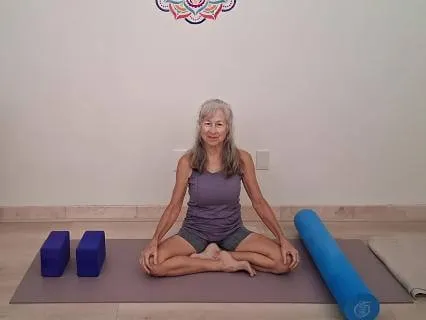
And today we're going to be using a foam roller.
You can have one similar to mine that's about 36 inches long.
You can also use a shorter one.
So in addition to the roller and two blocks,
You'll want to have maybe one or two blankets.
You can also use a bath towel or a beach towel.
Those can work great.
We're going to come to a seat.
And you might sit on a blanket so that your hips are up a little bit higher.
And just take a few breaths here.
You might close your eyes and begin to tune into your body.
So you might have a soft gaze or close your eyes.
Allow your lower body to be heavy.
Sinking your hips and legs into the support beneath you.
And gently elongate through your spine.
Reaching the top back of your head up to the sky.
So you can find a little bit of length in the back of your neck.
Notice your breath.
Soften your lower belly.
And allow your inhale to gently expand through your lower belly.
And as you exhale,
Just invite softness.
Softening through your shoulders.
And invite a sense of elongation.
From your ears to the.
.
.
Tops of your shoulders.
As if your shoulders are dripping away from your ears.
Notice how long your inhale is.
And see if you can gently extend your exhale.
A little bit longer,
Maybe by two counts or more.
Make sure you're not straining or forcing.
Breathe in and out through your nose.
Option for a soft ujjayi or ocean breath.
That makes your breath audible to you.
Two more breaths like that.
And then gently open your eyes.
And we're going to come into a little bit of movement before our first pose.
Extend your arms out beside you.
And we're going to get into the neck and side body a little bit.
So we'll do three movements on each side.
So as you inhale,
Taking your side ribs towards one direction and your head in the other.
So you'll feel a stretch in the side of your neck.
And as you exhale,
Slowly come back to center.
Inhale over to the other side.
And hands and arms wherever they're comfortable.
And exhale to slowly return.
So the hands on either side of you are just to give awareness so that you're not Dropping one shoulder too much on one side.
Focus here is probably in the side of the neck,
But you might feel the stretch in your side body as well.
Inhale slowly going over to one side.
I might pause at the top of your inhale.
And then exhale,
Slowly return back to center.
One more time on each side.
Keep that length through your spine.
And then return back to center.
So from here.
Or if you prefer,
In a table position,
We're going to come into a few cat-cows.
Take an inhale,
Draw your heart forward.
Exhale,
Navel to spine.
Now I like the seated pose for cats sometimes because I can sort of use my hands and really get a nice stretch through the upper back.
Find your variation,
Move with your breath.
Inhale cow.
Exhale,
Cat.
Inhale cow.
Exhale.
And then return back to neutral.
Notice how you feel just from that little bit of movement.
So if you like,
You can take a sip of water.
We're going to come into our first pose for the neck.
Just setting that roller aside.
Bring one of your blankets.
So it's about.
.
.
This shape.
Fringe towards one end from the folded edge.
Start to roll it.
And you're going to roll it about halfway.
Roll it nice and tightly.
And smooth out any of the wrinkles as you go.
It'll be more comfortable if you do.
So then you end up with a rolled blanket that's fairly firm.
Diameter is just about the width of your hand.
And you have some unrolled blanket real estate.
Where the back of your head may or may not touch.
So begin with your knees bent.
And bring your neck onto this rolled blanket and just pause there.
So before we straighten our legs.
We want to make sure the blanket is in the right thickness.
The right position.
So once you lay down and your neck is on the blanket,
Make sure your shoulders are not on the blanket.
The back of your head may or may not be touching the other side of the blanket.
That's okay.
If you have a shorter neck,
You might need to unroll the blanket.
If you have a longer neck,
You might need to roll it a little more.
And if your blanket is too squishy,
You might prefer to use a towel that will give you a little more density and support.
So once you're in the position and the blanket feels okay,
Straighten one leg and then the other.
Relax your arms.
Relax your feet and ankles.
We're getting compression and elongation.
Those are the two components.
As well as time.
For a longer lasting fascia relief.
So you should feel some pressure and maybe a sense of stretch as you straighten your legs out.
And then we're going to invite our body to soften.
And relax.
Little bit deeper.
With each exhale.
So allow your head to be heavy.
Allow your whole body to be supported.
By the blanket,
By your mat,
And the earth beneath you.
So you can either breathe in and out through your nose.
Or breathe in through your nose and exhale through your mouth like a soft sigh.
And anytime you want to encourage a little deeper release or Letting go,
Do that sigh,
Then exhale.
So we'll be here for about five minutes,
Maybe a little bit longer.
And then we'll come into a few variations and options.
Notice where you.
.
.
Observe any sense of holding.
Or tension in your body.
And as you inhale,
You might bring your breath.
Into that area.
Just visualize your breath.
Going to.
Maybe the area of your neck or your shoulders.
And then as you exhale.
Invite that area to soften.
To release,
To be a little bit heavier.
As you exhale and let go.
Let your feet and ankles relax and release.
Allow your legs to be heavy and soft.
Invite your hips.
To be heavy.
And relax.
Relax your torso.
Invite your shoulders and arms to soften.
Like they're melting towards the earth.
As best you can and invite your neck to relax.
And soften as you get this nice stretch So we're going to come into a variation now.
Or you can just stay where you are if you're really liking this position.
We're going to just gently turn the head one direction then the other.
But only slightly.
So take an inhale and ever so slightly turn your head to the right.
So you feel just a little more pressure on the right side of your cervical spine.
It's like your nose is going from 12 o'clock to 1 o'clock.
Inhale,
Bring your head back to center.
And exhale,
Slightly turn your head to your left.
Feeling the pressure more on the left side now.
Hat is heavy.
And then slowly inhale your head back to center.
And then bend one knee and then the other.
Pause.
Maybe shift your hips over to one side.
Keep your head on the rolled blanket initially as you roll over.
Keeping the head there.
And then maybe a hand under your head or hands and arms down.
Slowly press your way back up to a seat.
And pause.
Notice sensations.
Notice if your neck feels a little longer.
Or if there's any sensation even moving down into your upper back or shoulders.
Drink some water.
Sometimes just a little movement in your neck.
Maybe slowly taking your head over to one side and then the other.
Can feel really nice after.
Or you can slowly turn your head to the left or right,
Whatever's feeling good.
Maybe roll your shoulders,
Whatever your body wants.
Listen to your body.
So now I'm going to get into.
Releasing the upper back,
The shoulders.
I might release a little bit into the upper chest as well.
So set your rolled blanket aside.
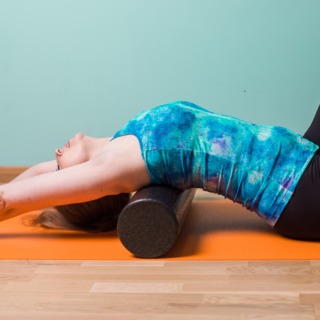
And position your ruler long ways on your mat.
So I'm going to show how to get into this pose if you have a long roller,
And then if you have a shorter roller,
I'll show you how to position the blocks if you have a shorter roller.
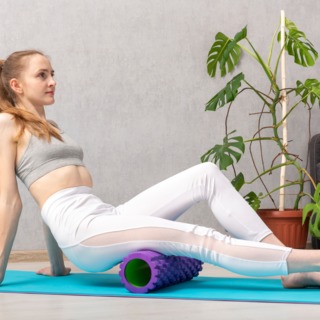
Start by sitting on the very end.
Further towards the end than you think you need to be.
So if you look down,
You can't see any rollers.
We want our head to be on the roller.
If your head is off the roller,
You need to scoot down or maybe use a block.
At the end of your roller to sit on.
And I'll demonstrate what that looks like in a moment.
So use your hands.
And then maybe scoot.
Your tailbone towards the end of the roller a little bit more.
Might come down onto your elbows.
Keep your feet wide and your knees bent.
One hand behind your head,
Make sure there's roller there.
And then let your head come down.
You might need to adjust your.
.
.
Shoulders or spine a little bit to make sure you're as centered on the roller as possible.
And keep your feet flat on the mat a little wide so that you have a little more stability.
So if this is feeling good and you're on a long roller,
Just stay there.
And then I'll demonstrate the other options.
So maybe your roller's just this long.
So you'll want to have a couple blocks.
And the block that's furthest away is where you're going to sit.
And then your upper back and head will be on the roller.
And because I'm not sitting on the roller,
I just have the first block sort of tucked up next to it so it doesn't roll away.
And you can move the block.
Further or closer,
Depending on the length of your roller and how tall you are.
So sitting on the block,
Blocks are on the low setting.
Again,
Lower yourself down onto your elbows.
Find that roller.
Hand behind your head and make sure your head is on that roller.
If you need to,
You might need to move the block down,
Scoot your hips down a little bit.
And make sure the roller feels like it's in the center of your spine.
Another advantage of this option.
Is if you feel unsteady on the longer roller.
Even if you have a longer roller,
You can put a block on one end of the roller and just sit on it so that you have more stability.
Make sure your head and upper back are on the roll.
Feet wide.
And allow your arms to go wherever they want to go.
And then from here.
As if you were a snow angel.
You can take your arms and move them out and up like you were making a little angel in the snow.
And find the position where it's like,
Oh,
There's a stretch or there's some tightness.
And then invite that sense of being stretched.
As if someone's holding your arms on either side of you,
Pulling.
Your arms in opposite directions.
And then see if you can soften.
So at any time.
You feel the need to adjust your arms,
Feel free to do so.
Encourage your shoulders to soften.
If you notice a release in your shoulders,
You might move your arms in a different position until you find another sensation of stress.
And pause there.
If you're not feeling any stretch into the shoulders.
Adjust your arms until you feel at least a slight stretch.
And of course if you have any shoulder injuries.
Modify as you need to and one arm or shoulder might be in a different position than the other especially if you have a issue going on in one side.
Notice your upper chest.
Same breath pattern in through your nose.
Either out through your nose or sigh out your exhale.
Urging your exhale to be longer.
You You might imagine your upper back and shoulders.
Melting over this roller.
So we have about another minute here.
If you've noticed a release in the arms or shoulders,
You might adjust the arm position slightly.
Just an option.
And sometimes when we do these myofascial releases.
The body just wants to move in a certain way.
And that can be referred to as unwinding.
Just continuing to release and let go of stored stress and past traumas.
Sort of like waking up in the morning and your body just wants to stretch.
What's that sort of sensation or feeling?
Like a yawn,
We don't try to yawn,
It just happens.
Sort of like that.
And then slowly.
Bring your arms a little closer towards your body if you had them out or up in another position.
Pause here for a couple breaths.
And then maybe one hand behind your neck.
To help support your head as you lift your head,
If you're on the long roller,
If your hips are on the roller.
Slide your hips off the roller.
And then make your way up to a C.
Notice what you're feeling.
From your head to your hips,
Notice any sensations.
Maybe even down your arm.
Great time to drink some more water.
So let's do the roller.
Perpendicular and bring your block to one end of your mat.
Position one block on the low setting.
And then maybe the other block right on top of it.
And this is just to start.
You might prefer this maybe too high,
In which case you might exchange the two blocks.
For one block on the medium setting.
And that's where your head is going to go.
But again,
You might start just to make sure you don't feel like your head is going back too much,
Which can cause anxiety.
If you're prone to anxiety,
You want to make sure that the head feels supported.
And then you can use one hand and adjust the blocks once you're there.
Come in front of your roller with your knees bent.
And we're going to position the roller just about at your mid back.
So you might use your elbows to sort of help you find that position just about at your mid back.
Shoulders and arms have room above the roller.
And one hand behind your head.
Other hand,
Making sure the blocks are where you want them.
Mine are a little too close so I've got to move them away.
And then lower your head onto the block.
You might just want to keep your.
Head on the two blocks.
Or if it's like,
Oh,
I want a little more openness into the chest or throat.
You might reach one block and push the other one away.
And make sure you're law.
If it's on that medium setting,
Make sure it's stable.
Make sure the back of your head.
Is supported and it doesn't feel like you're just on the edge of the block.
You might find that elongation through your arms.
Or you might goalpost the arms,
Maybe the hands are on the floor.
You're still feeling a nice stretch.
Option to straighten one leg and then the other.
I find I can relax a little more here.
It also feels like the roller moves up a little bit more into the upper back,
Which I find a little bit more doable to hold.
So find your variation.
If your shoulders don't like this position here.
You might bring your elbows onto the roller.
And explore.
What works for you there.
You might extend the arms out,
So part of your arm.
Is on the roller.
Be creative.
Find what your body wants.
You might also have a blanket nearby,
So if your arms are up overhead.
The backs of your hands.
Can be supported.
On that rolled or folded blanket.
Find your position.
And again,
Invite your body to soften.
And begin to release.
Head is supported.
And if this is feeling like it's just too much,
You can always roll your blanket all the way.
Rolling it nice and tightly.
And then use your blanket under your upper back and shoulder area.
Just like the same position where the roller is.
And then maybe have.
.
.
Another blanket to support your head.
Lots of options.
Relax the feet and ankles.
Relax your legs.
Allow your hips to be heavy and soft.
Notice the elongation through your spine.
And imagine you're melting over your props.
Shoulders softening.
Head supported.
Notice your breath.
And encourage that longer exhale.
Take a few more breaths here.
If your legs are straight,
Bend one knee and then the other.
One hand behind your neck.
Support your head as you lift your head.
And then whatever way makes sense to you.
To come off the roller.
Oh,
Coming back up.
And pause.
Notice what you're feeling.
Maybe drink some water if you would like.
And then set your roller and blocks aside.
And bring yourself into table pose.
Then move your left hand slightly forward on your mat,
Extend your right arm out to the side,
And we're going to come in to thread the needle.
Bring that right arm underneath your left.
Come on to your right shoulder.
Right side of your head.
And any variation with that left hand or arm.
This is a nice stretch for the upper back.
And should feel pretty good after being on that roller for over five minutes.
If the floor or mat seems too far away,
You can always put a blanket or a block under your head.
On your next inhale,
Press into that left hand,
Come back up.
From table pose,
Right hand moves slightly forward,
Extend your left arm out to the side.
And then thread the needle on this side.
Find your variation.
On your next inhale,
Press into that right hand.
And then we'll be coming into our show.
So position the roller under your knees,
Having your knees bent,
And come down onto your back.
And then use your feet onto the roller to move the roller away.
Maybe all the way,
Or maybe position the roller under your knees.
Or your lower legs or ankles.
This can feel real nice and support the low back.
This might be your Shavasana position.
So find your position for your final resting pose.
Allow your legs to be heavy.
You can always push the roller away if you start with it and then decide you don't want it.
Notice sensation in your body.
Invite your whole body to be heavy and soft.
You Take a nice inhale through your nose.
Exhale,
Sigh it out.
And let go.
You Gently bring your awareness back to being on your mat.
Notice your body.
Notice your breath.
And observe your mind.
And begin to make small movements,
Maybe wiggling fingers or toes.
And then bend one knee and then the other,
Drawing your knees in towards your chest,
Maybe giving yourself a little hug.
Stretching out that low back.
Maybe rocking side to side or whatever would feel good.
And then thoughtfully make your way over onto one side.
Support your head with your bottom arm or a prop.
And pause there.
And then slowly use your hands and arms and press your way back up to a comfortable seat.
And with appreciation for your awareness and focus,
Bring your hands together at your heart in Anjali Mudra.
The light in me sees and honors the light in you.
Namaste.
Thank you so much for joining me today for this myofascial release yoga practice.
I hope you enjoyed it and had some good releases.
Be sure to drink your water.
And let me know how you feel.