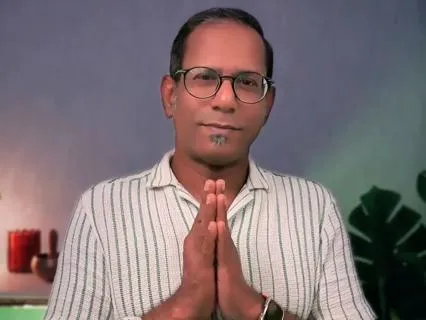
Namaste.
Have you ever told yourself that?
I'll begin when life becomes quieter.
I will start when I feel more disciplined.
I'll meditate when I have more time.
Or make the change.
When I feel ready.
And yet somehow,
The perfect moment never quite arrived.
There's always one more demand.
One more distracts.
One more reason to postpone what matters.
Patanjali begins the Yoga Sutras with a single word that interrupts all of this waiting.
A top.
Now.
Not tomorrow.
Not when the mind is calm.
Not when life is organized.
Not when you have become a better version of yourself.
THE FOREST SUTRA is Atha Yoga Anusasana.
Let's see its load.
Atta.
Yoga Anum Sasana.
A simple translation.
Now the teaching.
Of the disciplined instruction of Yoga begins.
Swami Sachid Ananda translates this as,
Now the exposition of Yoga is being made.
And he emphasizes that Patanjali is not offering abstract philosophy alone.
But direct instruction that's intended to be practiced.
Swami Vivekananda.
He explains this sutra very simply as,
Now concentration is explained.
His translation immediately points us toward Yoga as an inner science of attention and mastery of the mind.
But this first Sutra is much richer than it initially appears.
It contains only a few words.
Yet it establishes the attitude with which the entire path is entered.
Let's look at the key Sanskrit terms.
Atta.
Now.
The word ata means now.
But this is not simply a chronological now,
As though Patanjali was saying,
Now we shall begin chapter one.
But rather it carries the feeling of an auspicious beginning.
It suggests readiness.
As though the teacher is saying.
Now that you have a dive.
On all that.
Now that's something.
Within you is willing to listen.
Now that you are ready to move beyond mere curiosity.
Now the teaching can begin.
And this raises an important question.
What makes us red?
We often imagine that readiness means we should already be calm or disciplined or focused or we should be spiritually mature.
But perhaps readiness,
Perhaps being ready is much simpler.
Perhaps readiness begins when we become honest,
When we become honest enough to recognize that the way we have been living is no longer bringing us peace.
Or perhaps it begins when we notice that the same thoughts,
The same thoughts keep repeating.
Or the same emotional patterns keep returning,
Or the same fears keep shaping our choices,
The same reactions keep appearing in our different relationships.
And somewhere within us a quiet voice,
A quiet voice says,
There must be another way.
That moment is Adtha.
That moment is now.
Atha is the moment in which we stop postponing our inner life.
Atta is the moment.
We turned toward ourselves with sincerity.
Not because everything is perfect.
But because.
We are finally willing to begin.
The next word is Yoga.
And today the word yoga is often associated with postures,
Flexibility,
Exercise,
Even relaxation.
These all have value.
But Patanjali's concern is much deeper.
The Yoga Sutras are fundamentally concerned with the mind,
With consciousness,
With suffering,
With perception,
With practice and with freedom.
Swami Sachid Ananda describes Yoga as the science of understanding and mastering the mind.
Simply need to be admired intellectually.
So when Patanjali says that the teaching of yoga now begins,
He is not merely introducing a set of physical exercises.
He is introducing a disciplined path of inner transformation.
Yoga.
Will ask us to observe how the mind moves.
How we become caught in thought.
How we create suffering through attachment,
Through resistance,
Through mistaken identity.
And how we can gradually return to clarity.
And this is important.
Because the path does not begin by demanding that we change everything immediately.
It begins by asking us to become present.
To see.
To notice,
To become willing students of our own inner life.
I lose awesome.
Anusazh Saddam.
Teaching Instruction Discipline The Final Word Anusasana It can be translated as instruction or teaching or exposition or discipline.
It tells us something essential.
The Yoga Sutras are not only meant to be read.
They are meant to be followed.
To be tested.
To be lived,
To be practiced.
Swami Sachidananda makes this point very directly.
Without practice,
Words alone cannot take us to the goal.
And this is why the Yoga Sutras can remain relevant even in modern life.
They are not asking us to believe blindly.
They are inviting others to experiment.
Observe what happens when you become identified with the thought.
Observe what happens when you react from fear.
Observe what happens.
When you practice steadily.
Observe what happens when you release your attachment to a particular outcome.
Yoga becomes a laboratory.
And your life,
Our life,
It becomes the place of study.
And this completely changes the way we approach spiritual teaching.
We are not trying to collect more ideas.
We are not trying to sound knowledgeable.
We are not trying to memorize Sanskrit words merely to appear learned.
But we are asking.
Can this teaching change the way I live?
Can it change the way I relate to my thoughts?
Can it change the way I respond to difficulty?
Can it help me become less reactive?
More aware.
Can it help me experience greater freedom?
If the answer is yes.
Then the Sutra has moved from information into practice.
There is another way to understand Artha,
To understand the word now.
The entire path of Yoga unfolds in the present moment.
We cannot practice yesterday.
We cannot observe tomorrow's mind.
We cannot breathe in the future.
We cannot become aware somewhere else.
Everything begins here.
This can sound simple but.
It can be.
A bit challenging.
Because the mind is often elsewhere.
It's replaying what has happened.
It is anticipating what may happen.
It's regretting,
Planning,
Comparing,
Imagining,
Avoiding.
But yoga begins when.
.
.
Awareness is a dance.
To what is actually here.
The body.
As it is.
The Bread.
As it is.
The mind.
As it is,
The emotion as it is.
Not as we wish it to be.
Not as we think it should be.
As it is now.
This means.
.
.
You do not have to become calm.
Before beginning yoga.
You begin with the restless mind.
You do not have to become fearless.
You begin with the fear that is present.
You do not have to overcome every emotional pattern.
You begin by seeing the pattern clearly.
You do not have to arrive at peace before you practice.
The Practice.
Is how you begin to uncover the peace.
That is already beneath the table.
Imagine someone who has wanted to begin meditating for years.
They have downloaded the apps.
They are both the cushions.
They have saved the videos.
They have read the books.
They tell themselves.
Monday.
I'll begin on Monday.
Monday arrived.
But they are tired.
So they decide You know what,
Let's begin at the start of next module.
The month begins but work becomes busy.
So then they plan to start doing a holiday.
The holiday comes.
But the routine feels disrupted.
And yours,
Bepas.
Yours may pass this way.
The obstacle is not a lack of information.
The obstacle is the belief that a better moment will come.
That a better moment will come.
That's the obstacle.
But the only moment.
In which practice can begin,
Is the moment in which you are standing now.
Perhaps today's meditation lasts only two minutes.
Perhaps today's practice is simply one conscious breath.
Perhaps today's beginning is noticing one thought without immediately believing it.
The size of the beginning matters less than the sincerity of the end.
Atta.
It does not say now achieve everything.
It says now.
And there's also great compassion in this first word.
Because now is available more than once.
Now is available more than once.
You may begin.
Lose your way and begin again.
You may practice for a time,
Become distracted and then return.
You may forget the teaching in a moment of anger.
And you may remember it later.
That's remembering.
Is another thought.
Another now,
Another beginning.
The path is not destroyed because you became distracted.
But the practice is renewed the moment you return.
And this is especially important for those of us who carry perfectionism.
We may believe that if we cannot practice perfectly.
We are failed.
But Yoga does not require a perfect past.
It requires a willing present.
You can begin after inconsistency.
You can begin after disappointment.
You can begin after abandoning the practice.
You can begin while being uncertain,
While feeling uncertain.
You can begin before you feel ready.
Here's a simple practice for today that's inspired by this first sutra.
At three different moments today.
Three different moments,
Just pause.
You do not need to close your eye.
Simply take one conscious breath.
And silently say,
Atta.
Now.
And then notice.
What is happening in the body?
What is moving to the mind?
What emotion is present?
Do not judge what you find.
And do not immediately try to change,
Just arrive.
And you may discover that this one works.
It greens.
A small opening.
A space between one unconscious moment and the next.
And that Peace.
Is where practice begins.
So you might sit with this question today.
You might sit with this question.
What am I waiting for?
Before I allow myself to begin.
What am I waiting for before I allow myself to begin?
Am I waiting to feel more confident?
Or more disciplined,
Or less afraid,
Or less busy,
Or more certain.
What am I waiting for before I allow myself to begin?
And what might happen?
If I stopped waiting for that perfect moment,
And took one sincere step now.
Nithyanandam.
The First Sutra doesn't ask you to know the whole path.
It asks you to cross the threshold.
The path reveals itself through practice.
But first,
But first.
There must be a beginning.
At the beginning.
Is always now.
As you move through your day.
Remember that you do not need to transform your entire life in one moment.
You need only to recognize that.
Moment.
You need only recognize the moment that is available.
One breath.
One Pause,
One Act of AWARENESS Patanjali begins with Atha.
Because every meaningful change begins in the same place.
Now.
In the next episode.
We will explore Yoga Sutra 1.
2.
Where Patanjali gives us one of the clearest and most powerful definitions of yoga.
Yoga Siddha Vritti Nidhuta.
Yoga is the stilling of the fluctuations of the mind.
We talk about what is the mind,
What are its movements,
And what does it really mean to still them.
Thank you for listening.
Namaste.