Namaste.
Welcome.
I'm so grateful you're here.
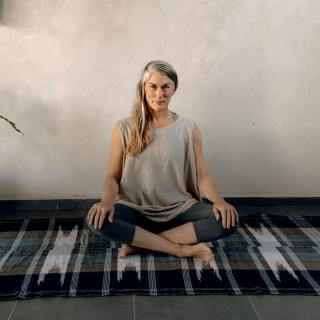
Let's begin by arriving.
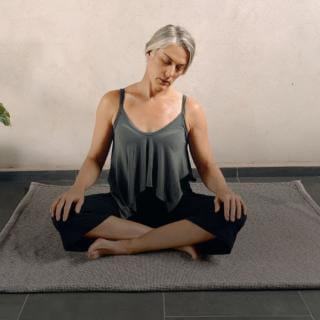
Find a comfortable seat or recline on your back.
Allow your eyes to close or soften your gaze.
Let your hands rest gently.
Palms face up in a gesture of receiving or down to feel more grounded.
Whatever feels nourishing.
Take a long full in-breath and then slowly release.
Tuning into the feeling of what a soothing breath feels like for you.
Let your breath be the anchor that draws your awareness inward.
Feel your shoulders drop down.
Your sit bones release.
Feel your body grounding into the stillness.
As we move through today's practice,
We'll spend time getting deep into the hips,
The inner thighs and the legs.
This is a space to soften,
To feel,
To let go.
Come to a seated position if you are reclined.
Let's begin with shoelace.
Cross your right knee over your left,
Stacking them if this is accessible and feels like you can sustain this shape for the next three minutes.
If it feels too intense,
Modify by extending your bottom leg.
Sit up tall to find length in your spine.
Inhale deeply and on your exhale,
Begin to fold.
Let the edges of the stretch guide you.
Explore the maximum depth of the stretch but then ease off.
In yin,
We don't need to push the boundaries of the body.
Just go to the edge of sensation.
Arms can rest on the ground or your head can be supported on a bolster or a block.
Let your shoulders melt.
Hips grow heavy.
Pelvis softens.
Legs release tension.
Inhale deeply and exhale letting go of holding.
Begin to ease your way out.
Let's move to the other side.
Cross your left knee over the right.
Stack if you can or again extend your bottom leg.
Inhale to find length in your spine.
Exhale and begin to fold forward.
Gently,
Slowly,
Slowly until you meet resistance.
Then ease back a little to allow muscles to soften so the stretch can move into the fascia and connective tissue.
Letting the weight of your head drop down to bring a nice stretch into the spine.
Or supporting your head to help regulate your nervous system.
Pause where you feel your first edge.
Then soften.
Let gravity carry you the rest of the way.
Notice if this side feels different.
Sending your breath into spaces of tension.
Welcoming the gentle release as you breathe out.
Just follow your breath.
Feel the broadness across your sacrum,
The pull in your glutes,
The space around your tailbone.
Feel into your outer hips.
Feel the tension slowly dissolve with each exhale.
Yin is not about doing,
Rather it's about being.
A time to let your gaze turn inward.
Taking your time,
Begin to come out of the shape.
Press up slowly.
Unwind your legs and let them rest on the floor.
Lean back on your hands.
Feel your pelvis recalibrating.
Your fascia rebounding.
Your nervous system reorganizing.
From here,
Make your way onto hands and knees.
Facing the long side of your mat.
Widen your knees to prepare to move into frog.
Your feet should be roughly in line with knees and perhaps sliding a blanket under your knees for more comfort.
Slowly begin to lower down onto your forearms.
This may be where you decide to remain.
Pause here and feel.
If your body is inviting you to go deeper,
Shift your weight a little back towards your heels and bring your chest down to the ground.
If the shape feels a little too strong,
Place a bolster under your chest and shift your weight a little forward.
Close your eyes.
Notice where sensation arises.
The stretch should feel tolerable.
A gentle and persistent tugging that will begin to unravel in the next few minutes.
If the stretch is too intense,
Your muscles will contract and resist,
Making the shape uncomfortable but also denying the deep layers of fascia and connective tissue the chance to stretch,
Untangle and hydrate.
Find ease.
Trusting that what needs to happen will happen without so much effort on our part.
Softening the inner groin,
The thighs.
Breathe deeply into your hips.
Can you sense the stretch differently on the left or right side?
Is one hip tighter or more guarded?
Just notice.
And breathe in towards the tension.
And when you exhale,
Let go and release the tension from your body.
Gently allow the stretch to move deeper,
Letting tension melt from the inner legs.
Your body is still.
Just your breath moving through your whole body.
To come out,
Slowly bring your legs back together and move onto your belly.
Rest your forehead on stacked hands or rest your cheek on the ground.
Take a few breaths here to feel the echo of the shape in your body.
In this pause,
Our nervous system is given time to rebound.
Mind and body integrating new information.
Feel what new sensations come to the surface.
Pausing here to notice the sensations as they rise and fade.
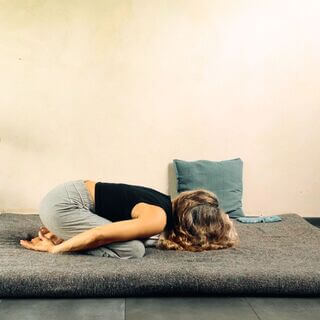
You may remain here for a few more moments or make your way into Balasana as a counter pose.
Shifting back to sit onto the backs of your legs,
Slightly compressing your belly and bringing some flexion into your spine.
Take a few deep breaths.
Feeling your breath in the back of the body.
Begin to make your way up to sit.
Place a bolster lengthwise in the middle of your mat.
If you'd like to explore saddle,
Come to sit in hero's pose with your legs folded underneath you.
Sit your hips down to the ground so you're sitting between your legs,
Feet at your sides and toes pointing straight behind you and slowly begin to lower yourself down.
If the floor feels too far away,
Just remain propped up on your forearms.
If your body feels open to move deeper,
Remove your bolster and lay down on the ground.
If your knees or ankles protest,
Try half saddle,
Straightening one leg or keeping the knee bent so the sole of your foot is on the floor.
And if there's any sharp or strong sensations in the knees or lower back,
Just come into a reclined butterfly shape,
Soles of your feet together with knees falling open.
Arms may rest at your side or extended overhead.
Take your time to feel the various options.
What feels best in your body?
Come to be still when you have found you're just right shape.
Breathe deeply all the way to the bottom of your belly,
Filling your body with breath.
Feel your breath move through the front line of the body,
Opening the thighs,
Hips and belly.
If you are in half saddle,
Change sides.
Otherwise,
Remain still in your shape for the remaining two minutes.
To release,
Slowly press yourself up with the support of your hands.
Place any props to the side.
Straighten both legs forward and lay down to rest on your back.
Close your eyes.
Breathe in to nourish your entire body.
Breath,
Filling every cell with prana.
Give your body time to respond.
Let it speak,
Keeping your awareness inward to listen.
Bring your knees in towards your belly.
Rest your hands on your knees.
And begin to make slow circles on your sacrum.
Drawing wide circles with your knees.
And changing directions.
Let's move into our final shape,
Twisted roots.
Cross your right leg over the left,
Like you're sitting in a chair.
Similar to Garudasana,
You could hook your toes behind your left ankle,
If that's available.
And then let your knees fall to the left.
If twisted roots doesn't feel like the shape for you,
There's no need to wrap your legs.
Just let both knees fall to the left,
Stacking your knees together for a reclined twist.
Adjusting where your knees land will subtly modify where you feel the stretch.
Drawing the knees closer to the chest,
Or keeping them level with your hips.
Spread your arms like wings out to the side.
Keeping your neck long,
Or maybe turning your gaze to the right for a deeper twist.
There's no need for both shoulders to be on the mat.
Come to be still once you have arrived in your just right shape.
Taking a few cleansing breaths,
Inhaling through your nose,
Exhale through your mouth,
Sighing out your breath all the way to the bottom.
Gently receiving the next inhale.
And let your exhalation be long,
Soft.
And complete.
Pausing at the bottom of the out breath,
Lingering in the stillness.
Coming back to your natural breath when this feels complete.
Making your way to a rebound shape.
Laying on your back,
Or keeping your knees bent in constructive rest.
Taking time here to feel the effects of the twist.
Letting the sensations come to the surface.
Notice what you feel.
Let's take our twist to the other side.
Taking your time to explore the shape on this side.
If you're doing twisted roots,
Cross your left leg over the right and let your knees fall to the right.
Make any adjustments and then come to be still.
You may wish to take a few cleansing breaths to help your muscles dissolve into the shape.
Sighing your breath out through an open mouth.
Letting your exhale be longer than your inhale.
Breathe into the spiral of your breath.
Breathing in through the back of your spine,
Opening the spaces in the vertebrae with each breath.
Breathe into your lower back.
Ribs,
The space behind your heart.
Bringing out tension from your spine.
Twisting at the end of our practice helps to restore equilibrium in the nervous system and release tension in the spine.
Feel your breath.
Rest your awareness in the flow of your breath.
Breathe naturally and calmly.
Breathe to nourish your body.
Let your breath guide you to the quiet place inside.
Begin to come out of your twist.
Roll onto your back and extend your legs,
Finding your most comfortable shavasana shape.
Close your eyes.
Breathe naturally in and out.
Settle in.
Awareness rooted in your body.
Whole body supported by the ground beneath you.
Whole body nourished by your own breath.
Let your entire body surrender into the ground.
Let your body rest in complete stillness.
Feet and ankles relaxed.
Feel the knees dissolve.
Hips heavy.
Low back released.
Spine soft.
Ribs melting.
Shoulders melting.
Heart quiet.
Hands open.
Face serene.
Throat soft.
Jaw unclenched.
Eyes floating.
Mind like a still pond.
Letting go of effort.
Letting go of thinking.
Letting go of holding.
Returning to the space around you.
Hearing the sounds around you.
Welcome movement back into your body.
Wiggling fingers,
Toes,
Toes.
Maybe stretch your arms overhead.
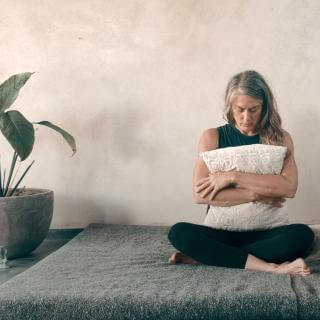
Draw your knees in gently.
Giving yourself a hug.
When you're ready,
Roll to one side.
Resting in fetal pose.
Pause here.
In this moment between stillness and rising.
And then press yourself slowly into a seated position.
Bring your hands to heart center.
Thank you for sharing this space with me today.
May your breath guide you gently through the rest of your day.