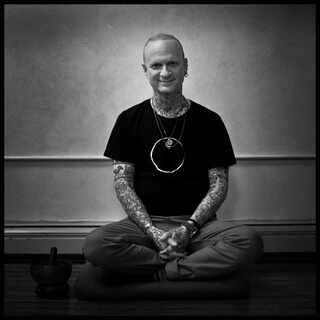
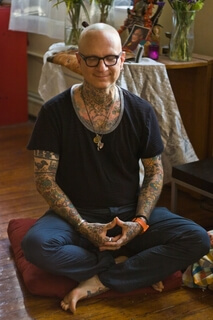
So the meditation we're about to do is based on a very old concept called Atami Atah.
In spiritual practice we're asked to focus our attention on very specific sensations.
For instance,
The breath,
Body sensations,
Sounds,
Or we can even recite meta-phrases.
And concentration practice can be very useful in reducing anxiety and cultivating tranquility.
An equally useful practice is to keep the mind open and spacious and capable of holding all the sensations of the present moment.
What the Buddha called Atami Atah or an unconcorted open awareness.
It's got a lot of names but the idea is very old.
When we do it patiently,
It can create wonderful states of non-dual transcendence and peace.
So let's close the eyes.
We'll take a few breaths just to bring awareness into the body and relax the body fabrication.
So take a nice slow in-breath through the nose and as you do so if you like,
Lift your shoulders up to touch your ears and hold the shoulders there for an extra beat longer.
And then as we breathe out,
Release the shoulders down and let them relax comfortably.
And pull them slightly back gently to open up the chest if that feels appropriate.
And now for our second long in-breath through the nose,
Tuck in the belly as tight as you can so that you're taking inches off the waistline if feels like and then hold and then breathe out.
Soften.
For the third in-breath,
Squinch the muscles in the face,
Tighten the fist,
The buttocks,
The legs,
The arms,
Everything you want to tight,
Hold,
Hold and then as we breathe out,
Soften.
And then take a nice survey of the body and see if there's anything you'd like to adjust right now to make your seat as comfortable as you can.
It's generally worthwhile at the beginning of a sit to bring the head in line with the shoulders and the shoulders in line with the hips.
In other words,
We could view the hips as the pot and soil of a plant and then the spinal cord is the stem and the head is the flower itself.
And the more alignment there is,
The more balance,
The less we have to use the shoulders and the neck and the top of the back and the lower back to keep ourselves upright.
Balance aids in attentiveness and ease.
So from this balanced posture,
See though if you can fully relax,
Softening any areas of habitual contraction without forcing anything,
Just encourage the muscles in the jaw to relax,
Shoulders again relaxed,
Muscles in the belly to soften,
All the way down the body.
So let's bring awareness to a first sensation to keep in mind.
And that sensation can be either the breath or just sounds of the room around you if you don't like working with the breath.
If you choose to work with the breath,
Find an area in the body where it's easy to discern whether you're breathing in,
Pausing or breathing out.
Areas such as the tip of the nose,
Feeling the stream of air entering and leaving the body,
The shoulders raising and lowering,
The chest or belly contracting,
Expanding and so forth.
At the start,
Using counting to aid keeping the breath in mind.
One approach I like is to count one,
The beginning of the in-breath,
Two,
The beginning of the following out-breath,
Three in the next inhalation and four on that exhalation and then five on the next in-breath and then start counting down.
Four on the out,
Three in the next in-breath,
Two on the out and we're back at one.
So we're counting from one to five,
One,
Three and five,
Always landing on the in-breath,
Two and four always on the out-breath.
If you find that your mind is very anxious at the start and jumpy,
You might want to extend the length of the out-breaths,
Which fall on two and four as long as you can.
That tends to relax both the mind and the body.
If however,
You're very tired and find yourself feeling as if you might fall asleep or becoming drowsy,
Try to hold the in-breath a little longer,
A beat longer before you release it.
Holding it tends to build up a sense of alertness or while you breathe in,
You could open up one eye and then as you breathe out,
Close it.
To work with sounds,
Just bring your awareness to the ambient auditory events that are occurring in the space that you're sitting in.
Some people like to listen for the sound furthest to the left and then the sound that appears to be furthest to the right and then to create a sense of a sweeping horizon of sound.
When we listen for sounds,
Try not to visualize what creates any sound.
So if you hear cars passing by or aircraft above or any other sound,
Try not to visualize what's creating it.
Just listen to the sound as if you've never heard such a thing before.
As each sound passes,
Just move on to the next without adding any wishing it would stay.
Or when new sounds arise,
Try not to resist tensing against the arising of a sound like a car horn that might be unpleasant.
Just be with the sounds without adding anything to the experience.
Now in this meditation,
We're not going to replace one concentration object with another.
We're going to continue to add objects into awareness to make the mind as spacious and open as we can.
So whether you're using the breath as an anchor or the sounds of the room,
Let's begin to add in other sensations to begin to broaden and expand our awareness.
So feel the contact sensations you're making with the cushion or the chair or whatever you're sitting on.
Notice the area that the mind believes delineates the end of the body and the contact with the floor.
And then all the sensations of pressure and weight that bring awareness to other contact sensations,
Such as the feel of clothing on the body.
Sometimes the clothes around the waist might be tighter.
Close sensations hanging from the shoulders around chest or the belly.
Feel the contact between the arms and the torso and the hands resting perhaps on the lap.
If there are any other internal sensations that are very apparent in addition to the breath,
Perhaps a slight ache or a slight simple sensation occurring in the mouth,
Slight tension in the jaw.
Anywhere there's continual sensations,
Just allow them to be in awareness as well.
So feel the contact with the body.
Notice the area that the mind believes delineates the end of the body and the contact with the floor.
Let's bring in awareness of the lights flickering behind the closed eyelids.
Rather than viewing sight as a distraction or something outside of our practice,
We can integrate awareness of lights and colors.
If we open our eyes though,
The surrounding world can often pull all of our awareness from what's going on internally.
But when the eyes are closed and we simply become aware of the closed eye visuals,
Those can be integrated into the meditative experience as well.
Additionally,
There are what the Buddha called feeling states arising and passing.
For this practice,
Let's note first the feeling states in the body.
Contractions of muscles in the front of the body,
The belly,
Chest,
Throat,
Face,
That let us know when we're feeling comfortable or uncomfortable with any situation.
So for example,
Sometimes when an unpleasant sensation occurs,
We might tense against it.
When we're feeling relaxed,
We might note that the shoulder begins to drop and the chest becomes comfortable and the belly softens.
So just notice the changing proto-emotions that are playing across the front of the body.
Additionally,
Feelings also occur in the mind.
You might notice that when we feel relaxed,
The mind feels less anxious and it settles easier.
But when the mind is uncomfortable or unhappy in a situation,
It jumps around,
It looks for solutions,
It abandons the present.
So just notice whether the mind is settled and present or whether it's distracted,
Agitated,
Or perhaps it's simply tired with very little energy.
So just notice that.
Now let's even bring in awareness of thoughts which come in two general types.
There's visual thinking,
Which plays often in an area that seems roughly equivalent with the forehead,
Behind the forehead,
Or perhaps the eyes.
There's auditory thought,
Which many of us hear by the ears.
Some people call it inner chatter,
Thinking.
The goal with becoming aware of these thoughts is to not allow them to pull all of our attention away from the other sensations,
Which we're also keeping in mind.
So we still maintain awareness of the breath,
Contact sensations,
Sensations of the sounds coming and going in the room,
Awareness of the lights behind the eyes,
Awareness of feeling states in the body and mind.
So you can see we're really asking a lot of awareness and this requires simply relaxing into the present moment.
Every time a thought,
Perhaps a memory or a plan or a fantasy seems so important that it wants to pull all of our attention away from the other sensations,
Just bring awareness back to the other sensations.
Let's remind ourselves that no single thought is going to be more important than opening to awareness of life in this moment.
Let's also remind ourselves that no single thought is going to be more important than opening to awareness of life in this moment.
Now here's where this practice can become fairly transformative.
Generally when we perceive life.
To every phenomenon and sensation we have a sense of either this is occurring inside me or outside of me.
In my body,
Outside in the world.
And we believe that everything that occurs in the body is subjective.
Whereas everything outside of us we believe to a certain degree might be objective.
And that other people see and experience the exact same things.
But what if everything we experience could be just thought of as occurring in the mind.
Without any sense of inner or outer,
Just everything is a phenomenon occurring in our conscious awareness.
So let's see if we can add a flavor of this non-dual quality into our meditation.
It can actually be,
If we do it correctly,
Quite soothing.
So find the sensations of sitting again,
The contact sensations you're making with the ground.
But see this time if you can begin to blur the sense of where you and the ground or the cushion begins.
Or for another approach see if you could almost feel the out-breath.
As you breathe out see if you could feel the sensations all the way going down through the body,
Almost entering the floor.
And then when you breathe in what would it be like if you could almost feel the energy arising up through the floor into your body,
Up to the chest,
To the face and then back down.
Breathing in the energy of the world and the earth and breathing out all the stress in the body into the earth that can receive it.
Another approach is to bring awareness to all the sounds surrounding us.
And working there with sounds see if you could remove any sense of inner and outer.
The sense of there being a skull that creates a disruption between the far left,
The center and the right horizon of sound.
When you hear sounds no longer add the sense of them occurring outside of the body.
For the body sensations itself see if we can let go of that sense of that outline of the body which creates a subtle shading in the mind of this is mine and that's outside of me.
See if you can use all of the sensations that are occurring and just let go of the sense that anything is either mine or not mine.
Just relax into an awareness of all that's occurring without adding the stamp of self and other.
Removing the outline of the body and just experiencing everything is occurring in the mind.
So we're going to begin the transition from the meditation.
And it's always worthwhile the end of practice to reflect on the virtue of our efforts.
Meditation is not only of great benefit to our mental and physical health and well-being.
But when we have a spiritual practice it means generally that in finding some tranquility and peace within we will wind up in less competition with other people around us.
Our practice in other words is not just to our own benefit but to the benefit of all beings we come into contact with.
It's a blameless endeavor.
It doesn't exploit or harm anyone.
It doesn't use up the world's resources.
It simply teaches us how to stop and open to our life without craving or consuming anything and find some degree of peace and tranquility using only awareness and compassion and care and calm focused attention.
So when I ring the bell to bring our blameless practice to a close use the entire length of the bell sound to slowly open up your eyes.
If you quickly open up your eyes you'll find that looking around will completely push all the other sensory awareness and internal awareness that you've developed into the background.
You'll simply once again wind up in the busy mind that is searching for solutions exclusively in the world around us without any internal resources available for happiness.
So take your time and integrate sight into the larger awareness of the Tamiyatta.