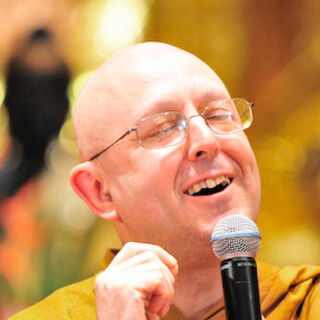
Hello and welcome once again to our Buddhist Society for the Saturday afternoon meditation.
And as usual,
I have to make the announcement if anyone is here for the introduction to meditation class,
That is being held in the room on my right,
The room between here and the reception area.
And this is the class for those who have meditated before who can sit quietly for at least 40 minutes because that's the usual time we meditate here for.
So I have made the announcement,
You know the next announcement,
Please when we're meditating,
Please turn off all your mobile phones so it doesn't make a noise during the meditation period.
And somebody just asked me,
Can I talk a little bit about how to empty your minds during the meditation.
And it's a common idea that when you meditate you empty your mind and blank out.
Remember we're only emptying our mind of some things,
We're keeping other things very clearly there.
And one of the most important things which we keep in meditation,
Which we never empty out,
Is our awareness,
Our mindfulness,
Our clarity of mind,
Which is what really distinguishes meditation from hypnosis or trance.
Because in meditation no matter how deep you go,
You're always fully aware.
In fact the deeper you go,
The more powerful and more precise is your awareness.
Your awareness is just simply the ability to see,
Perceive,
To know what's going on.
In the same way that your eyes can see the shapes when your eyes are open,
In the dark you can't see very much,
In the bright sunlight you can see a lot,
It's a little bit more detailed,
In the same way that mindfulness has these different levels of penetration.
And part of the process of meditation is to reinforce that mindfulness through the power of stillness until it gets so precise and so strong.
However,
It's good that we maintain the mindfulness there.
We empty the mind of other things.
The reason is because you want to be very light,
Very clear.
The old similes which I have given in meditation,
I mentioned it briefly yesterday night,
But not in the same context,
It's the context of a balloon,
Like a hot air balloon.
Yesterday,
Or rather yesterday evening,
I was saying that a person in a hot air balloon will never feel the wind,
Even though on the ground the wind is blowing from the west or the east or wherever,
Up in a hot air balloon because you're going fully with the wind.
There's no resistance to the wind because you're not tied down or anchored anywhere.
It means in that hot air balloon you never feel any wind at all,
It's absolutely still.
That's an interesting idea but the idea now is in order to go high,
We have to empty out that balloon to try and make it weightless.
So the more ballast,
Ballast is the sand bags and other weight you put in the basket when you start your ascent.
To go high you have to throw more and more things out.
And that idea of emptying out is a very good simile for going deeper into the meditation.
As you empty out the weights and surplus stuff from the basket of a hot air balloon,
You go higher.
So if we empty out from the mind the useless stuff,
The unneeded attachments,
Then we can actually go higher and higher in meditation.
So what are those useless attachments we want to throw away?
Every week I say we start to empty out progressively,
To empty out the coarse things first of all and then the less coarse things until we empty out the refined things.
So in meditation you think what is it you don't really need in meditation?
What's superfluous to requirements?
When you look at that in meditation,
First of all you have to look after your body to make sure it's comfortable but after a while it's superfluous to your requirements.
In meditation you put the body down on a seat,
On a chair,
On a bench,
On a cushion,
You've made sure it's reasonably comfortable and then you let it go.
It's almost like you empty your body out.
And when you contemplate the nature of a person's body,
How much time it takes of your attention throughout the day,
Scratching,
Eating,
Moving,
Going to the toilet,
Whatever.
This body takes a huge amount of a person's time and that's when you're healthy,
A little low when you're sick and it takes 90-95% of your time looking after this body either directly or indirectly.
So it's a wonderful thing when you sit down in meditation in a reasonably comfortable position to say now I can empty this out,
It's no longer my concern.
A good simile which helps you let go of the body to empty it out of your mind,
It's almost like emptying it out of your to-do tray,
Is a simile of parking your car outside.
Because when you come here,
Many of you come in a vehicle,
You park your car,
What do you do?
Obviously you put it in the park mode,
Put the handbrake on,
You get out,
You lock the door.
Once you lock the door,
The alarm is activated and you're quite satisfied,
You can leave your car out there in the car park and it's going to be there,
Quite safe,
Quite sound as you left it when you finish the meditation.
You can lock it up and let it go.
So you empty it out of your to-do basket.
So this is how we let go of our body.
We got to make sure it's secure first of all,
Sitting down,
Comfortable,
Well set up and then we can lock it up,
Let it go and enjoy some quiet meditation.
That's the first thing we empty out,
The concern for our body.
The next emptying we do is emptying out this thing we call time.
If you again reflect on the sort of things which occupy and fill up your mind,
In this simile of the bloom,
What is the basket in which you're standing,
Which you have all this stuff in.
That's why I call many people basket cases.
Because you got the mind full of all sorts of rubbish.
We want to start throwing some of that out.
You look at some of the stuff which we keep in our mind,
In our basket.
It is superfluous,
Why do we always have to keep thinking about what happened in the past?
Why do we always have to keep planning for what's going to happen next in the future?
Worrying about these things,
Why can't we just let these things go?
So we deliberately do that,
We imagine that our basket is weighed down because of our past history and because of our fears of the future.
The only way to rise high spiritually as well as literally if you're in a balloon,
Is to throw out all that unnecessary package.
So we literally toss it out so we can go higher.
We empty our mind of the past and the future.
Now it's important you don't empty your mind of the present moment because that's where mindfulness lives.
You keep that,
You preserve that,
That awareness of what's happening right now.
Then you empty your mind of all this stupid thinking.
After a while,
When you've done the past and the future,
You really empty that out and you're in this present moment,
Then you start to see one thing which is burdening you even more is these thoughts,
Descriptions,
Words and that is a huge burden.
It's wonderful that when people become silent and quiet,
These days teaching meditation to people who haven't got much time,
So often when they ask about,
I think there's people coming for the first time,
Thank you,
When you ask about what does it really mean to be silent,
So often that I tell these new meditators how they just to listen when I speak in a way when there are pauses between my words,
Because in those spaces between the words,
You experience silence.
It's quite amazing just how many people when I speak like that and they pay attention to what's going on between their ears,
They actually experience that silence,
Maybe for the first time they start recognising it.
This is wonderful,
This is almost like a burdenless state of mind.
They have emptied their mind of the need to describe,
To note down,
To give a name to all the phenomena which they experience.
They are empty.
So the next thing we do is empty the mind out of this inner speech.
We go more to the silence and that silence is a state of emptiness.
It's empty from all these words.
We go deeper than that into the emptying our mind,
What we call diversity.
Sometimes it's like you have an office and on your office desk is all these telephones and sometimes they all ring at the same time.
You decide to throw out all the telephones except one.
Just keep one and the rest you throw away.
You're going from diversity to unity.
Those telephones represent all the different senses which you have,
The seeing,
Hearing,
Smelling,
Tasting,
Touching and knowing.
You're throwing them all out except just keeping one.
In this particular case,
Just the feeling of your breath.
You're throwing everything else out,
Just like you're going up in this balloon in a spasket,
You're throwing it out.
Everything except just one thing,
The breath,
That's all you're carrying with you.
That means you go higher,
You get more peaceful.
Then you start throwing up more things.
But at that time,
What happens,
You get to some stages of meditation.
You may be watching the breath but you're not going any further.
You feel like you're plateauing.
It's okay but it's not deep,
It's not really peaceful,
Beautiful yet.
So your next thing to do is to see,
Check in your mind,
What are you holding on to?
Is anything else in there you can throw out of your basket?
Anything else you can empty out?
And if you do,
You find something,
You throw that out,
You immediately feel the mind gets deeper and more peaceful.
This is one of the things which I do when I meditate.
You start meditating,
You get into reasonably deep states of mind.
If you can't go further,
What am I holding on to?
What am I carrying around in my basket which is unnecessary?
Once you see that,
You throw it out and straight away,
It's almost as soon as you see it,
You can let go of it and it goes further.
Because one of the things which you find you have to empty out is expectation.
Because as you go deeper in meditation,
Sometimes we get this expectation,
It's going to be working now,
It's going to happen.
And those of you who have read some of the details of what happens in deep meditation,
Things like nimittas and bliss and even jhanas,
Sometimes that expectation is that burden,
The thing which you're not emptying out of your mind,
Which causes you to stop going further.
So if you see expectation in your basket,
You throw it out every time.
So you're not looking even to the next moment,
You're just staying with this moment you have now,
Being more fully where you already are,
Not moving,
You're throwing out,
Emptying out that which causes all movement in your mind.
You're learning how to be truly still.
Because the result of emptiness is this beautiful stillness of the mind.
You emptied out all your burdens,
You've risen high into the stratosphere of meditation and up there is so still,
So quiet.
The other advantage of that simile is the higher you go,
The further you can see.
See for miles the landscape underneath.
We call that the insight.
Seeing the bigger picture,
The landscape,
The territory of your life laid out in a huge map beneath you.
The higher you go,
Only because you carry less things,
The more you see.
So you can take that idea of emptiness,
To use it for the beginning stages,
To know you're emptying one thing,
The most difficult things first and then later on the more refined things,
Little by little.
Whenever you get stuck,
What can I empty out now?
Remembering this is a mind which empties out all these burdens and baggages which sometimes we think is so important.
And then,
When you go no further,
See what else you can empty out.
See what else you can empty,
See what else.
And that way you go deeper and deeper.
Until you've hardly got anything left at all,
Just the mindfulness being absolutely still.
The mindfulness which is still grows in power.
This here where the bliss and the beautiful stuff of meditation comes from,
The mindfulness which doesn't carry anything,
Which just rises and rises and rises.
So we're called emptying the mind gradually.
Is there any comments or questions about that?
Okay,
So we're going to go now.
Start our meditation.
For those of you who've been sitting down a while,
And you want to sort of stand up,
To stretch your legs to get yourselves comfortable again,
Please do so.
And again,
Just again,
This is a class for the ongoing meditation,
If you come to the introduction to meditation class,
That is being held in the room to my right between here and the reception area.
Because in this class,
It's for people who've meditated before,
Know what they're doing,
So that we can sit for 40-45 minutes without too much difficulty.
Okay,
So here we go.
So if you'd like to get yourselves comfortable,
Close your eyes,
We'll begin the meditation now.
Close your eyes.
Before we lock up our car,
Our body,
Got to make sure everything is in order.
So really check your body as best you possibly can,
Making sure you're in the optimum possible posture.
Okay.
Just relaxing the body by spending time with it.
Caring for this body.
Adjusting any part of it,
If that's what it needs.
Okay.
And when the body is relaxed,
You can let it go.
Imagining yourself in that balloon and emptying out that baggage.
Saying I've looked after you body,
Now I'm going to lock you up,
Put the alarm on and walk away.
As you start being more concerned about the quality of your mind,
What's it doing now?
Is it starting to linger on the past,
What happened earlier?
Start projecting onto the future.
Remember those are burdens which are unnecessary on the journey of meditation.
It is the memories and thoughts of the past and the worries about the future which hold you down.
Which stop you rising into the peace and happiness of deep meditation.
So recognize these things,
The past and the future as burdens,
As useless weights.
Toss them out in your mind anytime you see the past or the future coming up,
Toss it out.
And you'll notice that as you reject all the past and all the future,
You empty your mind of those things.
Takes time,
Because many parts of the past and the future which you have to keep discovering and throwing out,
Keep coming back and throw them out again.
Because once the past and the future are gone,
All you're left with is the present moment,
The beautiful powerful now.
.
.
.
.
.
.
.
.
.
.
.
.
.
.
.
.
.
.
.
.
.
.
.
.
.
.
.
.
.
.
.
.
.
.
.
.
.
.
.
.
.
.
.
.
.
.
.
.
.
.
.
.
.
.
.
.
.
.
.
.
.
.
.
.
.
.
.
.
.
.
.
.
.
.
.
.
.
.
.
.
.
.
.
.
.
.
.
.
.
.
.
.
.
.
.
.
.
.
.
.
.
.
.
.
.
.
.
.
.
.
.
.
.
.
.
.
.
.
.
.
.
.
.
.
.
.
.
.
.
.
.
.
.
.
.
.
.
.
.
.
.
.
.
.
.
.
.
.
.
.
.
.
.
.
.
.
.
.
.
.