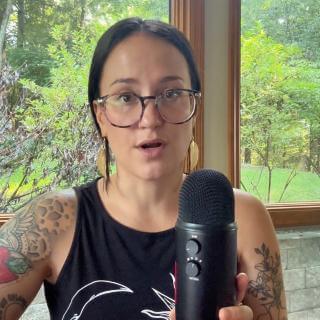
I wanted to make a track about questions to ask yourself if you're doubting your relationship because it's one of my most viewed videos on YouTube and I published it in 2021.
So we were about a year into COVID and a lot of my friends were going through breakups and I was thinking about Okay,
Well,
I have clients in my therapy practice,
I've got friends,
And they're asking me the same thing.
How do I know?
How do I know when I should leave and how do I know when I should stay?
So I just wanted to recap some of the questions from that video.
Now,
When I'm making tracks,
I don't write anything down beforehand.
I do want to speak from the heart,
And so if you notice,
It's a little more vulnerable.
I may stumble on my words,
I may say um sometimes,
But I do my best to not edit everything to make it sound perfect,
Because I really want the humanity of what I'm saying to come through.
So,
Without further ado,
Questions to ask yourself if you're doubting your relationship.
So the first thing I want to mention is that doubting your relationship is not an immediate red flag that you should absolutely leave.
There are so many reasons why we could be doubting our relationship,
Be it our own traumas in the past or attachment wounds,
Or maybe our self-esteem and self-worth is low and we're questioning if we are worthy and deserving of love.
So there are so many different pieces here.
I think pieces that are a little more black and white have to do with the safety of the relationship itself.
So I will just put this caveat in the beginning.
If there is a level of physical abuse,
Sexual abuse,
Financial abuse,
Which is actually much more nuanced and can go under the radar for longer,
Verbal abuse,
Emotional abuse,
You know,
To me,
That's going to require usually a level of professional assistance if you are choosing to stay,
So couples counseling.
And also,
That could maybe be a whole separate video,
Is about what to do when there's abuse of my relationship,
Abuse of any kind.
This is not about relationships where there is any level of abuse.
This is about,
You know,
I've been with my partner for X amount of time and there's something in me that is just doubting it.
And I don't know what questions to ask myself because when I go to friends or family,
Their opinions are inherently going to be rooted in their own biases and in their own life experiences.
And ultimately you are the only one that knows your truth.
But like the doubt aging says,
Do you have the patience to sit still until the water of your mind settles.
I just paraphrased it,
That is not the actual quote,
But shout out to the Tao Te Ching,
Which has phenomenal insight about everything.
Actually,
I do recommend going over to the Insight Timer teacher's Charles Freely's course.
It's 83 Days of Tao Mastery.
Tao as in T-A-O,
And it's phenomenal and life-changing.
So questions to ask yourself.
Here's the first one.
I like to think of a relationship dynamic as a pie.
In terms of a pie chart.
And so you have this pie chart.
And if you're thinking about your relationship,
How much of the pie chart is spent feeling secure,
Feeling supported,
Feeling seen,
Feeling joy,
And any values that you want to bring into a relationship,
Like having fun together or having deep stimulating conversations.
I mean,
Fill in the blanks.
How much of the pie chart is by your own definition positive and how much of the pie chart is spent doubting Bye!
How much of the pie chart is spent angry,
Resentful,
Distrustful.
I mean,
Fill in the blank with.
Emotions that we would not typically assign a positive meaning to.
My dog just yawned so loudly,
But I don't know if you could hear it because I have a new microphone.
So take a moment,
You can pause this audio if you want and you can take out a notebook or maybe the notes app on your phone and just say,
Okay,
Pie chart,
Where are we at?
How much is positive?
How much is spent in an un-positive place?
And if you want to get specific with it,
It might be helpful.
So let's say you have a cyclical argument about trust or about staying out late or something that is a point of contention.
How much of the pie chart is spent there?
And so you can even break down the not positive part into subsections of what is filling up this part?
What is filling up this part of the pie chart?
It is,
Or is it my own lack of trust?
And is that based on evidence that my partner has provided me with to not trust them?
Or is this my own experiences from the past and bringing them into this current relationship?
So part one,
The pie chart.
Again,
You can pause this,
Start to write things down if you'd like.
I may recap at the end if you don't pause it.
So here's the second one.
What part of me wants to be with this person.
Now,
If you are unfamiliar with parts work,
Which is also called internal family systems,
Parts work is phenomenal.
We are made up of many different parts,
Which is not so dissimilar to the concept of non-duality and interconnectedness in Buddhism,
Where everything is connected.
And so we don't have separate parts that don't impact each other.
We have many parts that do impact each other.
And so what part of me wants to be in this relationship?
How old is that part of me?
What does she look like?
What does she sound like?
I'm saying she because I am a female and identify as a female.
So input with your own pronouns.
But what part of me wants to be in this relationship?
Is it the part of me that seeks chaos and drama and wants to be potentially treated poorly because it validates my core irrational beliefs that I am unworthy of love?
Does the part of me that wants to be in this relationship fear being alone?
Does the part of me that wants to be in this relationship Have high self-esteem.
Do they care about emotional intimacy and vulnerability?
I mean,
I don't want to project my values onto you,
So you can fill in the blank.
What part of me wants to be with this person?
And now on the flip side,
What part of me doesn't?
Is the part of me that is doubting my relationship coming from a deep sense of knowing?
Like a deep knowing that is at the core of every single human being.
Or is it coming from insecurity?
Is it coming from self-sabotage?
Is it coming from,
I'm afraid that it's going to end,
So I want to end it first,
Right?
It's tough to cover the whole spectrum of human experience and different narratives,
But what part of me wants to stay?
What part of me is doubting it?
And that may also help just get some clarity around where these doubts coming from.
So again,
You can pause here if you'd like to just write down some of this.
The pro and con is.
Is a great tool,
But I think what part of me is a greater tool,
Because it's really bringing insight and clarity into your own internal experience.
So I'll give a personal anecdote here.
I was in a relationship.
Maybe around 2016 to 2018,
For about two and a half years.
And I had doubts from the very beginning.
And I told my,
I almost gaslit myself.
I told myself,
Don't listen to these fears.
Don't listen to these.
I wouldn't say there were overt red flags by any means.
This person,
I don't have one negative thing to say about them.
They were wonderful.
And.
I had doubts from the beginning.
And so it wasn't because of any glaring reason.
I would love to stay here.
There doesn't have to be a reason for you to end a relationship if you are not.
Fully in it,
If you have a gut knowing.
So I had this gut knowing from the very beginning,
But I shoved it down and I layered it with intellectualizing my way out of what my body was telling me,
Which was,
I just don't think this is the right fit.
And I couldn't point to why.
And as someone with a history of over-intellectualizing everything,
If I couldn't point to why,
I thought it just must be me.
You know,
I'm damaged.
I have baggage and this is a good thing.
And I,
And you know,
I think I did the best I could with what I had at the time.
And luckily for me,
There were no,
It was not a horrible relationship.
There was no abuse,
But I spent two and a half years building a life with this person.
And I really put myself in a lot of emotional pain because I wasn't listening to this spark of knowing that was there.
And it took,
You know,
Quite a bit of therapy.
And really just time for me to listen.
And that was when I did have somewhat of a meditation practice,
A spiritual practice.
I was seeking.
I've been a seeker for quite some time.
And even with that,
It's like I would journal and say like,
Oh,
Universe,
Like,
Please show me a sign.
And like signs would be presented and I would turn the other way.
And I remember specifically speaking to a therapist of mine and saying,
I just don't know.
I just don't know.
And she looked at me.
Her name was Wendy.
Wendy,
She saved my life in many ways.
And Wendy said to me,
I think you do know.
I think once you say,
I don't know enough times,
It's actually clear that you do know.
You just don't want to listen to that knowing.
God,
If that didn't mess me up.
But she was right.
And we didn't break up for another probably year or so.
In hindsight,
I think I was scared.
The part of me that wanted to stay was embarrassed,
Right,
To have another failed relationship.
I was in my mid to late 20s.
I thought,
Okay,
This is it.
I'm finally here.
And I think the part of me that wanted to stay really craved the habitual comfort of familiarity.
Wow.
I've never pinpointed that,
But yeah,
I think familiarity is really strong.
And,
Um,
As the teacher that I alluded to Charles freely,
He writes in his book,
Which is called the will to do nothing.
You know,
We choose the control of guaranteed unhappiness over.
I forget the exact words,
But something like the unknown of potential happiness,
Right?
The control of guaranteed unhappiness because control.
Um,
You know,
How many of you I'm acting like I'm in a stadium,
How many of you show of hands struggle with uncertainty?
And so doubting a relationship.
Is this something to listen to,
Or is this something that you're sabotaging?
You want to blow up your life because you're bored?
I mean,
There's just so many different routes here,
But is part of the reason you're staying because you're scared of,
You're scared of the unknown and scared of quote unquote,
Being alone.
So.
Recap,
The first one is the pie chart,
The second one is what part of me is staying,
Or what part of me wants to stay,
And what part of me does not.
Let's see.
Oh,
I've been talking for 11 minutes.
Well,
This is not going to be as short as I thought it would be,
But that's okay.
So here's another one.
So I am in a 12 step program.
I got sober when I was 20 years old.
I'm currently in my mid to late thirties.
And so it's been a while for me.
And one of the most amazing tools that I got from the 12 steps is part of the fourth step,
Which is a written inventory on resentments,
Fears,
And sex conduct.
Woo.
And so.
A piece of this fourth step that actually goes unnoticed quite a bit,
But it is written in the literature is to It says,
In this way,
We try to shape a sane and sound ideal for our future sex partners.
The fact that I'm quoting this by heart can show you that I have read this part many times because some of my relationships were a bit of a dumpster fire throughout my early sobriety.
And so,
You know,
What I was told to do is make an ideals list.
What is my standard here?
So what are the ideals?
So when you take your current partner out of your mind's eye and you make a list of ideals.
What do I want in a partner?
So I'll just talk about some of mine.
I will try to remove my husband from my brain.
And I did not marry the one that I was with.
I married someone else.
And I've never doubted it.
Which is crazy for me.
And I don't think that you need to never doubt your relationship.
I'm just sharing that from my own personal experience.
So my ideals list,
You know,
My first one when I was 20 years old looks a little different than mine when I was in my late 20s,
But I could,
I can just remember some of the things I wrote are,
You know,
Emotionally available.
Um,
Sense of humor likes to have fun is able to swim out into the deep end,
Right?
Like I usually was with people who they either would hang out in the shallow end,
Which was nice sometimes.
Like I want to just have fun and not overthink things.
But I also have been with people that could only hang out in the deep end and everything is intense and everything is trauma.
I'm a therapist.
So,
You know,
Sometimes we attract that and,
You know,
I'm just always in the deep end.
And so for me,
I think someone who can hang out in both ends of the pool.
Wall.
And maybe just really reside in the middle but have the capacity to go to either end.
I don't remember how I wrote that down,
But that was on my ideals list.
What else?
Emotionally available.
Lives in the United States.
I had an ex from England.
Long distance went on for three years.
It was hard,
But it was really a great relationship.
Let's see.
I don't think that they were also sober was on my ideals list.
I'm trying to think like emotionally available.
Oh,
Emotionally aware and attuned and communicative.
Like I would really have loved someone to be emotionally intelligent.
Right.
So for me,
You can you can see where some of my values lie,
But writing down like what are some things that are important to you?
And maybe they're a little more simple,
Like has a car,
Has a job,
Is ambitious.
Actually,
I added that one later after a breakup is ambitious and not ambitious in like,
Oh,
I have to go be famous or make tons of money but like do you have goals in life,
Um,
You know,
Playful,
But not immature.
Like there was just,
And so if you make an ideals list.
And then you look at your current partner.
How much of the ideals list are they making?
And the kicker in the 12 steps is that we're not supposed to use the ideals list to then go out and find the perfect partner.
We're actually supposed to be the things on the ideals list ourselves.
That's the kicker.
And then we're more likely to attract that in another person.
But,
But really the work is always internal.
The work is not changing someone else.
The work is not changing our partner.
The work is how can I become the most ideal self that is already inside of me,
But probably blocked from unhealed wounds,
Right?
So.
Look at your ideals list.
How many things on your ideals list are you?
Would you date you?
Would you be married to you?
If the answer's no for those questions,
I'm deviating a bit.
That's also something to look at,
Right?
Because I truly believe that we accept the love we think we deserve,
Which means if I don't believe that I'm worthy of it,
I don't believe that I'm lovable,
I will sabotage.
Anything that it resembles healthy attachment.
That's psychological phenomenon.
I mean,
That's a thing.
So my standard for dating or marriage or any kind of partnership,
Does this person match at least most of my ideals?
And if not,
What go back to the previous one,
Right?
What part of me is staying with this person?
Okay,
So recap,
Again,
We've got,
Oh no,
The YouTube is about to play.
No!
Okay,
The YouTube video just started playing because I X'd out of it by accident.
How do I find it again?
Okay.
The pie chart.
What part of me is doubting it?
What part of me wants to stay?
Ideals list,
Right?
What are my standards in a partner?
Oh,
In the 12-step program,
It also says,
We put each sex relation to the test,
Was it selfish or not.
And that's huge,
Right?
It's like,
Am I with this person because I get something out of it?
What am I bringing to this?
Is it selfish?
Because is it satiating my need to not be alone?
Is it satiating my desire for attention?
What's going on here?
Let me make sure this is still recording.
16 minutes.
I think it is.
All right,
We're on a roll.
Okay,
My standard for dating,
That was ideals list.
Okay,
Here's the next part.
Do you like them?
As a person.
Now here was something that was pretty groundbreaking for me.
I used to be in love.
With the way people were in love with me.
You know,
There was like a,
We'll call it an addiction there.
I loved when people loved me.
And so I remember making my ideals list for the first time at 20 years old and.
You know,
What's my,
What,
What do I have on my ideals list?
And it was like,
They like me,
They treat me well.
I mean,
Everything on my ideals list was about how they treat me,
Which don't get me wrong.
That's important.
But I remember it was gently,
Um,
It was gently shown to me that like Hannah,
That's my name by the way.
Hi,
If you're new here,
Welcome.
Hannah,
Your ideals are all about how you are treated.
What about how you feel about the other person?
And I was like,
Does not compute.
What do you mean?
Because.
I'm moving around a bit because here's my rule of thumb,
Or it became my rule of thumb when I was like,
I don't know,
26.
25?
I don't know.
If I remove the way that this person treats me,
If I take it out of the equation,
And this is specifically helpful if they treat you well,
Right?
If they don't treat you well,
That is something to look at.
But if they treat you well,
You love the way they make you feel.
If you take that completely out of the picture.
And you look at your partner.
Do you like them?
Do you respect them?
Right,
Like.
I don't want to be too sappy over here,
But like.
If I remove the way that my husband treats me.
And I just see him as a person.
You know,
I'm just like,
Wow,
Like,
I mean,
I will cry.
I'm like,
I am so proud of who you are as a person who you continue to become.
He's more emotionally communicative than me.
Not all the time,
But like,
You know,
As the therapist of the couple,
I'm like,
You know,
I remember when we first started dating,
I'm like,
You're making me look bad.
I would send him like really long texts and he would respond and be like,
Um,
Hey,
This sounds like a serious conversation.
Maybe we should have it in person.
And I was like,
The health,
The health of this man.
And we were 20.
7 or 28.
So to me,
That was a real green flag.
And so when you remove the way that your partner feels about you and treats you,
What do you feel about them?
Not in relation to you.
Because longevity,
I think,
I mean,
Listen,
I am not an expert.
I will never claim to be an expert.
So in my opinion,
I think.
What can really stand the test of time is like,
Is not this person makes me feel really good because they give me love and attention.
That's all great.
And how do I feel about them?
Do I like them?
Do I respect them?
So this,
This part is just called,
Do I like them?
And again,
Rule of thumb,
When I remove how they feel about me,
How do I feel about them?
And then here is the second to last one,
Which I do think might be one of the most profound in my own personal opinion.
We're coming up on 20 minutes.
This is just becoming a whole talk.
I thought I was going to do a three minute talk.
It's become more of like a podcast.
I'm just talking to you as if you're a friend,
Which.
I hope you are.
Maybe I'll make a course.
You know what?
I'm gonna,
I'm gonna flesh that out on my own.
I'm a very new Insight Timer teacher and nothing has even been published yet.
So I don't know if anyone will ever listen to this,
But I'm just going to keep speaking and Wu Wei,
Which is a Taoist concept.
I'm trusting the universe.
So Recap,
Pie chart,
What part of me,
Ideals list,
Do I like them?
And now,
Would I stay if so?
This one kind of gets people angry sometimes.
I'm a firm believer that I cannot be in love with someone's potential.
That does not land well for audiences often,
Um,
Because.
A lot of times we cling on to this virtual reality,
Right?
This future that doesn't exist yet,
Where my partner is different.
And I am not saying people can't change.
People absolutely can change.
I do not believe that we are one static thing.
I actually just took this note from a podcast.
It's actually the secular Buddhism podcast,
Um,
With Noah Reschetta and it's phenomenal secular Buddhism podcast.
You are the sky.
Everything else is just the weather.
So that's Pema Chodron.
Wow,
I mispronounced that.
Oh,
I read the wrong thing.
Oh,
Here we go.
Secular Buddhism podcast.
The state of being is not the self,
Right?
So what you're feeling is not who you are.
The state is not the self.
And so.
People can change.
I really,
Really believe that.
And how long have you been in this relationship?
Have you seen evidence of change?
What would happen if you stop trying to change your partner and focus on yourself?
What would you have to look at?
That's actually from another 12 step program.
I love a 12 step where that's part of the first step is,
You know,
If I stopped trying to control X,
Y,
And Z,
What would I have to look at in myself?
Oh,
Talk about the hard truths.
And so this one is,
If I had a crystal ball.
That said,
My partner is going to be exactly like they are today in one year,
In five years,
In 10 years in 30 years,
Would I stay?
So I have never been able to answer yes to that question.
Currently that's a hundred percent yes.
If my partner was exactly the way he is today in 30 years,
Would I stay?
100% yes.
However,
In all of my past relationships,
It was like,
Well,
No,
I need them to grow up and I need them to do this.
And I need them to be more communicative.
And,
You know,
I had this narrative that I was controlling,
But I don't think I am inherently controlling.
Also the state is not the self.
I think that I was consistently in relationships.
Trying to make something work that simply wasn't working because it was not an organic fit.
And so I'm out here trying to fit a square peg in a round hole and saying,
Well,
What's wrong with me?
And then that ate away at my self-worth.
Okay.
So would I stay if crystal ball?
So ask yourself the crystal ball question and just see where it lands.
Again,
I'm not an expert.
I am not saying,
Hey,
If your crystal ball is no,
Or if your answer to the crystal ball is no,
That doesn't mean you need to end your relationship today,
But it is something to look at.
All we're doing is gathering information.
And then the last one.
What parts of you come out most in your relationship?
The playful part?
The compassionate part?
The fun part?
The empathetic part.
The resentful part,
The controlling part,
The angry part,
The frustrated part,
The depressed part,
Right?
What parts of you does your partner bring out?
It's just something to think about.
So I'm not going to go into it on that one.
Interestingly,
The YouTube video is only 11 minutes,
And this is.
.
.
Almost 25 minutes.
So I'm going to wrap it up here.
I would love to hear from you.
If you have more questions that have been helpful that you've asked yourself,
Please leave a comment.
If you want me to answer any kinds of questions or get more,
Make maybe a track that is specifically about one of these,
Please let me know.
I'm really interested in doing a course that's on,
You know,
Emotional health and the relationship we have with ourselves,
Because really none of these questions are to be asked of your partner.
Of these questions are to be asked of yourself,
Because that is where the work happens.
And that is where the healing happens.
So if you've made it this far,
Thank you for listening to me talk for 25 minutes.
Like I said,
Brand new Insight Timer teacher,
I have no idea what I'm doing.
I don't know how to edit things.
So I'm just gonna give you this raw audio.
And I hope Insight Timer publishes it.
And if they don't,
That's okay,
Too.
Bye.
Take care,
And I will see you next time.