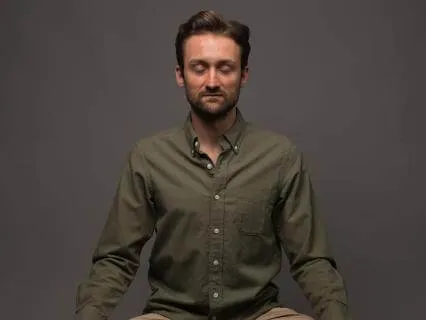
So there are different ways to.
Sit in meditation.
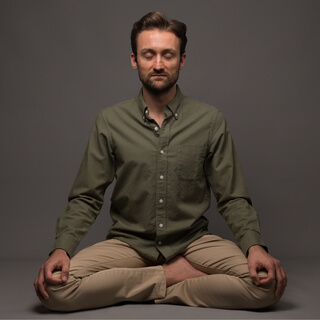
This one here is the most common.
It's the Burmese posture.
The important thing is that you want both your knees to be on the floor.
And you have to have these three points of stability.
If one of your knees is like this,
Then either you need to work on your flexibility little by little by doing the butterfly exercises before meditation.
Or you need to place a little cushion here.
So that you have these three points of stability.
Now this posture is something that with the right props most people will be able to do for a period of time.
Then there are more advanced postures that are used.
By yogis and advanced meditators.
This is the first one that is a little simpler.
You just put the sole of your foot in between.
And this is called the swastikasana.
Then we have the half lotus.
It goes fully above your legs.
Now,
I have some training because I'm able to sit in this posture maybe for 40 minutes,
But it's not so comfortable,
So I rarely use it.
And then we have the full lotus position,
Which typically requires a lot of training to be able to do.
And I never meditate in this posture,
Nor do I recommend for 99% of people.
Now if you cannot sit.
In this posture.
This is the posture that I meditate most of the time.
Sometimes I will.
Meditate like this.
It feels like the energy is more contained,
More centered,
But I cannot sit as long in this position.
These positions don't work for you and this is using a meditation cushion.
You can use a meditation stool.
And sit in the Japanese Or using a cushion,
You can also sit like this in the Japanese Seiza position.
Or if you have a meditation stool or bench,
Then you would place it like this and sit.
Now,
If you're going to sit in this position,
Make sure that you have a soft floor,
Not this one.
So that your instep don't hurt.
So that's a brief introduction for the legs position.
The most important thing when it comes to leg position is that your legs are stable.
And comfortable.
If you are meditating only for 10 minutes,
You need to make sure that you are sitting in a position that you can sit for 10 minutes without pain distracting you from the practice.
Now the most important element in the meditation posture is that our back is straight and unsupported.
One of the most common complaints I receive is that people are saying their lower back hurts.
And that is,
In almost every case,
Fixed by having the right height.
Of cushion and the right tilt of the pelvis.
My lower back is working very little.
I can sit in this position.
For an hour and a half,
And I'm okay.
My back is not gonna hurt.
My feet may hurt,
But not my back.
Now,
When people are saying that their back hurts,
Usually they are sitting like this,
Or too much like this.
And that is fixed by having the right height.
So for example,
If this cushion is not adequate for me,
I could get a thicker cushion or I could put a folded towel to gain more height.
And then we sit on the first third of the cushion.
We tilt our pelvis forward a little bit.
So that our whole spine in a comfortable position without too much strain.
So for example,
This feels more comfortable.
For me,
It feels easier.
I don't need this much height,
But with this height,
It becomes easier.
So you have to experiment with different heights until you find something that works for you.
Now a few more details about the posture,
This time the upper body.
You want your chest to be open so that it's easy to breathe.
You want your abdomen to be able to move.
Without hindrances and so if you're sitting with the right posture in your lower back half of the job is already done.
Now the other part is slightly opening your chest and allowing your shoulders to be a little open and down.
So you don't want to meditate like this,
You don't want to meditate like this,
You don't want to meditate like this.
It's finding the right angle tells your body that I am relaxed.
And allows you to have that sense of balance and free flow of breath.
There should be no tension in the rest of the arms.
Hanging here.
You can just meditate like this if you like or you can use this mudra facing up.
Or facing down In Buddhism they use this mudra.
I always meditate like this.
I find that it has a good effect on the mind.
And it's easy enough to be kept for long periods of time.
Now finally when it comes to the head and neck,
You don't want them to be hanging down like this.
You want your neck to be straight,
Slightly curved.
And you're looking slightly up.
Now in some traditions,
Such as Zen,
They say that imagine that There's someone pulling you from the crown of your head towards the ceiling.
And that allows our whole spine to be more elongated.
Now you may spend a few moments swinging left and right,
Front and back.
Until you find your center of gravity.
And when you do.
.
.
You will notice that it's It's easy to stay there.
And it brings a greater sense of balance and centeredness to your mind as well.
Now when you have found your center,
Your position then you set an intention to stay in this position without moving.
For the entire meditation.
If you need to move,
It's no big deal.
But the stillness of the body will greatly aid the stillness of the mind.
Now,
If sitting on the floor is not an option for you due to your body type,
Health conditions or whatever,
You can meditate seated on a chair.
But we don't meditate like this.
We meditate sitting on the.
.
.
Front third of the chair.
Keeping our knees at a 90 degree angle.
So if the chair is too low,
You're going to have to put some cushion or folded towel under so that you have the right angle.
And if it's too high,
Then you're going to have to put something under your feet.
And it's the same thing the rest of the posture,
It's from here up,
It's all the same guidelines as sitting on the floor.
So the way that you sit on the chair,
Again you need to have that that curvature in the lower back.
So if I'm sitting like this First,
This is going to be painful after a while and now all of this is kind of sinking in and the breathing doesn't happen as freely.
You see,
This is not a great posture.
Now when I sit with that little tilt,
Into pelvis.
Now my back can stay straight more effortlessly.
I can breathe better.
And this has a much more.
A positive influence in our mind.
It makes us more present,
More still,
More attentive.
So that's how we would sit for meditation.
Using a chair.