Hi folks,
This is Dr.
Diana Hill.
I'm a clinical psychologist,
Author of the book Wise Effort.
I'm so glad that you're here.
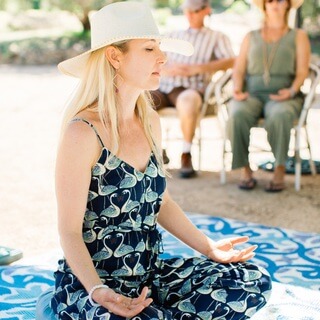
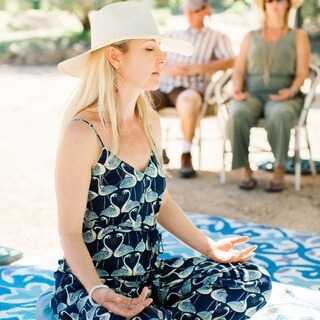
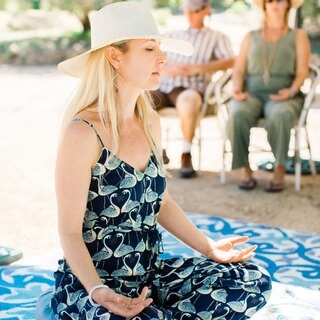
And this is a new type of episode that I'm offering you called Secret Sangha.
The word Sangha means community and it's considered to be one of the three refuges in Buddhism.
I think more than ever,
We need to take refuge in community right now.
And this little Sangha that we have developed meets once a week.
I want you to join us.
So you get to join here by listening in and you're part of my community.
We are a Sangha here on the Wise Effort show.
The second refuge is Dharma.
So you'll hear me share about contemplative practice in these talks,
But you're also going to hear a lot of psychological science.
And today's conversation is drawing from psychological flexibility,
This newer way of talking about psychological flexibility.
So if you're an ACT practitioner,
You'll hear the slight nuance of the wording that I have there.
But if you're totally new to ACT,
You're going to get some practices and ways to think about how you're relating to the world,
Either in a flexible way or an inflexible way.
And then the third refuge is your true nature,
Our true nature.
We can take refuge in our goodness,
Our wholeness.
And I really do believe that when we are in community with each other,
Maybe we get reflected back some of that which is good,
That we can trust.
So enjoy this conversation.
It's live.
You're going to hear me talking to kids in the crowd.
You're going to hear freeway noise.
That's how these things are going to go.
And then you can listen to the meditation as well.
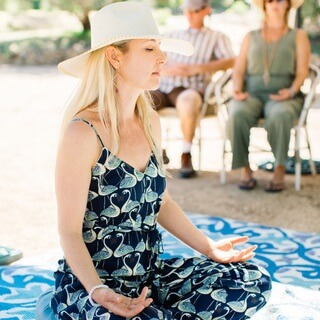
So practice with me.
And your work for this week is to practice psychological flexibility.
We usually give a little talk on a topic.
And then we have a highly guided meditation.
And then we open it up for discussion.
And I am Diana Hill.
I'm a psychologist.
And today we thought about,
We were throwing around different ideas,
But we thought flexibility as a good topic and have sort of a,
This is sort of my,
My specialty is in something called psychological flexibility.
So I thought it would be fun today to introduce this like super highly sophisticated model of flexibility from psychology that is making a lot of waves right now in that there's a good amount of research showing that if you are psychologically flexible,
If you're able to stay open,
Aware,
And engaged,
Even when things are difficult,
If you're able to contact the present moment fully as a conscious human being,
And then you can change or persist in order to serve your own sort of values of what matters most.
If you can say yes to things that you're scared of,
Then not only do you have end up having better mental health,
Your relationships get better and you can navigate really hard things.
And then you're also,
Your performance gets better.
So the type,
The six ways of being psychologically flexible that we're going to talk about today,
And that we're going to practice in our meditation are being used in everything from like sports teams,
Like really high level sports teams,
Their coaches are teaching psychological flexibility skills,
But also the World Health Organization has adopted it as the primary intervention for refugees,
So it's being used and disseminated in Syria,
In the Ukraine,
And then it's also the primary treatment of choice for things like chronic pain.
So psychological flexibility has these sort of six ways of relating to your inner world.
And if you think about something that you're struggling with right now,
Could be a relationship or you're about to get your braces off and you don't know if it's going to hurt,
What will be like,
Are your teeth going to be slimy,
Or maybe you have a work project or you're in a place of indecision.
One of the things that we tend to do is we tend to get inflexible around it.
And we can get inflexible with our minds,
Which is called cognitive inflexibility.
Cognitive inflexibility means whatever your mind says,
You believe.
And unfortunately,
Our minds evolved to keep us safe but not to live very good lives.
So if you think about that struggle that you have or the thing that you're in and the relationship you're in,
What your mind says about it,
Does your mind have something to say?
And is that thing helpful,
Motivating,
Encouraging,
Kind?
I was just doing,
I was in Reno doing this training for therapists.
Hundreds of therapists came from all over the world.
Someone from Turkey came and brought me Turkish Delight.
Have you had Turkish Delight before?
A big box of Turkish Delight.
I almost brought it for you all.
Maybe I'll bring it next week.
So somebody from Turkey came.
There was someone from Peru and someone from Australia.
And we do these long trainings.
It was called the ACT boot camp.
So we'd start in the morning.
We'd go all the way until seven at night.
And at the end of the day,
We'd do these real plays where you'd have to get up on the stage and then pull somebody,
Like from the hundreds of people in the audience,
Some person comes up and gives their problem.
You have to demonstrate the therapy.
I had to demonstrate the therapy to show people what we were doing that day.
So we're at the end of this really long day.
I'm exhausted.
And everyone's going out to dinner afterwards.
But the night before,
I'd come in a little bit late,
And I'd gotten the best salmon salad at my hotel.
So these like,
Kind of rad researchers,
Innovators,
People are going out to dinner.
And I get in the car with them.
And I'm like,
Can I just get a ride back to the hotel?
Because I have a salmon salad that I want to get.
And I'd figured out how to work the TV in my hotel room.
Right.
And sometimes our mind tells us things that keep us safe,
But don't lead us to have a bigger life.
Right.
My mind said,
Just go back and be by yourself.
So psychological flexibility is learning how to say thank you to your mind,
But not always obey it.
And then we have emotional flexibility is another aspect of psychological flexibility.
So if you think about that struggle that you're having,
Or the decision you need to make,
Or a difficulty you have,
What emotions show up for you?
And when we're inflexible with our emotions,
We are either fixing or flooding.
So fixing is we're trying to make it go away.
Or flooding is we're swimming in them so much we can't see clearly.
And maybe you lean towards one or the other.
But emotional flexibility is being able to allow the wave of emotions that come to us in life,
Be willing to experience them.
Say yes to what you're scared of so that you can do things that matter.
Yeah.
So I'm like,
Okay,
Don't drop me at the hotel.
I'll go with you.
It was kind of scary.
It's kind of more scary than doing the real play on the stage in front of hundreds of people,
Was going to a dinner with like five.
And then we can have attentional flexibility.
So these are all flexibility with your inner world.
If you think about that problem,
Where does your mind go?
Our inflexible attention is either scattered attention or over-focused attention.
All you can do is think about that problem.
Everything you see is related to that problem.
Or your attention is so scattered and you can't focus it where you want it to focus.
So attentional flexibility is your ability to shift your attention to where you want it to go.
And that's a lot of what we're doing in here when we do the meditation,
Is we learn how to be in charge of our own attention.
Am I putting my attention on my breath?
Or am I expanding my attention to the room?
Am I putting my attention on compassion?
Perspective is another aspect of psychological flexibility.
Inflexible for perspective taking.
If you think about your problem,
Can you only see your perspective and not see the other persons or other peoples?
Are you unable to take a compassionate perspective on yourself?
So flexible perspective taking is everything from like,
If you think about your problem,
What would be the perspective of your problem or your struggle from the person across the circle from you?
What would be the perspective of your problem from yourself 30 years from now?
What would be the perspective of your problem from the tree outside your window?
See how it shifts?
That's flexible perspective taking.
And then we have flexibility in our chosen purpose,
Being able to choose what matters rather than what other people think or what the rules are or what it should be.
And when you're inflexible with your purpose,
You don't have a purpose or you don't know what your purpose is.
When you're inflexible with your purpose,
You don't pursue what matters,
You pursue what you should do.
A very classic line is to ask yourself,
If this weren't such a problem for me,
What would I be doing?
If this wasn't such a problem for you,
What would you do?
And then finally,
Behavioral flexibility is being able to make small moves,
Tiny moves,
Sometimes minuscule moves,
Say yes to go to dinner,
Right?
Tiny moves that are in the service of your values and those become habits and then you start to build a values-based life.
Kelly Wilson,
Who's one of the founders of ACT,
Says,
When we describe that which is unacceptable,
We describe the edges of the world we are free to inhabit.
So the flip of that is when you're flexible and you describe what is acceptable,
What you are willing to experience,
Then you can describe the edges of the world that you will inhabit and it becomes a much bigger world.
So that's a little 101 on psychological flexibility.
We're going to practice with a flexibility in our meditation,
Psychological flexibility,
And we're going to move around.
This is called the hexaflex of psychological flexibility.
So we're going to move around the hexaflex and we're going to touch on all of these pieces for ourselves and our own struggle.
And good luck with those braces.
Yeah.
He goes to the same orthodontist that my son goes to.
And when you get your braces off at that orthodontist,
They give you a big bag full of all the things that you weren't allowed to eat,
Like gummy bears and peanuts and candy corn.
Did you get that?
Thank you so much for listening to this episode of the Wise Effort podcast.
Wise Effort is about you taking your energy and putting it in the places that matter most to you.
And when you do so,
You'll get to savor the good of your life along the way.
I would like to thank my team,
My partner in all things,
Including the producer of this podcast,
Craig,
Ashley Hyatt,
The podcast manager,
And thank you to Bangold at Bell and Branch for our music.
This podcast is for informational and entertainment purposes only,
And it's not meant to be a substitute for mental health treatments.