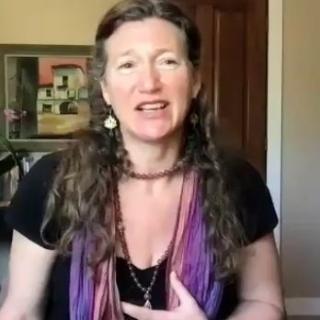
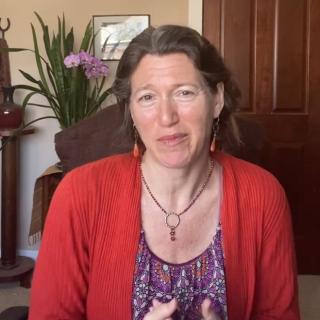
Hello,
And welcome to your practice.
If we haven't practiced together before,
My name is Arielle Schwartz,
And I'm also the author of Therapeutic Yoga for Trauma Recovery,
Applying the Principles of Polyvagal Theory for Self-Discovery,
Embodied Healing,
And Meaningful Change.
And I wanted to come in specifically for this time together today to share with you some of the practices,
Some of which are in the book and some additional practices focused on applying those principles of polyvagal theory for the purpose of regulating your nervous system.
Sometimes this gets referred to as natural stimulation or neuromodulation of the vagus nerve.
And I think it's a confusing term sometimes because it's the vagus nerve,
Which is associated with our parasympathetic nervous system,
Ultimately has a calming effect.
But when we are stimulating the vagus nerve,
Sometimes that word stimulation seems that we're going to somehow be kind of energizing or activating the body.
And the truth is,
Is that stimulating vagus nerve does both.
So what it actually allows us to do is respond to our environment and to our internal experience by up-regulating or energizing as needed or calming and down-regulating as needed.
And so when we stimulate the vagus nerve,
What we're really doing is kind of waking up more of your body-mind connection so that you can be a better responder for your own personal needs and for the environment around you.
So the first part of this practice invites you to begin to notice the state of your own nervous system.
One of my mentors,
His name is Dr.
Stephen Porges,
And he's the originator of the polyvagal theory,
And he coined a term called neuroception.
And neuroception is something that our nervous system is doing all of the time,
Basically determining whether we feel safe or whether there's a threat and leading us to respond to that sense of safety or that sense of being threatened.
And we'll do this unconsciously.
It's a way that we're kind of built for survival.
However,
We can bring conscious awareness to the neuroceptive cues by paying attention to our somatic experience,
The heart rate in your breathing,
And quality of your thoughts and emotions.
So when we pay attention,
We can actually kind of gauge what is the state of our nervous system and whether we are having a kind of threat response when we're actually indeed currently safe or at times when we are not responding in a way to protect ourselves and there's actual threats in our environment.
So by paying attention to what's happening inside,
It lets us fine tune and be more accurately responsive.
So with that said,
I'm going to invite you into some practices.
And I will say that you can kind of do this at your own pace,
And you might do just a few practices and then build your capacity to stay with the practice longer.
And the most important thing is to listen to your body all the way through.
Your body is going to keep giving you feedback about which practices really nourish you and work for you and which practices don't support you.
So listening is the key to success.
With that listening as our intention,
I'll invite you to begin to notice what's happening for you right now.
And your eyes can be open or closed for this practice.
So constantly knowing that you have choice about how to move into any practice helps facilitate a sense of safety.
And as you notice your own nervous system,
Perhaps sensing the quality of your thoughts,
Your mind,
Whether your thoughts are racing around or whether you feel more focused and present.
And again,
There's no judgment,
There's no better or wrong state of your nervous system right now.
It's really just about getting to know what's present for you.
And then noticing your body.
Any physical sensations that are here for you right now,
Responses of tension or contraction in your body,
Any areas of ease.
And right now we're not trying to change anything,
We're kind of getting a baseline for what you're bringing into this practice.
And closely connected to our body,
Of course,
Is the breath.
So noticing your breath.
Noticing where the breath seems to flow smoothly or where,
Again,
You might feel some constriction.
Whether it feels easy to take a deep breath or difficult,
Or maybe you're breathing in a shallow manner,
Whether you notice if your sinuses feel clogged in any way,
Congested.
And closely connected to our breath are our emotions.
We can think of emotions as kind of what we allow ourselves to feel in this moment.
And sometimes when the breath is shallow,
It restricts our ability to feel.
Maybe we're not inhaling fully or allowing our internal awareness to sense what's happening inside.
And maybe our exhales are blocking our expression of our feelings.
Just making more space.
Noticing what is present for you emotionally and inviting more of yourself to arrive here.
And closely connected to our emotions is energy.
We can think of energy as the kind of quality of whether you can feel kind of real restricted or tight or small or contracted.
Whether you feel like you can energetically take up space.
Whether you feel alert and vibrant or dull and heavy,
All of that might give you feedback about the quality of energy.
And taking all of this in,
Mind and body,
Breath,
Emotions and energy,
Noticing how that might give you feedback about the state of your nervous system right now.
And you can return to that kind of check-in all throughout this practice.
So as we begin to explore the layers of practice that might facilitate subtle change,
The first of these will be what we call in yoga the sum of riti or the balanced breath.
And so in this breath pattern,
There's an invitation to find an even length of your inhale and an even length of your exhale.
It's very balancing often for the nervous system.
And I'll invite you to find and start with a four-count breath and you can expand that to six or eight.
But inhaling for one,
Two,
Three,
Four,
And exhale one,
Two,
Three,
Four.
So you might notice that my hand is kind of moving in this circular motion.
You can keep breathing here,
Finding your own count and lengthening it if you'd like.
And the hand here,
Which you can do or just observe,
Is kind of representing the smooth transition from the inhalation to the exhalation,
And from the exhale back to the inhale.
Good.
And perhaps you begin to sense that at that top of the inhale,
Just like a feather on the air,
You might float for a moment before smoothly entering your exhale.
And perhaps at the end of the exhale,
You might gently pause and empty before progressing back into your inhale.
Now,
If at any point those pauses create anxiety or distress,
Drop them,
Come back to the smooth circular motion,
And finding one more breath with or without those brief pauses.
And then noticing perhaps any subtle shifts in mind,
Body,
Emotional tone.
Our next practice is something that's talked about quite a bit in the Natural Vagus Nerve Stimulation literature,
And it's called the Valsalva Maneuver.
And it's basically a practice of holding your breath on the inhale,
And as if you were trying to exhale,
But holding back on that exhale.
So you might take a deep inhalation,
And like you're about to go underwater,
Hold that,
And press out with the exhale,
But don't let it go.
So I'll show it,
It's kind of hard to see or certainly speak about and demonstrate,
So I'll show it and then talk a little bit more.
Now,
If you find it difficult to hold the breath and press against it without some air leaking out your nose,
You can squeeze your nose,
Like again,
You're going to kind of go underwater,
But it's as if you're trying to press that air out and you don't let it go.
So I'll show with the nose squeeze here,
Inhale,
And let it go.
And if you like that,
You might pause and do a few more of those.
Again,
Some practices are going to resonate for you,
And you'll feel like,
Wow,
That just brought me right back in,
And some not so much.
So get to know what serves you.
Okay,
Our next practice is something that I've always heard referred to as the straw breathing practice.
You can give it your own name if you like.
In this practice,
We're going to turn our lips into a kind of purse shape like a straw,
And this is a exhale-emphasized practice.
So in this practice,
We do just a natural short inhale,
Just let it happen.
The exhale is a long count,
So it's actually a 10-count exhale in all.
There's eight counts through the mouth.
The last two counts,
You're going to send a kind of more forceful breath out the nose,
Drawing the navel in to let all of the air out of your lungs to empty,
And then let the breath fill.
So I'm going to show this,
And I'm going to count the breaths on my fingers,
And I'll let you know when to transition to your nose,
And then we can practice it together a few times.
So inhale naturally,
And exhale through the mouth,
Through the nose,
Inhale.
And let that go.
You might notice a subtle change in the temperature of your body or your heart rate,
The quality of focus of your mind,
Alertness.
We'll do one more together.
Inhale naturally,
And exhale through the nose,
And inhale naturally.
All right,
Maybe join me in a little bit of that sigh,
Let something go,
Just inhale,
And sigh something out again.
So the vagus nerve travels through the larynx and pharynx in your throat.
And so when we vibrate our vocal cords,
We're vibrating the vagus nerve.
Vagus nerve also travels into the inner ear.
So when we hear the sound of that vibration,
It's going to create a little stimulation of the vagus nerve once again.
So this next practice in yoga is called Brahmari Pranayama.
It's a humming breath practice.
And you can amplify that vibration of the humming by closing off the ears.
You can close off with the thumbs.
And there's a little tragus flap in the front of the ears,
That little bit of cartilage.
And you can use that to close off your ears.
And you can use your hands.
You can have your hands up.
Sometimes this is practiced with hands down,
Just play around with it.
I'll use my thumbs here.
And you can even use your hands here,
Kind of across your forehead,
Just closing your eyes and really sensing the vibration of the sound in the entire cavity of your head.
So the other thing I'll say about adding the vibration of sound is you can kind of choose the tone of your humming.
So we're going to hum.
We're going to close off the ears.
And you might hum low.
You might hum in a mid-range.
You might hum in an upper range of your vocal toning and just notice the feeling in your body and where the humming resonates.
So we'll do three rounds of this.
And if your ears are closed and you're humming,
You might just go more inward and be paying less attention to my sound or what I'm doing.
I'll invite you to start with an inhale and begin here.
Mm,
Following your own rhythm of breath and humming.
Again.
And one more time.
And when you've completed this practice for yourself,
Letting your hands rest and simply noticing these pauses between the practices become a very sacred part of the whole practice.
It really allows you to notice those subtle changes.
All righty.
I'll come into another practice here if you'd like to continue with me.
And this one is based on something called oculocardiac convergence.
And it's basically this recognition that the focal capacity of our eyes,
Whether we're focused or panoramic in our vision,
Is actually very connected to our heart rate.
So if we think about the vagus nerve,
Once again,
Vagus nerve is traveling in and connects to the muscles and even other cranial nerves around the eyes and also connects into the heart and our lungs.
So we can notice sometimes that when we feel relaxed,
We're much more naturally panoramic with our vision.
It's like all of a sudden we can kind of see the horizon more clearly.
And when we're stressed,
We can feel a little bit of that tunnel vision coming in.
So we can also access this in the reverse,
Which means that we can kind of work with our eyes and perhaps facilitate change in the overall tone of the nervous system.
So in this practice,
I'll invite you to place your hands together and you can kind of gauge the distance where you might be able to just focus on your thumbs or the tips of your fingers,
Whatever you choose.
Just let your eyes be kind of focused and obviously somewhat close in with the focal point.
And then we're going to transition by opening the hands and letting your hands come out wider so that your eyes can kind of trace in peripheral vision,
Your fingertips in the side view.
And then bringing your hands together,
Letting your eyes come towards the central focus.
And then allowing your hands to widen and broaden.
So as your hands are broadened and your vision is more peripheral,
Also maybe take your eyes as if you're looking at a far off horizon,
Far off horizon and kind of in a way taking in the entire horizon line all the way back around to each fingertips.
So this real broad sense of vision and of a far away gaze.
One more time,
Coming back to center.
And broadening out,
Widening your vision as if you're looking at a far off horizon or maybe all the way out to a distant star.
And coming back,
Releasing your hands and then noticing.
I'll invite you for our next practice to rub your palms together and a little bit of warmth in your arms.
And then bringing your hands just sweeping across your hairline,
Your forehead,
Your cheekbones out towards your ears,
Maybe pausing there,
Giving your earlobes a little love,
Massage out through the earlobes.
And then we'll go back to that tragus that we closed off before and just kind of let very gentle little tragus massage.
The tragus tends to be one of those focal points for vagus nerve stimulation.
There's little devices that you can clip on to your tragus or your earlobe that creates a little electrical stimulation.
And of course,
We can do this naturally as well.
Giving a little bit of love there,
Back to your earlobes,
Massaging them out and then taking your hands behind your ears.
It's often a tender point or the muscles of your jaw and ears kind of meet and you can massage around below and front and behind your ears.
And then down through the sides of your neck.
You might even give that those strong sternocleidomastoid muscles and scalenes a little massage and then reaching your fingertips behind,
Massaging around the occiput or the base of your skull,
Right underneath the bones of your skull there.
And then from shoulders down to your elbows,
A little bit of self-havening touch.
Lovely,
And letting your hands rest and receiving,
Noticing.
Noticing the feeling of your face,
Your ears,
Your neck,
And your arms.
So our final exercise here,
Final little exploration,
Is just a little bit of spinal movement.
So once again,
As we're tracing the vagus nerve,
We also recognize that vagus nerve goes below the diaphragm and into the digestive organs and a little bit of spinal movement.
And I will say that I'm doing this practice seated on a bolster on the side of my head.
But you can do this seated in a chair,
On your couch,
In your bed.
There's lots of ways to move into this.
And I'm taking some spinal flexion and extension.
And you might even find a little side-to-side movement.
You might even twist a little bit each side,
Just super gentle.
And you can even find a little bit through your cervical spine,
Your neck,
Looking your gaze down to the front and to the other side,
Maybe around,
But very gentle on the cervical spine.
And coming back to center,
A moment of stillness.
One more opportunity to notice your mind,
Body,
Your breath,
Emotional tone,
And your energy.
Okay,
So last piece that I'll leave you with before we close out for today is when you look at the research about vagal tone and what facilitates optimal vagal tone,
One of those elements is connecting to your heart,
Whether that's through a gratitude practice or whether that's through loving kindness.
Some way or another,
Being able to connect to a sense of kindness towards yourself,
Gratitude perhaps for one thing or person in your life that brings you a sense of peace or ease or joy,
And being able to just take a nice loving breath into your heart,
Your physical heart,
Your spiritual heart.
And with that,
I'll offer a close for today,
Knowing that you can come back to this practice,
And obviously there's many more practices in my book and that I have out there for you.
Whatever brings you back home,
Which I think we need so much in our world right now.
Thank you for practicing with me.
Namaste.