Hi,
It's Dr.
Arielle Schwartz.
I wanted to come on and just do a little bit of a personal share and also a little bit of a guided embodiment practice.
So the first thing that is just present for me right now is that I want to share with you that all of the practices that I teach,
Whether it's on my yoga mat,
Or what I write in my books,
Or what I do in these mini talks,
I share them with you because I use them for myself.
I was just sharing this with someone this morning in a call,
And it just felt important to share this a little bit more broadly,
That I have wrestled with my own anxiety,
I have grown up with my own struggles,
And none of us are immune to this kind of human journey that we're on.
We might want to pretend that we are,
But in reality,
When we drop in,
We all have that capacity to be vulnerable and to be impacted and to feel sensitive to this world that we're in.
And we all,
At times,
Need to really drop into care,
Whether that's offering care to ourselves through something like a self-compassion practice,
Or whether that is providing spaces for ourselves to be cared for by others,
To really allow others to hold us and to reach out for that contact.
So it's part of what keeps the whole wheel turning.
I say this a lot,
That when I'm taking good care of myself,
Or allowing myself to be cared for,
It's also what allows me to care for others.
And I'm so grateful to be on both sides of that caring relationship.
So I want to speak today about one of those particular strategies,
Which I draw upon a lot,
Which has to do with self-compassion and what I'll call today embodied compassion.
And that the places where we tend to feel tight or constricted or afraid or shame show up,
It's not so much up in our minds,
But it's really how it shows up in our own bodies.
And whether that's areas of constriction,
Or how we're breathing,
That there's some way in which the body is the marker for the pain,
And it will hold on to that until we have the time and space to drop in and attend to it.
So that's the invitation right here.
And if this isn't right time and space for you,
You can pause this video and come back to it.
But if you have a few moments and just want to turn inward,
That's the first invitation in this practice is to just allow your senses to go inward.
And I'll model this here for a moment.
And you can even just allow your hands to come over your face.
You could even cover your ears and your eyes if you want,
As that kind of somatic holding for your attention to turn inward.
So you can still hear perhaps the sound of my voice if you're not closing off your ears too tightly.
But allow these words to just invite your attention to drop inside,
Perhaps to scan what you're noticing on the inward terrain of your body,
Emotional tone,
What's been showing up for you in this complicated world that we live in.
How is that landing inside of you?
And if at any point this feels like it's too much to go inward and turn toward that,
You can simply open your eyes and come back out,
Right?
And whether that's oriented to something beautiful in your environment or just feeling my voice or seeing my face,
Right?
So that you can choose to go inward and come back out so that that's the pacing of the first stage of this embodied compassion practice.
And then the second step is to just notice what's present for you.
Are there any areas of constriction or tightness,
Pockets of emotional tone?
Maybe a constriction around your breath.
And as you notice this,
Especially if it's an area of your body where maybe there's tension or tightness,
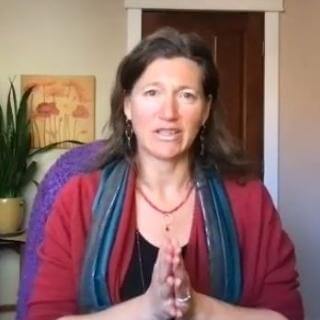
See if you can invite your hands to come right over that place.
So I'm going to do that here as I speak to you.
Just allowing yourself with your own hands to communicate the simple message of I'm willing to be present with this feeling.
I'm willing to be present with you.
And you can pace yourself going toward this and coming back out,
Looking around your space.
I'll look at my flowers,
Right?
And then going back in.
And you might even explore what this feeling is needing from you,
Whether you might move toward it,
Bring more breath into it.
Are there any movements of your body in relationship to that felt experience?
Are there any words or sounds that match the feeling?
Whatever it might be,
Right?
It's really being with what's present.
And sometimes when we awaken to one part of the body,
Something begins to move and you might feel that something else wakes up and you might bring your hands to that next place.
And I'll offer another layer here,
Which is that if at any point it feels like,
Whoa,
I woke up to this and there's a lot there,
I'm going to invite you to move your attention to one area,
Either of your body or to your external environment that feels okay right now.
That might be your feet on the floor.
That might be feeling the palms of your hands.
That might be amplifying a sensation of okayness by bringing your hands over some part of your body that maybe doesn't feel in distress,
Doesn't feel in pain.
Sending your breath and your full awareness into that resourcing area.
Not that we're going to ignore or leave behind any place in your body that might be hurting,
Any emotional tone of distress,
But just to have a kind of widened container,
Widened capacity to be with that.
So we're going to breathe into that widened container by tapping into some area of resource.
And then if you would like,
Making another good full breath into that area of resource,
Whether that's another part of your body or your external environment.
And then we're going to bring that,
It's like if we can get sticky with that positive state and bring it right over to that area that was calling for your attention.
And just kind of bringing together the nourishment,
The resource,
That expanded sense of space into wherever the tightness resides.
And then the last part of this is to maybe move back and forth between that spaciousness or that resourced place and that place of discomfort or holding.
And as you alternate or pendulate your attention,
Just notice what changes.
Maybe offering just a little bit of appreciation for your body,
Your emotions,
For holding on to whatever that pain or overwhelm or distress,
Anxiety,
Whatever that might have been,
Just holding that until you had the time and readiness to be present with it.
So a little appreciation.
And then slowly,
And this is an important part of any practice,
Is that as we come to completion,
And of course,
You can redo this if you're not done yet,
You can rewind and listen for some more support.
But when you are complete,
Really allow this to be enough for now.
Say,
Ah,
I attended to one area of discomfort or pain or distress,
And I gave a little bit of my love and I gave some care and compassion and acceptance right into that place,
And that's enough for now.
And so we kind of close the book for now.
We leave a little bookmark if we need to come back.
And thank yourself for giving yourself this time.
And perhaps if you're aware that this wasn't quite sufficient as enough external support,
Then continue to reach out and turn towards those that can hold you.
And it's such an important part of the entirety of this world is that we give and receive,
And receiving being a key component.
So thank you for allowing me to give this to you at this time,
And we'll connect again soon.