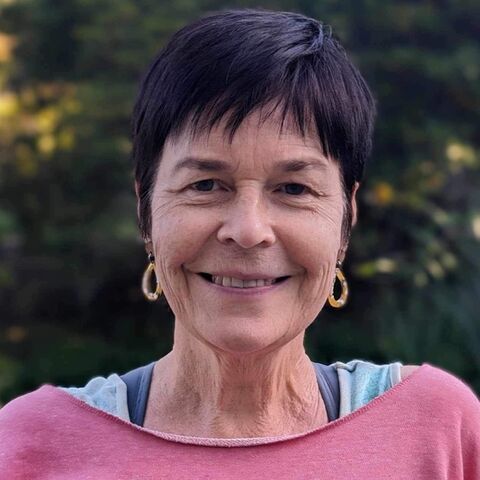
Recorded by Adele Stewart,
MBSR teacher in Woonoona,
April 2020.
So finding yourself a comfortable position for meditation,
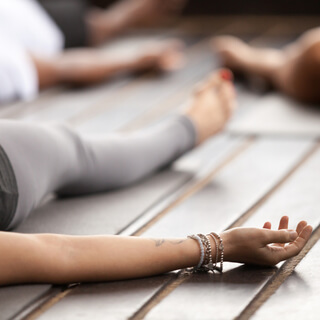
Perhaps sitting on a dining room chair or using a kneeling stool or sitting on a cushion on the floor or even lying down if that feels right today.
And within whatever position you choose,
Seeing if your posture can reflect your intention to meditate now.
Seeing if your posture can reflect the right amount of effort.
So not that over-striving,
Hard rigidity and not too chilled whatever casual attitude.
That nice balance in between.
And taking a few seconds to just notice what you bring to this meditation in the body,
Heart and mind.
Seeing if it's possible to allow whatever's present right now to be here.
To be here.
And now narrowing that focus of attention to the breath.
So we're not imagining the breath or analyzing it or visualizing it.
As best we can of actually feeling the breath in the body.
And throughout the rest of the meditation,
I'll be dropping in some questions to help become more intimate with the breath.
To help that focus and clarity.
These questions are not meant to be cognitive questions for the mind to solve a problem.
As best you can,
Just receiving them and noticing what comes up.
And just ignoring them if they don't work for you or if they get the mind overly stirred up.
Starting off by seeing if you can notice where in the body is the breath easiest to notice.
Not just assuming the answer but actually investigating the felt sense.
Perhaps that might be in the nostrils.
Where the air touches the walls of the nostrils.
Might be in the mouth or throat.
Or it might be in the rise and fall of the chest or abdomen.
Now to practice.
Which direction is your breath going?
Again,
Not where it should be going,
But where is it?
Up,
Down,
Outwards.
Again,
Not where it should be going,
But where is it?
Up,
Down,
Outwards.
Is the breath clearer and easier to follow on the inspiration or the expiration?
Or the little gaps in between?
Becoming intimate with the breath.
Allowing the breath to breathe itself.
No need to control or manipulate.
Can you be gently curious about the next breath?
Which will be subtly different from the breath before and the breath after.
And of course,
Like with any meditation,
The mind will get distracted.
Thoughts,
Sounds,
Other body sensations.
This is absolutely no problem.
In this meditation,
The breath is our primary object of meditation that we're focusing on.
And if we notice anything else,
It can become our secondary object.
Just noticing the way the thoughts come in,
The texture of the sound,
The quality of a body sensation,
And gently coming back to the primary object of the breath.
Every time we do that,
We're improving our ability to pay attention,
To shift attention.
Shaping the brain.
Shaping the brain.
Some other very light questions that can help that investigation.
Some other very light questions that can help that investigation of the felt sense of the breath.
So we're coming down really close to it,
Really getting to know it.
Regular or irregular.
Deep or shallow.
Is there any resistance to the breath in the chest or the nostrils?
Or is it flowing quite freely?
Is there a sense of the quality of the breath today,
Right now?
Somewhere on the spectrum between springy and full of life.
Or a sense of flat lifelessness.
And how about the texture right now?
Is there a smoothness,
A silkiness?
Or is it more rough and ragged?
Is there a smoothness?
Again,
No need to change the breath or control it or manipulate it.
This is actually a mindfulness practice,
Not a breath practice.
Okay.
Okay.
Okay.
No need to block out any other experience that arises.
Sounds.
Urges.
Remembering not blocking out an urge doesn't necessarily mean that we follow the urge.
We can still notice it and not necessarily act on it.
Another experience like thoughts,
Of course.
Agitation,
Restlessness,
Drowsiness,
Sleepiness.
No need to judge any of our experience.
Forcefully block it out.
Just gently noticing it.
Perhaps spending a few seconds investigating it.
Again,
On the physical level can be really useful way of investigating all of our experience.
And then coming back to the breath.
Okay.
Okay.
Okay.
Okay.
Okay.
Okay.
Focusing on this breath.
And this breath.
Okay.
Okay.
If you notice you've been thinking.
Perhaps you can see whether it's affected the breath in any way.
Okay.
Okay.
Okay.
Okay.
Okay.