Hi,
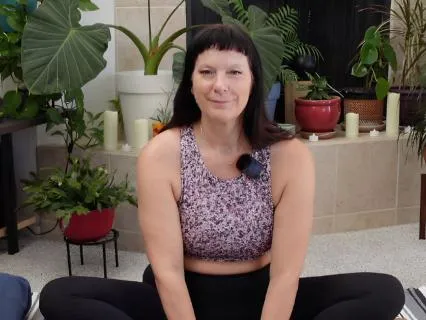
And welcome to this Yin Yoga session that is meant to help rebalance and reset.
It's a 30 minute practice.
So just a few poses.
But I just know you're going to be feeling so much more relaxed,
Grounded and present through doing this practice.
I'll see you in the video.
My name is Kumari Skye.
I'm the relaxationist.
And I love sharing the practices that have helped me heal my nervous system and come into more of a place of peace and balance in my life.
Start out together,
Just taking a few moments of centering and a few deep breaths.
Go ahead and find whatever position is comfortable for you.
Close down your eyes.
Take a long,
Slow,
Deep breath in through your nose.
Softly sigh it out.
Another just like that?
This time,
Two sips of breath through the nose.
Pausing here to connect with the body.
Noticing how your body's feeling.
As we sit in this stillness.
And there's a N-word practice.
I like to think of it as a gateway to meditation.
You can use your breathing to help you bring yourself back to the present moment at any time while we're practicing.
Let's inhale the arms up overhead.
Exhale,
Take a little twist off to one side.
Take another breath here.
Inhale,
Bringing your arms up.
And exhale and come to the other side.
Inhale,
Come on up.
Exhale,
Bring your hands behind your back and release your fingers,
Pull the shoulders down,
Gently raise the gaze.
Inhale,
Arms come up.
Exhale,
Right arm in front.
Or left,
It doesn't really matter.
Inhale,
Come up.
On our side.
One more little warm up stretch,
Just a little side stretch over to one side.
Inhale,
Come up.
Awesome.
All right,
Let's take a little time for Child's Pose.
Really so many ways that you can do child's pose.
If you happen to have some props,
Those are always nice to help you get more settled.
So again,
However,
Child's pose is going to work best for you.
I'm feeling like feeling it a little on my shoulders today.
So I'm going to use my blocks,
But you could also use a bolster for this.
Come down like this.
Hey,
So while you're here,
As you've gotten settled,
Start to come back to your breathing.
When we practice,
We want the breath to remain smooth,
Even and continuous.
And this sends a signal to the nervous system that all is well,
That it's safe to let go and relax into this pose.
You've got one more minute here.
So allowing the body to soften.
I'm just feeling a couple more long,
Slow,
Deep breaths.
While you're in your child's pose,
Just going over the sensations you're feeling one more time.
Placing your palms on the floor and pressing yourself up and away from the shape.
Maybe taking a moment to stretch out your legs.
Do some cat and cow movements.
Next off,
We'll be doing a butterfly pose.
I always recommend sitting up on something.
So this is like a thin,
Firm blanket,
But you could also use a folded blanket,
Or a block or bolster.
For most people coming up a little higher with the hips is helpful.
No.
You can draw the soles of your feet together.
We're looking to create sensation in the inner thighs.
If in your,
Excuse me,
Your body,
It feels better to have some support,
You can do that.
You don't even have to lean forward if you're feeling that nice tug in the inner thighs.
Other ways of practicing using something to come out front to lean into.
If this is bothersome for your lower back,
You by all means can do this laying on your back.
Yin is all about creating sensation.
And that's what we're trying to do here.
Spend a little time creating sensation in the inner thighs.
Close your eyes.
And bring your attention inward.
Notice what you're feeling.
Keep coming back to the rise and fall of your breath.
Listen for signals that your body might like to take this a little bit deeper.
Or maybe there's a signal that your body is asking for a little less intensity.
We're always endeavoring to find this space,
Not too much,
Not too little.
Bye.
Take one more breath here.
Releasing,
Lean back into your hands.
Let's let the hips relax a second.
And then from there,
You might extend out the legs.
My favorite is windshield wipers after butterfly pose.
Next up we'll do the sleeping swans.
You might know this one as the half pigeon pose in other styles of yoga.
So in yin yoga,
A lot of them are renamed.
So we remember that we're doing them in a really yin like manner versus our more active yang like practices.
I like to lean into the bolster.
And in case you're still not knowing what I'm talking about.
It's this one,
All four and then you bring your knee and ankle or knee and wrist together,
Then slide the hips down.
So my hips are mostly equally level towards the floor or the mat.
And I'm wanting to feel a big stretch in the glutes and thigh of whatever leg is in the front.
So You can adjust you can put this leg under a little bit more or bring it out a little more.
You can also do this laying on your back.
Then I like to take a bolster and hang out like this.
You also might be feeling something in the hip flexors or the front of the thigh of your leg that's out long.
You can stay upright and propped or you can come down.
This one can tend to be pretty sensational.
So just be with that,
Breathe.
Letting time be the magic ingredient here.
Our muscles receive a nice big stretch.
And the fascia and connective tissues receive some nice stimulation.
They don't really stretch very much,
But A little,
Like four to six percent.
But what happens is we don't want to overstretch because that's what happens when we get like a sprained ankle.
We did too much too fast.
So we just want to take this slow and easy.
Keep in mind that not too much,
Not too little,
Sensation-wise.
Okay,
So I'm going to be quiet here for the rest of the time.
You We'll begin to make our way from this pose,
Rising up.
I really enjoy some windshield wipers in between.
Another thing I like after that is just this little roo-roosh tabletop or hammocks.
And then we'll move on to practicing on the other side.
I don't know if I mentioned this on the other side,
But it is totally fine to stay more upright if that suits you better today.
Starting the timer for you.
Diving right back inward.
Welcoming the sensations and seeing if you can breathe into them.
Really noticing the quality of the sensation.
Until all of this awareness is what ultimately is going to help you regulate your nervous system.
When we are practicing with intention and consciousness,
We know the body's limits.
If we start to push too far,
Then then we're actually not helping.
We want to be in a place where we can melt,
Relax and let go.
And then this slows the brainwaves.
When the brainwaves slow.
This is when the potency of the practice really kicks in.
This is when your body's innate healing and balancing properties really shine.
A lot of silence for the rest of the time.
Enjoy one more full,
Deep breath here.
Mmm.
Easing your way out.
Kill some movement.
Welcome that hyper oxygenated blood into the hip joint.
Nice.
All right.
Short and sweet practice today,
We are going to do a supported reclined twist.
Actually,
It doesn't have to be supported if you don't want it to be.
So lying on your back,
If you want the supported version.
This is what it would look like just a little gentler,
A little less intense.
But really,
You're free to do whatever twist works in your body.
The main thing is we're just looking and wanting to put the spine in that twisted position for several minutes.
Be sure you're turning your head the opposite direction of your knees.
There's layers and layers of muscle and tissues.
Protecting the spinal column.
So resting in a twist every day is so,
So valuable.
Spinal health is truly a key to long-lasting vibrant health.
With each exhale,
Feeling the weight of your body letting go.
Notice how your body can relax even if it's in a funky position.
And if it's not fully relaxing,
How can you support yourself?
What changes could you make to make this a little more accessible?
Take a breath as you bring your head to center,
Your legs to center.
Ease on over to doing your twist on the other side.
We get to practice giving ourselves what we need.
That's a beautiful thing that we can practice that we can really take off the mat.
Sometimes it's hard to ask for what we need.
And so when we give ourselves what we need,
When we keep making adjustments,
We use the props,
We do it a little different than last time.
This is really the foundation for the ability to speak our truth,
To say what we need.
Practice taking a few fuller breaths here and come back to that idea of softening with the exhale.
Either way back to center.
You might simply just give your legs a hug in.
Do a happy baby.
Finishing off with a little bit of a Shavasana.
I like to put something under my knees.
I'm going to rest my hands on the lower abdomen.
Take all the time you need to get settled here.
And then when you do,
Simply follow your butt.
And allow your whole body to let go.
Relax and receive this stillness.
Back to your breath.
Feel your body moving your hands.
Take an even deeper breath.
Reach out your legs.
Reach out your arms.
Knees to chest.
Have a moment on your side.
If you'd like to close our class together.
Mmm,
Bringing your hands to your heart space.
A moment of gratitude for these bodies that can do all of these things.
Breathing in.
A moment of gratitude for each other for sharing this time.
And this space.
Offering each other the greeting of Namaste Namaste.
Hmm.
Thank you so much for joining this quick yin yoga session.
I hope that you found the poses that we did very nourishing to your body and your mind.
I'm always happy to hear from you in the comments and I can't wait to share more of my offerings with you.
Until next time,
Take care.