In this meditation,
You will first be guided with some stretches,
And then you'll move into a sitting meditation.
In this first section,
We will be focusing on a moment-by-moment awareness,
A non-judgmental awareness.
We explore the body as it moves,
Not in a sense of success or failure,
But with a sense of curiosity to how it moves and how it feels in the body from moment to moment.
So now taking the time to find somewhere that you can be by yourself and won't be disturbed.
Starting now in standing,
With your feet hip widths apart.
If this isn't right for you,
Of course you may also start in sitting.
Remembering throughout this movement practice to tune into the wisdom of your own body.
So not pushing yourself beyond your limits or competing with yourself or others,
But instead just exploring the sensations of movement,
However they are.
If at any point you are physically unable to perform the movements,
Please feel free to stay still or move only slightly.
Honouring the limits of your own body in every moment and sensing the body just as it is,
Either still or moving.
And so if it's right for you,
Starting in standing,
Feet shoulder width apart,
With knees slightly bent and your arms hanging by your side.
Taking a moment to tune into your breath,
Noticing the movements of the breath throughout your body.
And then on an in-breath,
Slowly and mindfully raise your arms out to the sides and stopping parallel to the floor,
If you can,
Or to whatever distance is comfortable for you.
And then after breathing out,
Continue on the next in-breath,
Raising them slowly a little further and mindfully up above your head until your hands meet.
Tuning into any sensations of stretching or tension in the muscles as they work to lift the arms and then as they work to hold the stretch.
If it's okay,
Continue to stretch upward,
The fingertips gently pushing towards the sky,
The feet firmly grounded on the floor.
As you feel the stretch in the muscles and joints of the body throughout the arms,
The back and the legs.
Continuing to breathe in and out freely,
Noticing any changes in the sensations in the body,
Including perhaps discomfort,
And if so,
Opening to that as well.
And then when you are ready,
Slowly,
Very slowly,
On an out-breath,
Allow the arms to come down.
Slowly allowing the arms to come back to rest along the sides of your body,
Hanging from the shoulders and allow the eyes to close gently and focus attention on the movements of the breath and the sensations and feelings throughout the body as you stand or sit here.
Perhaps noticing the physical sense of release and often relief associated with returning to a neutral stance.
Continue now by mindfully stretching each arm and hand up in turn as if reaching to pick a piece of fruit from a tree.
With full awareness of the sensations in the body and of the breath.
See what happens to the extension of the hand and to the breath if you lift the opposite heel off the floor while stretching up.
Reaching each arm and hand up in turn.
And after this sequence,
Slowly and mindfully raise both arms up above your head,
Parallel to each other and then allow the body to bend over as a whole to the left.
Feeling the stretch down the torso.
Then come back to standing on an in-breath and then on the out-breath,
Slowly bending over to the right.
This movement can also be done with the arms by your side.
Once you have returned to standing in a neutral position with the arms alongside the body,
You can play around with rolling the shoulders while still allowing the arms to dangle passively.
First raising the shoulders upwards towards the ears as far as they will go.
Then backwards,
Drawing the shoulder blades together and then letting them drop down completely.
And then moving forwards,
Squeezing the shoulders together in front of the body as far as they will go.
Still with the arms passively dangling.
And continue rolling through these positions as smoothly and mindfully as you can.
Moving up,
Then back,
Then down,
Then forward.
And then once you have rested in a neutral standing posture again,
Play with slowly and mindfully moving the head and neck,
Starting with taking the left ear to your left shoulder.
Then looking down and then taking your right ear over to your right shoulder.
And then return back to the starting neutral position.
So moving the head in this semi-circular motion as it feels right for you.
Perhaps breathing in for half of the movement and breathing out for the other half.
Moving in one direction and then changing to the other direction as you please.
And then finally,
At the end of this sequence,
Remain still for a while,
Tuning into the after effects of these movements.
Being aware of these sensations along with the sensation of the breath in the body.
Allowing the body to be just as it is.
Now in a moment,
We're going to change from this standing position into a sitting position.
So seeing if it's possible to be completely aware of this change in posture,
Making this a part of the meditation.
Slowly and intentionally moving mindfully.
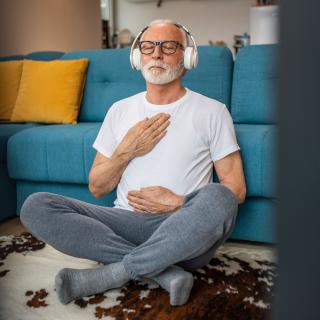
So getting comfortable in a sitting position that is supportive for you,
In an upright posture that resembles wakefulness and alertness,
But still with a sense of ease.
Tucking the chin under slightly to protect your neck.
Making sure your hips are above your knees and your feet are flat on the ground and your hands are resting comfortably in your lap.
And then when you're ready,
Gathering your attention to the sensations of the breath.
Tuning into the lower abdomen,
The rise and fall of the abdomen,
The expansion of the body on the in-breath and the release on the out-breath.
Perhaps noticing the rise and fall of the chest and the movement of the ribs.
Or maybe noticing the air moving through your nostrils or past the back of your throat.
So now choosing to focus on wherever the physical sensations of breathing are most vivid to you.
Using the sensations of our breath to anchor ourselves in this moment.
And reminding yourself from time to time that we're not trying to get anywhere.
We're not even trying to relax,
Not trying to clear our minds,
But simply resting in the here and now of being.
Seeing the patterns of the mind.
Allowing the mind to be just as it is,
Rather than try and make it be a certain way.
So again when you notice your mind wandering off,
Just guide it back.
Not because it's a mistake,
But because that's what minds do.
And bring yourself back into this moment once more.
And now expanding your awareness around your breath to include the whole body.
As if the whole body were breathing.
And noticing any other physical sensations in the body as you sit here breathing.
From the surface of the body to deep inside the body.
Holding all in awareness now.
And from time to time you may be noticing intense sensations.
Sensations of discomfort or perhaps pain.
And if this is the case,
You have a choice on what to do.
Either we can adjust our posture to try to ease the discomfort a little.
And if we decide to move,
Making the movement a part of the meditation.
By moving mindfully.
So being aware of the intention to move,
The movement itself.
And then of the after effects of the movement.
The second option when intense sensations arise is to remain still.
And deliberately bring the focus of awareness right up to and into where the sensations are arising.
Perhaps imagining the breath moving to that area of the body.
As a way to explore and discover what's arising in this place.
You may find that the sense of discomfort consists of a whole bundle of sensations.
They may be pulling or stabbing or burning or maybe throbbing or whatever.
And that each of these sensations may change from time to time.
They may have a constantly changing pattern.
And so perhaps using the breath to breathe into these parts of the body.
To explore this pattern with friendly curiosity.
So not trying to change it or fix it in any way.
But just exploring it with a sense of discovery.
And then if it stops pulling at your attention,
Letting it go.
And returning back to sensing the body as a whole sitting here.
Sensing the whole body breathing and sitting.
Just this body sitting right here right now.
A sense of openness to all the sensations of the body in this moment right now.
And now for the last few moments,
Focusing your attention on the breath at your abdomen.
Tuning into each in-breath and each out-breath and the pauses in between.
And as we finish,
Perhaps congratulating yourself for taking the time out for this meditation.
And reminding yourself that the breath is always here for you throughout your day.
As a way to centre or ground yourself whenever you need.