So find me a comfortable seat.
Sitting with your spine tall.
Your neck straight,
Your chin parallel to the mat.
You can sit cross-legged or on your shins if this is easier.
Not comfortable.
Always sit on top of a pillow or folded up blanket just to tilt your hips forward a little bit.
It helps you sit taller.
Lengthening your spine.
And then.
.
.
Start to soften your gaze or close your eyes.
Soften your shoulders down your back and allow your hands to rest gently somewhere on your legs or on your lap.
Is beginning to arrive here on your mat.
Finding your breath without trying to change it,
Just notice how your breath feels.
Notice if it's fast or slow,
Deep or shallow,
Quiet or loud.
Notice if you're breathing through your nose or the mouth.
Notice if there are areas in your body that move as you breathe.
And then taking three cleansing breaths here together,
Take a deep breath in through your nose.
Then open your mouth and slowly and quietly sigh it out.
Let it go.
Two more like that,
Deep inhale through your nose.
Exhale through the mouth,
Let it go.
And one more like that,
Deep inhale.
And exhale,
Sigh it out,
Let it go.
Now continue breathing deeply in and out of your nose if that feels comfortable for you.
And throughout the practice,
Just be mindful of your breath.
Any of the poses.
Restrict your breath or for any reason you feel that.
In the pose,
You can't breathe naturally and smoothly.
Maybe that just means that you've gone too far into the pose and maybe you back out a little bit.
As you breathe here,
Bring your awareness to your body,
Noticing how your body feels,
Scanning from the crown of your head all the way down.
To your fingers and your toes.
Notice if there is Any part of your body that's maybe a little tight or sore that may need a little bit more love during practice today.
Just being mindful of that.
If something I say doesn't feel right in your body,
Please don't do it.
Come out of the pose and just take a resting posture that works for you.
And join me when you're ready.
From here,
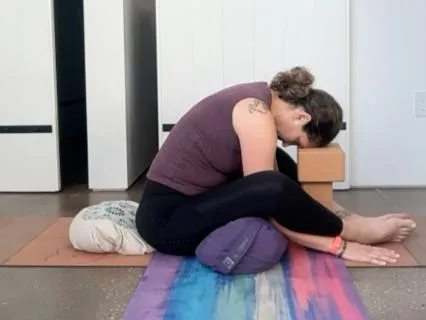
Slowly start to bring the soles of the feet together.
So if you're kneeling,
You can come to a cross-legged seat,
Bringing the soles of the feet together,
Making this diamond shape with your legs,
Allowing your knees to fall out.
So coming to seated butterfly,
And then maybe walk your feet further away from you.
Just so this is clear.
Easier on your inner thighs and outer thighs.
And then if you have blocks or a bolster,
You can use them under your thighs,
Your knees,
Just so you don't have to hold your legs up and allowing your legs to just rest on something.
If you have a bolster or folded up blankets,
You can,
Or rolled up blanket,
You can also use that under your knees and just let your knees rest.
So,
Soles of the feet together,
You can start to walk your hands forward,
So grabbing your legs,
Your shins,
Your ankles.
And.
.
.
Starting to come into a fold.
So for this forward fold,
You can round your back.
And just allow your head to be heavy.
You can grab your feet or maybe you can bring your arms under your legs.
And let your hands rest.
On the mat beside your feet.
So just taking a few moments.
To find Your forward fold here,
Your posture.
And going to a place where this feels comfortable in your body.
So in yin,
Because we hold poses for longer durations,
We want to make sure we move to our edge,
So a place where we can feel the pose.
And then back out just a little bit so we can hold the pose for a longer duration of time.
So we're gonna be here for about five minutes,
Which is a long hold.
So you wanna make sure that your lower back,
Your shoulders,
Your neck.
Is comfortable.
Maybe you can grab blocks or bring your hands together and allow your head to rest somewhere.
So letting your forehead rest either on blocks on the hands.
Just so you don't have to hold.
Your head up.
And this may not be a huge forward fold,
But you're rounding your back and allowing your head to rest.
So don't worry about what this looks like.
Don't worry about the image in your head.
That is telling you to move deeper.
Just find a place where you can hold the pose and as we hold the pose for a few minutes,
Your body will start to open up,
So allowing your muscles to relax.
Letting go of anything you're holding on to.
And allowing gravity to pull everything down.
And as you hold the pose and breathe.
Your body will start to open up,
So the connective tissues,
The joints.
The ligaments that hold the join.
Yay.
Start to stretch and open up.
And after a few minutes,
You may realize that the pose is.
.
.
Now more accessible than it was before.
And maybe you can go a little bit deeper.
Maybe you can fold deeper.
Maybe you can bring your knees closer to the mat.
So just breathing here.
Soften your gaze or close your eyes.
And just notice if there's any part of your body that you're holding onto.
Maybe it's your jaw.
Maybe you're pressing your teeth together or pressing your tongue to the roof of the mouth.
Maybe you're gripping with your fingers or your toes.
See if you can let that go.
As you come to stillness and quiet.
You may notice that your mind will start to wander.
You'll start to think about the rest of your day.
Maybe weekend plans.
What you need to do after this practice.
And when you notice those thoughts,
Just know that that's completely normal that they're coming up.
That's what our mind does.
See if you can allow yourself to set those aside for now and just come back to your breath.
Without being hard on yourself or judgments.
Just really kindly.
Set the thoughts aside and come back to your practice.
Whatever that means for you.
Maybe that means.
.
.
Focusing on the air moving in and out of your nostrils.
Maybe that means.
.
.
Becoming aware of areas in your body that move as you breathe.
We've held this for a few minutes now.
You may notice that Your body's opened up a little bit and you may be able to go a little deeper into the pose.
So if you need to make shifts or adjustments,
Do that.
And then come back to stillness.
And maybe like me you go a little bit deeper and then realize that that's too much and you need to back out a little bit and you can do that.
Wherever you land.
Let go of any expectations.
And just come back to your breath.
Take a deep breath in.
And a long breath out.
Let it go.
Now slowly start to come out of the pose.
Starting to walk your hands toward you,
Sitting tall.
And then slowly move any props aside,
Bring the soles of the feet to the mat and walk them close to you.
And just hug your knees in.
You can bring your forehead to your knees.
Just notice any sensations in your body.
Maybe there is a rush of energy in your head.
From moving out of the forward folds.
Maybe in your leg.
Just notice if there's any sensations in your body after that pose.
Good,
Bring your feet.
Math distance apart.
Your hands behind you,
Maybe your fingers point forward or back.
And then start to gently windshield wiper your knees from side to side.
And from here,
Make your way to a child's pose.
So we're going to find a child's pose for our second yin posture.
So this really depends on how you feel today.
You may have your knees close together or you can bring your knees wider on the mat,
Big toes together,
And then start to just come to whatever variation of child's pose feels right for you.
So you may have a pillow or a bolster,
In front of you and just bring.
Your upper body and your forehead on the pillow or bolster.
You may feel that today you can come all the way down.
Bringing your forehead to the mat or to a block.
So taking a few moments to get settled in.
Your version of child's pose for today.
You have a bolster,
You can prop it up with a block.
And.
Allowing your shoulders to roll off the bolster and be heavy.
Whatever variation you choose just make sure you're had is resting on something.
So you don't have to hold your head up.
Letting go of muscles in your neck,
In your shoulders,
In your back.
And then bring your attention to your knees and notice if your knees are comfortable.
We're gonna hold this for a while,
So if there's any kind of pain or discomfort in your knees,
Um holding it may not be the best.
Feeling so you can always bring a bolster or rolled up blanket under your hips just to lift them up a little bit You can bring your forehead on the mat or on a block.
So.
.
.
Taking your time and finding your pose for today.
And you may.
.
.
Have.
And expectation in your mind of what child's pose looks like for you.
And the pose that you usually take when you hear a child's pose.
See if you can let that go and try something different today.
Maybe it works,
Maybe it doesn't.
And you can always Change.
Let's see if we can find something that.
.
.
A little different from what you usually do.
When you find your pose.
Allow your body to settle.
Allow gravity to pull you towards the mat.
And just come to your breath.
Letting go of anything you're holding onto in your body,
Maybe it's your jaw,
Your forehead,
Your gaze.
And just breathing in stillness,
Allowing gravity to open you up.
And pull you closer to the earth.
If at any point you need to make adjustments or you notice that you may be able to go deeper or your body is telling you to back out a little bit,
Just move really mindfully and slowly.
Not rushing it.
Really thinking about the movement.
Being deliberate.
And then finding a place where you can hold stillness.
When thoughts or emotions start to come up.
Just notice them without judgment and bring your awareness back to your breath.
Take a deep breath in.
Exhale,
Let it go.
And slowly start to make your way out of the pose,
Moving really slowly.
Gently.
Moving your props aside,
Let's come to our.
.
.
Tabletop position.
Your wrists,
Under your shoulders,
Knees,
Under your hips,
You can tuck your toes.
You can tap the tops of the feet to the mat.
You can rock your ankles from side to side.
Good.
And then finding tabletop,
Looking straight down,
Back of the neck long,
Belly to spine,
Moving through some cat cows with our breath.
Inhale,
Drop your belly,
Open up your heart.
Exhale,
Round your back,
Tuck your tail,
Look down.
Inhale,
Drop your belly,
Open up your heart,
Look up.
Exhale to round your back,
Tuck your tail,
Look down.
Give it one more inhale.
And exhale.
From here,
We're going to come into pigeon pose.
So just bring in your right knee towards your right wrist.
You're going to bring your shin on a slight angle,
Angle,
Walk the left foot back,
Just coming to pigeon pose with your right knee,
Right leg forward.
And just finding Bye.
A position where your knee is comfortable.
You can use props,
Maybe bring a block or a pillow under your right hip.
Um,
You can bring a bolster in front of you.
And just come down to whatever variation of bridge feels right in your body.
So maybe you come all the way down,
Maybe you come to your elbows,
And let your forehead rest on a block or a bolster.
So finding pigeon pose here,
Allowing your body to settle into the pose.
If pigeon doesn't feel right in your body,
You can come to your back.
And find a figure four.
So coming to your back,
Having your knees bent,
Um,
Flex the right foot and just bring your right ankle on top of the left thigh.
So Just pausing here and allowing your right hip to open.
You can have your right hand on top of your right thigh,
Not really pressing or pushing it,
Just allowing a little weight from your hand on your thigh to help guide it away from you.
So.
.
.
Whatever variation you choose.
Make sure to make any adjustments you need.
To get comfortable and settled.
And Come to stillness.
Finding a place where you can hold the pose.
We're not gonna be here for too long,
Maybe a couple of minutes.
Just making sure you're in a place where you're not holding pain or discomfort.
And then letting go of any areas in your body that you're holding on to that you can soften and let go of.
Maybe it's your shoulders.
Maybe it's your fingers or your toes.
Meets your jaw or your gaze.
And then bringing your awareness to your breath,
Just noticing your breath move in and out of your body.
And see if you can visualize the breath.
Moving to the areas in your body that you're feeling the pose.
And then softening those areas.
As you exhale.
Notice any thoughts,
Feelings,
Emotions start to come up for you.
Just bringing your awareness back to your breath.
Everything else can wait.
Deep breath in.
Long breath out.
One more deep inhale.
Exhale all the air out.
And slowly make your way out of the pose.
You're in Pigeon.
You can come to tabletop or downward dog,
Just moving really slowly.
If you're on your back,
You can just Bring your feet flat on the mat,
Keeping your knees bent.
And you can just make any movements in your body that feel good.
When you're ready,
We're moving to the second side.
So if you're moving into pigeon,
Left knee.
Comes to your left wrist,
Walking.
The right foot back,
And then finding your pose on this side.
So if you're on your back,
Flex the left foot,
Bringing your ankle on top of your right thigh.
And as you move as you start to find your pose just notice if this side of your body feels different.
And it probably does.
And it's completely natural.
That our bodies are different.
On each side.
So letting go of the expectation that this side will look exactly the same.
Finding whatever feels good here.
So maybe pigeon on this side doesn't feel good and you come to your back.
And take figure four.
Maybe you can go a little bit deeper into your pigeon pose.
On this side.
So taking a few moments,
A few breaths to find.
Your variation of your hip opener on this side.
And then finding stillness and coming to your breath.
Take a deep breath in.
And a long breath out.
One more full inhale.
I'm going to plead exhale.
And then slowly start to make your way out of the pose.
And if you're in pigeon pose,
You can come to tabletop or downward dog.
If you're on your back,
You can bring your feet flat on the mat and just make any movements you need.
To let go of that pose.
And then when you're ready,
Make your way to your back.
So coming to your back and we're all gonna meet in.
.
.
A reclined position with the knees bent,
Feet flat on the mat.
And allow your arms to rest by your side either in the T or to cactus arms.
And lift your hips up to the left side.
And let your knees fall towards the right side.
So coming into a twist.
Making sure your left knee is still grounded.
So maybe that means that your knees don't come all the way down.
And if that's the case,
You can always bring a blanket or a pillow on your knees to bring the earth up to you.
Maybe it feels good to bring a pillow between your knees.
And.
.
.
Coming into a twist,
Whatever that looks like for you.
You can always extend the top leg.
And turn your head to.
.
.
The left side if that feels good in your neck.
Again,
Wherever you are,
Shoulders grounded and heavy.
Soften your gaze or close your eyes.
Soften your jaw.
And allow your body to breathe into this twist.
Noticing if there's any part of your body that you can let go of.
You just feel really heavy,
Allowing your mat.
To hold you.
Completely.
Take a deep breath in through your nose.
Open your mouth and slowly and quietly sigh it out.
Let it go.
And slowly start to relax.
Make your way out of the pose,
So moving any props.
And bring your feet flat on the mat,
Your hips.
Grounded.
Coming back to center,
Pausing here for a breath or two.
Noticing your lower back.
Supported by the ground.
And then when you're ready,
Making your way to the second side.
So lift your hips up to the right side,
Let your knees fall to the left.
And again,
Making sure that your shoulders stay grounded on the mat.
So adjusting your arm variation or using props under your knees or between.
Your legs,
You can extend the top leg straight or forward.
Maybe turn your head to the right.
So finding your twist on the side,
Allowing your body to settle.
Your eyes to close.
And your body to breathe.
Letting go of any muscles or anything you're holding onto in your body.
Allowing gravity to pull you towards here.
Take a deep breath in through your nose.
And open your mouth and slowly,
Quietly,
Sigh it out,
Let it go.
Let's do one more like that.
Deep inhale through your nose.
Oh Paramount,
Sigh it out.
Slowly start to make your way out of the pose.
You can bring your feet flat on the mat.
Lower back grounded,
You can maybe windshield wiper your knees.
Gently from side to side.
You can start to slowly hug your knees into your chest,
Maybe rocking from side to side.
Making circles with your knees in one direction and then the other.
Now we're going to get ready for our final relaxation pose,
Shavasana.
So taking your time here,
Grabbing props,
Layers.
Anything you need.
To get really.
.
.
Comfortable.
And your final pose.
So I like to bring a bolster under my knee.
And this helps ground my lower back.
Making sure you move any props aside so your body isn't touching anything but your mats.
Good.
Making movements,
Adjustments to get settled.
Bring your arms by your side,
Palms face up,
Fingers gently curled in,
Your hips and your shoulders heavy and comfortable on the mat.
Soften your jaw,
Part your teeth,
Allow your tongue to fall away from the roof of the mouth.
Soften the muscles of the face,
Allowing your eyelids to gently close.
And then scan from the crown of your head all the way down to your fingers and your toes.
Notice if there's any part of your body that you can soften and let go just a little bit more.
To get comfortable here.
Allow your body to rest and breathe naturally and take in the effects of your practice.
Take a deep breath in.
And a long breath in.
One more just like that deep inhale Full and complete exhale,
Let it go.
Slowly start to bring some movement back to your body,
Moving your fingers,
Your toes.
Your wrists and your ankles.
Rocking your head from side to side.
And then when you're ready,
Bend one knee and then the other.
And roll onto your right side in a fetal position.
Using your bottom arm as a pillow.
Fetal pose after corpse pose reminds us that after every ending.
There is a new beginning.
And slowly start to make your way to a seat,
Sitting with your spine tall,
Your neck straight,
Chin parallel to the mat.
Soften your gaze or close your eyes.
Hands by your side,
Inhale,
Reach your arms all the way up,
Palms touch overhead.
As you exhale,
Bring your hands to your heart and bow your head to your hands.
Thanking yourself for coming to your mat today,
For spending this time for yourself.
For your practice.
Thumbs to your third eye,
The space between your eyebrows.
May your thoughts be kind.
Thumbs to your lips,
May your words be caring,
And thumbs to your heart send her.
May your heart be filled with love and gratitude.
Thank you for practicing with me today.
Namaste.