This session is part of the 21 Day Breathwork Challenge.
If this is the first time tuning in and you'd like to start at day one,
If you follow my profile,
Inge Wolsink,
You can find all the available previous sessions there.
You can also find all the other tracks in the playlist,
The 21 Day Breathwork Challenge.
Are you ready?
Let's begin.
Hello and welcome.
You have made it to the final week.
We're two weeks in,
Or maybe you've taken a little longer,
And that's absolutely okay.
We're in the final week,
Which means we're going to move into mixed practices.
And these are the more advanced practices.
They're going to take longer.
They're going to stress out your system,
Your body a little bit.
We'll have longer and multiple rounds.
And so before we go into these a bit more strenuous breathwork exercises,
I'd first like to take you through three very simple relaxation exercises,
Which are the physiological sight,
Box breathing,
And triangle breathing.
Now,
If you're really,
Really enthusiastic to go into these more advanced practices,
And you feel absolutely confident that you can do them,
Feel free to skip to day 17 on resistance breathing.
But otherwise,
Bear with me,
Because there are some good advantages of knowing these very simple relaxation techniques.
Because if you know you have your favorite,
The one that really suits you,
It can really help you to have a go-to practice to calm yourself down during any stressful event,
Including breathwork,
But maybe also other stressful events in your life.
So bear with me,
Three days of very short and simple practices,
And then we're going to dive right into the juice.
Let's start with today's practice.
The physiological sigh.
This breathing practice is a useful and quick tool to help you maximize oxygen uptake and carbon dioxide offload in the lungs in a few single breaths.
It is particularly useful if you've been focusing on work uninterrupted for a long time,
Sitting in collapsed posture for a while,
And have been unconsciously breathing quick and shallow while tensing up your muscles.
So it's useful to quickly offload stress.
The physiological sigh is two inhales followed by a long exhale.
So one long inhale through the nose,
Followed by another inhale to top it off,
Popping open the lungs,
Followed by a long and extended exhale through the mouth.
Although the term physiological sigh comes from modern neuroscience,
And it has been popularized by Andrew Umerman and thoroughly researched by Jack Feldman,
Similar breathing patterns have long been practiced in ancient traditions,
Such as yoga and meditation.
Some pranayama techniques often include long exhales and double inhales.
Instructions are very simple.
Inhale normally but not fully,
Pause,
Inhale more to top it off,
And then sigh out.
Hence,
The physiological sigh.
Something to be mindful of when we're doing the physiological sigh is that we're not tensing up our shoulders.
If you notice yourself having difficulty with the second inhale,
It is very likely that you might still experience some tension in the shoulders,
Perhaps from sitting in bad posture,
Or perhaps from feeling stressed overall.
So if this is what you notice and you feel like you can't take that second full inhale,
Mindfully relax the shoulders and see if you can then expand your intercostals and the back ribs further.
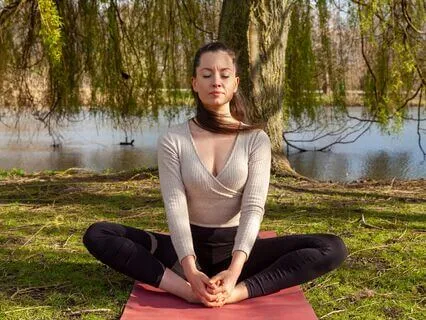
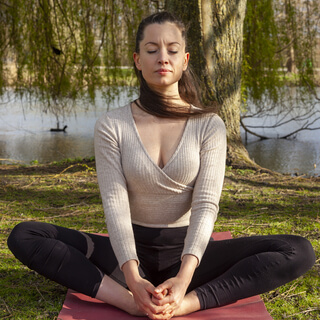
Sit in a comfortable position.
Open your posture for a deep breath.
Make sure your head is over your sits bones.
Collarbones are open and wide.
Shoulders are relaxed down the back.
When you breathe in,
Remember that a large part of the lungs fills up into your back.
So allow your shoulder to relax and create space for your ribs to move to the sides,
Front and back.
Take a normal inhale through your nose,
Filling up your lungs.
Pause.
Fill the inhale as deep as you can and release through your mouth on the exhale,
Allowing your diaphragm and your lungs to fully release all the air out.
Let's repeat.
Inhale.
Pause.
Inhale to the top of your lungs and fully release.
Sighing all the air out in a long,
Light and relaxed exhale.
Take a few regular breaths.
Let's repeat.
Inhale.
Pause.
Inhale to the top of your lungs and fully release.
Sighing all the air out in a long,
Light and relaxed exhale.
Inhale and slowly sigh out.
Remember to relax your shoulders.
Inhale more.
Take a few regular breaths.
That is it.
Easy does it.
Our next relaxation tool is called the box breath.
Box breath is useful when you are training to keep your cool during a stressful event and it will induce relaxation and alertness at the same time.
As always,
If you enjoyed this particular practice or are enjoying the breathing journey you are on,
Please leave your insights,
Your experiences and your feedback in the review section.
I always enjoy reading your comments and you might actually help another person come to the practice when they need it most.
Thank you for sharing your practice and I'm looking forward to our next session together.