In tonight's episode,
We're gonna go back in time.
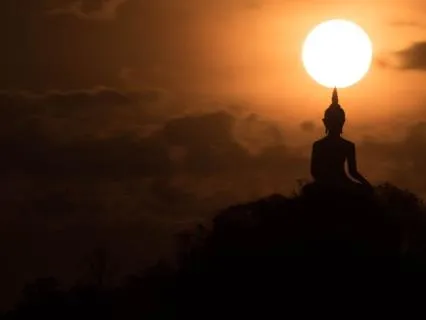
And walk through the history and the stories of the Buddha and Buddhism.
When you're ready.
Get into bed.
Turn the lights off.
Make sure you're nice and comfortable.
The temperature is good.
And everything is set for you to let go of the day.
And start to drift off into sleep.
And with your eyes closed as you begin to breathe in.
As your belly fills with air and rises.
You breathe in a sense of gratitude.
And as you exhale.
And your belly drops.
You breathe out relief.
And again,
As you breathe in.
And your belly rises,
You breathe in a sense of gratitude.
And as you breathe out.
And your belly drops.
You release a sense of ease.
Take relief.
As you begin to melt into your bed.
And let go of the day.
We're gonna take a journey back.
Over 2,
500 years.
Into the foothills of the Himalayas.
In what is now present-day Nepal.
And in this place,
There was a kingdom where a special child was born.
Surrounded by legend.
And his name?
With Siddhartha Gautama.
And the legend goes.
That a wise man came to his father,
The king,
And told him that his son would either be a king or be a sage,
A master.
And like many fathers,
He wanted his son to follow in his footsteps.
So he kept him inside the palace walls,
Away from any suffering,
Giving him all the indulgences and luxuries that life at that time had to offer.
But as you can imagine.
That protection didn't last forever.
It couldn't last forever.
And as Siddhartha grew older,
His curiosity about the world His curiosity about what was outside the palace walls began to deepen.
And in Buddhism,
In many traditions,
They say.
At the reason he had such a desire.
To go outside of the palace walls was because of all the knowledge and wisdom and experience that his soul was born with.
So one day he eventually ventured outside.
And what he saw changed the course of his life.
As the story goes,
He encountered for the first time an elderly man.
Bent over with age.
Than a person suffering from being sick.
And then somebody who had died.
And these sights reveal to him the truths of aging,
Of illness,
And of death.
Universal realities.
That we all eventually experience.
But then he saw a fourth figure,
A wandering monk who was calm and peaceful.
And this man's presence really struck Siddhartha deeply.
How could someone live with such serenity?
In the face of life's inevitable suffering.
And that question stayed with him.
Echoing in his mind.
Until he couldn't ignore it anymore.
And at the age of 29,
Siddhartha made a choice.
He decided to leave the palace,
His family,
His title,
And everything behind.
To seek answers.
He wanted to know why we suffer.
Is their way to find peace.
What's enlightenment.
And so he ventured out into the forest.
With nothing but a robe.
And a begging bowl.
And for six years Siddhartha traveled across northern India,
Studying with various teachers.
Finding different practices.
He fasted.
Barely eating any food,
Living a very basic life.
Until one point his body was so frail.
He was so weak he could barely stand.
Yet even after pushing himself to the edge of human endurance,
He couldn't seem to find lasting answers to his questions.
And it was then that Siddhartha realized that the path to wisdom wasn't in extreme wealth,
Nor was it in extreme poverty or suffering.
It was neither in indulgence nor,
We could say,
In deprivation.
Instead,
He discovered what he eventually called the middle way.
A path of moderation.
Balance and of harmony.
And one night Siddhartha sat beneath a great fig tree known as the Bodhi tree in a quiet village called Bodh Gaya.
He decided not to get up.
Until he had found the enlightenment that he was searching for.
And the story goes,
He meditated for 49 days.
And in his meditation.
He had many different experiences.
Temptations,
Doubts.
Physical,
Mental,
Emotional pain.
But he sat still.
And then as the morning began to break on the 49th day.
He attained enlightenment.
He became what we refer to as the Buddha or the awakened one.
His realization was profound and yet simple.
And he turned that realization into the Four Noble Truths.
The first noble truth.
He acknowledged that there is suffering.
And discontentment in the world.
What he called dukkha.
Life,
With all of its beauty,
With all of its pleasure,
Also contains pain,
Loss,
And impermanence.
And then the second trance,
Or the second noble trance.
That there's a cause of suffering.
Part of that cause is our cravings,
Our attachments.
And our resistance to change.
It's our clinging to what's temporary in life that brings us so much suffering.
And then the third noble truth.
As suffering can end.
By letting go of these cravings,
These attachments.
We can find inner peace.
And then the fourth noble truth.
What he called the Eightfold Path.
Which was a guide to ethical living,
To meditation,
The cultivation of wisdom,
And really how to live life.
And that was the foundation of the Buddha's teaching.
And before we go any further.
Make sure you're nice and still.
Perhaps even just slowing your breath down a bit more.
And really easing into the night.
Now let's take a bit of a journey into the philosophy.
Of Buddhism.
What came out of the Buddha's teachings.
So at its core,
Buddhism teaches us to embrace impermanence.
You can think of it like waves on the ocean or clouds in the sky.
Everything is constantly in motion.
And when we cling to something that changes.
That's impermanent.
We begin to suffer.
But when we learn to let go.
To accept life.
As it is.
That's when a deep peace.
Arises within us.
In Buddhism,
There's also.
Not a fixed self.
The person.
That we think we are is actually more like a river.
Constantly flowing,
Constantly changing.
And another core philosophy of Buddhism is compassion.
The Buddha taught that all beings.
In whatever form they come in.
Human,
Animal,
Or otherwise.
All beings.
Are interconnected.
And when we act with kindness,
We nurture that web of life.
Even as you're falling asleep,
You can notice that compassion,
That kindness inside yourself.
And you can extend it.
Through your whole being.
As you fall asleep.
Kindness and compassion are not just energies we extend to others.
Just feel that for a moment in yourself.
And as you drift away into sleep tonight.
I'll share one more part of the Buddhist journey.
Which is the spread of Buddhism.
So the Buddha taught for about 45 years.
Traveling from village to village.
All across India and Nepal.
Teaching the Four Noble Truths,
Teaching meditation,
Lecturing to thousands and thousands of monks.
And after the Buddha died.
His teachings continue to spread and grow.
And the earliest spread of Buddhism began through the dedication of his disciples and his monks.
After his passing.
A council of monks gather to preserve and share his teachings.
They memorized his words.
Chanted them together and passed them down orally.
A practice that continues in some traditions today.
The Indian emperor,
Ashoka,
Played a pivotal role.
In Buddhism spread.
He ruled during the 3rd century BCE.
And was initially a powerful warrior king.
But after witnessing all of the horrors of war,
He embraced Buddha's teachings of non-violence and of compassion.
And under his reign.
Buddhism flourished.
He built stupas,
Which are sacred monuments,
All across India.
And sent emissaries to spread the teachings to Sri Lanka,
Central Asia,
And beyond.
In Sri Lanka,
Buddhism found fertile ground.
According to tradition,
Ashoka's own son.
Brought the teachings to the island.
The Theravada tradition.
Known as teaching of the elders.
Took root there.
And it emphasized meditation.
Simplicity,
And really,
An adherence.
To the earliest recorded teachings of the Buddha.
Sri Lanka became a center of Buddhist scholarship,
Preserving ancient texts in the Pali language.
In these texts known as the Polycanon.
Remain central.
To Theravada Buddhism practice.
And are revered as one of the most complete collections of the Buddha's teachings.
Buddhism traveled not only through missionary efforts,
But also along ancient trade routes like the Silk Road.
Merchants carried the teachings across deserts and mountains,
Sharing stories of the Buddha's wisdom.
And along these routes,
Monasteries sprang up.
Providing shelter and spiritual guidance for people,
For travelers.
And then Buddhism.
Arrived in China around the 1st century.
Initially,
It was met with curiosity.
And skepticism.
Since it was a foreign tradition.
But over time it began to integrate with Chinese culture.
Blending it with Confucianism and Taoist philosophies,
It gave rise to new schools such as Chan Buddhism.
Which would later evolve into Zen in Japan.
And Chinese Buddhism emphasized the importance of compassion and the pursuit of enlightenment for all beings.
Many temples and statues were built,
And thousands of images of the Buddha were carved into cliffs.
And then there is Buddhism in Japan.
Which also took a unique character.
Arriving in the 6th century.
And intertwined with Shinto,
The indigenous spiritual tradition.
And Zen Buddhism became especially influential in Japan.
And Zen emphasizes simplicity,
Mindfulness,
And direct experience.
Then we also have Buddhism in Tibet.
And this developed in the high mountains of Tibet around the 7th century.
And this tradition is rich in rituals,
Chants,
And visualizations.
And it was integrated with ancient Bon practices,
The indigenous spirituality of Tibet.
The Dalai Lama,
Who's a central figure in Tibetan Buddhism.
Really is an embodiment today.
Of many of the Buddhist principles,
Such as compassion and wisdom.
In a human being.
And I had the opportunity to see him speak.
And also to go where he lives in India.
And it was special to see.
A living being.
Really in that energy.
Buddhism continued to spread throughout the world over the last few thousand years.
And today,
There are millions of people practicing Buddhism.
Practicing meditation.
Compassion.
And here we are.
Falling asleep together.
Very much so because of the teachings of the Buddha.
So as we fall asleep tonight.
Gratitude for him and his journey and his teachings.
Remembering that we all have a Buddha inside of us.
Part of us that is awakening into this moment.
And even as we fall asleep.
That seed of enlightenment.
Is beginning to sprout.
Let yourself really begin to drift away.
As you fall asleep.
Feeling that connection to all of life,
To every being.
Feeling that sense of compassion.
Have a beautiful night of sleep.
And I'll see you on the other side.