Bye,
Guys.
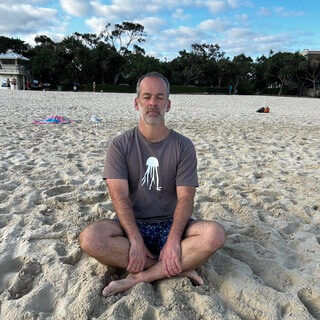
It's Ross here from Breathwork Solutions.
Firstly,
Thank you for following me on Insight Timer.
Giving you feedback,
Giving it ratings.
And for those of you that are coming back repeatedly,
I really appreciate this.
So breath work.
There are many,
Many different identities.
What's the one I teach?
Functional braiding.
I learnt it from the legendary Patrick McKeown from Oxygen and Action.
Basically,
It's the way we're supposed to breathe.
We are not supposed to breathe throughout our full stop.
Lips are supposed to be sealed.
Tang is supposed to be on the roof.
And we're only supposed to breathe in and out of our car.
Why in and out of our noses?
Because when you breathe in through your nose,
You warm the air,
You humidify it,
And you clean it,
Which is a better quality of oxygen getting into your lungs,
Your bloodstream,
And into your tissue.
We also reduce a magic gas in our nostrils called nitric oxide.
Nitric oxide,
When you breathe through your nose,
Is flushed down into your lungs,
Into the bloodstream,
Through your lungs.
And it vasodilates,
Meaning it opens up the vessels,
Providing better blood flow.
We also raise our carbon dioxide slightly.
This is called the bar effect when we breathe in.
Which means that it elevates slightly.
Carbon dioxide is always seen as a waste product.
But it has a very,
Very important role.
It's the cane.
Opening more oxygen off the haemoglobin and having it delivered into the tissues and indeed the brain up to 20 percent.
So it is a very,
Very positive thing to have it slightly off.
Olsa.
The diaphragm is intact.
And when we breathe with the diagram,
Particularly during exhale.
We trigger the vagus nerve.
The vagus nerve is your break to your heart.
So everything that we're doing here is bringing us into rest and digest.
And as you know,
Through many of my recordings,
We talk about being in constant fight or flight.
Which is not good because fight or flight was designed for when we were in actual life threats.
We're not.
We just have all these stresses every day that we've turned into butterflies.
When you do the breathing exercises,
Listen very carefully and message me if you have any questions.
But what we are doing is we are bringing ourselves back down.
Into a calm state,
Into a restful state,
Which will help with.
Anxiety levels,
Stress levels,
Give you better focus and indeed a flow on it.
To a better night's sleep.
Thanks again for supporting me on Insight Time.
I love interacting with you guys,
And I love to see that people are coming back repeatedly,
And people are getting better.
That's the one aim.
I want people to breathe.
Healthier.
And just feel better about they died at that event.
Anyway,
That's enough from me.
I look forward to seeing you on Insight Time.