Hello again.
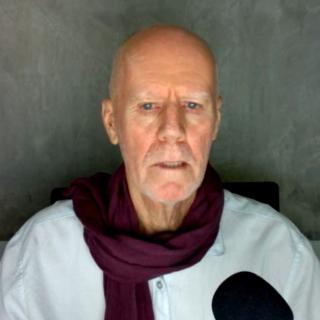
This is a spontaneous video.
I wanted to share with you something that I've just come across in terms of helping you to bring a nervous system which may be in a place of imbalance back to a place of calm.
And rest.
We're all familiar,
And the exercises that I have given,
A number of videos already on my page talking about somatic breathing and deep breathing.
And all of this still is relevant,
Including the fact that through that breathing,
We're activating the vagus nerve,
And the vagus nerve then in turn sends the feel-good hormones into the body and helps the whole physical aspect of our being come back to a place of rest and calm.
Now in addition to that,
A very important muscle within our body that can retain tension is called the pocis muscle.
It's a long muscle.
It actually connects the spinal column to our hips.
And this muscle has been known through scientific research to also hold tension and stress over long periods of time.
Now,
As we do the vagus nerve breathing,
That muscle can release some of the held tension.
But another benefit in helping to release tension held in the postus muscles,
And they're just two muscles that run down either side next to your kidneys and connect down to your hips and connect up onto your spinal column.
But the exercise,
For those of you who do yoga would be familiar,
Is called the Child's Pose.
Now,
This is quite a simple relaxation exercise,
But the pose itself actually helps stretch the pocis muscle,
And that in turn then helps to release any tension or stress that may be held within the memory of the fibers within the muscle itself.
Now the child's pose is quite a simple stretch,
A very gentle stretch.
So you get down on your knees and you put your hands on the floor.
Now you sit back on your heels.
So you're on your knees,
You rock your body back onto your heels,
And then lay forward with sliding your hands out in front of you.
And to the point,
If you can,
Where your forehead touches the ground.
And that is called the Child's Pose.
And you can look it up on any yoga website if you're not exactly sure,
If this description is not very clear for you.
But when you go into the Child's Pose,
Just hold it for a few moments.
Breathe quietly and deeply.
Go into the deep breathing while you're actually in that pose,
And that will help to release any residual stress or tension that you may be holding.
And it's particular interest that The tests and the research they've done has shown that the postus nerves can hold tension and stress,
Which has been there for quite a few number of years.
So it is a very potent way to help release further,
Apart from the vagus nerve activation,
Which is through the deep breathing.
And I hold a couple of meditations each week,
Live free meditation session each week,
Which are dedicated to the deep breathing process.
But now I'll also,
Within those meditations,
Mention about the significance of the pocis muscles.
But this is just a little bit of a heads up for those of you who are following the content on my page.
So I'll give it a title,
Pocis Muscle and Nervous System Balance,
And you'll see it there.
So you can listen to this again.
All right?
So blessings to you.
And the pocis muscle,
It's spelled P-S-O-I-S,
Pocis,
P-S-O-I-S.
Pocis muscle,
Two long,
Thin muscles that run down next to the kidneys.
Connecting to the hips and that's why when you're feeling stress The characteristic of the tightening of the posterior muscles makes you feel tight in the hips and in the stomach muscles.
And those all combine together as soon as the posterior muscle begins to feel stress and anxiety.
It's just doing what it has been inherently guided to do,
To bring you into a place of contraction if you're feeling stressed and anxious,
And then the cortisol and the cholesterol,
Sorry,
The flight and flight hormone will be there ready to spring you away if you need to be away from that particular environment.
But the characteristic of the posterior muscle is that when you are feeling stressed,
It goes into a place of contraction,
And that can be felt as a tightness in the hips and a tightening in the stomach muscles.
So there you go.