Good morning,
Everybody.
Welcome back.
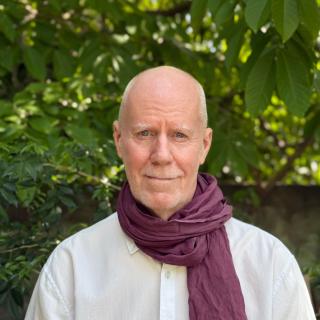
My name's Pratika.
This morning's meditation is very impromptu,
One that has been buzzing around in my awareness for the last couple of days.
I wanted to kind of put it together and formalize it a little bit and give you some insights.
About what to do with the thoughts and thinking in the process of your meditations.
This.
This aspect of.
Struggle that many people have,
And I know I did.
Especially in the early days of meditating and becoming a monk.
And I found it.
Exceedingly difficult to actually find the space in my meditations to actually where I had no thought.
And just by the nature of the creative processes of mind.
I knew when I first began the classes given by the students of my spiritual master.
They were introducing meditation through a series of guided visualizations.
So that's the way I began,
Just by focusing on something which wasn't the chatter of normal daily activity.
So I would imagine sunrises and sunsets and sitting by the beach on the soft sand,
You know,
Watching the sunrise over the beautiful ocean and having the sounds of the lapping waves very much fully present in my awareness.
So that got me.
A connection through that visualization and the feelings that I was having,
The beautiful light.
Open,
Expansive,
Soft feelings which was giving me direct access to my heart.
And that was really the basis for quite some time.
And it wasn't only that,
I was sitting on mountaintops and sitting on snow-capped mountains and sitting by waterfalls.
Whatever it was,
I had a number of favorite visualizations that I would go to regularly.
Over time,
I found that Those eventually just lost their potency and I was back into the thinking process again.
Just trying to find the calm.
And I don't remember anywhere actually where Guru gave specific guidance.
Breathing exercises as such.
In all the books that Guru had written,
I hadn't actually found that one.
I was more involved in meditating,
And this is something I'm just going to mention now.
If you can find something that's inspiring,
Like beautiful meditation poems Guru wrote hundreds of thousands of them.
So these were little three or four line what they call aphorisms.
So I used to read those.
And this is something I need to mention now,
Because if I don't,
I will forget to mention it to you.
In your practice,
Sit at the same time every day,
Whether it's in the morning and evening,
And that's preferred,
Or just once a day,
But at the same time.
That's really important for the mind because the mind identifies with habits of doing things at the same time.
So it will gradually begin to understand that the times that you are doing regularly,
Maybe at six o'clock in the morning or five o'clock in the morning or seven o'clock in the evening or nine o'clock in the evening before you're going to bed The mind will recognize that as a pattern that you're establishing,
And it will recognize that its distractions are actually not desired at that time.
So it kind of leaves you alone a bit.
They'll still be there,
But they're not as intense.
So that's the first thing to remember.
Same time every day.
And I would emphasize every day.
All right.
That's the first thing.
Now,
So I would read Guru's poems and just the feeling that the poems evoked in my heart,
I would just meditate on that feeling.
And that took me maybe through the whole meditation.
I would read one poem,
Meditate on that feeling and what it brought to my heart,
To my awareness at the time.
I'd keep reading,
I'd find another poem,
I'd meditate.
I'd use that as the source of my meditation.
And I'd keep going,
Going,
Going.
And that was,
For me,
The beginning.
Of how I began to meditate,
Rather than just sitting still and trying to create visualizations.
I've just made some notes here.
After that,
I then found listening to Guru's music Guru played a lot of beautiful flute music,
So I would listen to that.
And then as the music took me into a beautiful meditative space,
I would just use the energy of the music to be the basis of my visualization.
Within my meditation,
And that also served a very beautiful purpose.
And then,
As a musician,
I then began playing,
Learning,
Initially,
The harmonium.
And I would play that,
And then I would sing some mantras as well.
So this is all part of your meditation.
And once you get to that point where you feel that strong connection to the heart,
I'd just close the harmonium,
Stop playing it,
And just sit and then meditate on that vibration,
On that feeling.
So you can be very creative in your process of meditation.
Now,
While you're focusing either on a visualization,
Reading a poem,
Playing a musical instrument,
Then the mind is focused on just that.
So you find the mind is beginning to become accustomed to the fact that you're not following the train of thinking,
And most importantly,
You're not identifying with the content of your thinking.
All right,
So all these little tricks,
You can do them in combinations.
You might start with reading and then you might go to playing a musical instrument and then come back to listening to some beautiful,
Inspiring music.
Or you might even take all of that as a package and then go for a walk and have a walking meditation.
And they're also really,
Really beautiful.
And you might specify or dedicate a particular time on the weekend where you simply go and sit in the park somewhere or go into nature,
Into a lovely forest.
By a stream and take a book.
Take your music and just make it a combination of all of those things.
So all of these work.
In their own way,
So whatever you can identify,
Whatever brings you back to your heart.
Is what to follow.
Now.
Another.
Aspect of this was that I found that music ultimately,
Listening or playing music,
Is was me still involved in doing something.
Listening.
Playing.
And I experienced that as my meditation practice became more refined.
Then I no longer needed to listen to music.
I was able to Find that stillness and it can be referred to as the gap between the thoughts.
I was able to experience that for longer and longer periods.
I mean this is over months and years that.
.
.
That gap became wider and wider and wider,
Leaving me for increasingly longer periods in absolute stillness.
Now another thing that you could do.
Which is I think also very beneficial,
Is it set aside sometime during the week to actually have a longer meditation than you would normally.
I mean during a working week you have all sorts of things to do in the morning,
Getting ready for work and then going to work.
So even if it's only five minutes in the morning,
That's more.
Than you would have if you weren't doing it.
And even within the five minutes,
If it's only 10 seconds of silence,
Then that is much better than not having any silence at all.
When I say silence,
It's not necessarily where everything is completely silent.
It can be.
It's just an expanded awareness where thought is not present.
And that is silence in itself,
But you don't necessarily have to concentrate on wanting to be silent.
It will just be part of the experience.
Part of the spaciousness of your meditation experience.
And then over the years,
It has evolved now into being just simply being aware.
So not doing anything.
And that.
Ultimately means that what you are in the space of your meditation is that you become You are the awareness of the thoughts that are coming,
And they'll always be there.
Thinking is always a process.
But as you continue to meditate,
You'll find that the intensity of thinking to be a distraction will become less and less.
You'll be less inclined to want to go across and focus on any distracting thoughts.
You want to maintain the discipline.
And a wonderful way to do that also is through somatic breathing.
So that's that.
If you like to use the numbers,
It's an inhaling,
Sorry,
An inhalation.
The breath is coming into your body.
Maybe on the count to four.
So a very long,
Slow,
Relaxed,
Deep process of bringing the air right to the top of your lungs.
So you're sitting with a straight back.
The chest is expanding.
You're coming to the very top of your breath.
Pause.
Then exhale.
And as your air is leaving your lungs,
That's a count to six.
So it's an incoming breath,
Four,
And outgoing breath,
Six.
That in itself is extremely relaxing because there's a shift away from the thinking mind which is driven by the sympathetic nervous system.
This is the act of doing and analyzing and judging,
The whole process of projecting.
A normal thinking working day,
That is the mind,
That is the sympathetic nervous system.
So as you do this deep breathing,
What you're doing is shifting from sympathetic across to parasympathetic.
So you're activating the vagus nerve.
Then the feel-good hormones like serotonin is released into the body mass and the mind.
And at that point,
Then you're becoming more and more connected and aware of the deeper meditative stillness.
That spacious presence of simply being.
And from that presence of being,
You are the awareness which notices and is aware of thoughts,
But you're not connecting to them.
You're just quietly aware,
And you just come back to being the awareness.
Just keep being.
The awareness,
The essential nature of our own being.
And then there is no effort.
There's nothing happening on a mental level because energetically and physiologically you're not actually in the mind state.
You're not an identity.
You don't have a personality in the presence of deep meditative awareness.
You are simply aware.
You are the awareness of being.
So in that space,
Thoughts really don't have a foothold anywhere because you're not engaging with that energy.
You're not in the sympathetic nervous system energy field.
You're completely in the parasympathetic nervous system.
So that one exercise of breathing like that is very potent And even that will fall aside,
And you'll just naturally,
As you breathe,
You will have developed that pattern and that awareness,
That increasing recognition.
Of your own pure awareness,
And that will just become the target.
When you sit to close your eyes,
You are fully present there.
And then anything that might be in the periphery of some sort of thought or whatever,
It just fades away.
It's just not there.
You don't give it any attention whatsoever.
You're completely focused on the awareness.
And that's all there is to it.
Nothing difficult.
And the main thing is always maintain your practice with us.
Determined how it did.
Be enthusiastic.
Be surrendered to the process.
All right,
It can take some time and we're all different.
Never feel frustrated if one day you have this beautiful period of silence and then all of a sudden the monkey mind comes in.
Ignore,
Ignore,
Ignore.
Whatever you need to do,
Whatever trick you have in your bag of tricks when you sit to meditate,
Just ignore it.
Don't be disappointed if all of a sudden there's a surge of thinking that hasn't been there for weeks.
Remain the awareness of being and that's all you have to do let me just quickly check my notes The awareness itself is focusing on deep breathing.
Um.
.
.
If you want to move to a couple of simple visualizations,
This is prior to being just awareness itself,
But this leads to that presence.
Imagine thoughts just being clouds appearing in the sky.
Type here They're there for a moment and then fade.
And what's there after the clouds fade?
The infinite presence of being,
The vastness of the sky itself.
The essence of your own being.
Or another one you could use perhaps is sitting on a beautiful mountain boulder.
In a stream looking into the forest,
The beautiful,
Quiet,
Serene stillness of a forest.
It is completely engrossed in the sensation and the wholeness and the oneness of your experience.
And you notice out of the corner of your eye,
This leaf is just floating.
Very peacefully in the flow of the stream.
And then you notice it's in front of you,
You're still focused on the forest,
And then that leaf just continues on its journey and ultimately will become part of the ocean itself.
And there's that sense again of there is something noticed.
You're aware of the forest,
You're aware deeply in presence yourself,
And then that thought is gone.
But it ultimately becomes the vastness of the ocean itself.
So all of these little tricks you can employ,
But ultimately.
.
.
I would suggest that the ultimate awareness will be just do nothing.
Do nothing at all.
Don't extend any effort of trying to get rid of thinking.
Just be the presence of awareness that you are behind all activities,
Behind all thinking.
Because essentially.
.
.
The very presence of being that is your true nature.
Is prior to the mind.
It is prior to thinking.
Just remember that.
You are the essence,
In which thinking and words appear.
They are not what you are.
You are prior to that thinking.
You are pure awareness itself and you are just simply the physical manifestation of that divine presence.
In this particular lifetime,
In this shape and form,
In this body form.
But the very energy of all that you are is pure awareness.
I hope this helps.
All the best to you.
Thank you for listening.