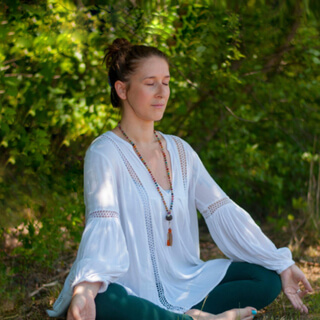
Welcome.
My name is Alex.
I'm a therapist,
Mindfulness teacher,
And writer,
Among many things.
Today's practice is for anyone struggling with intrusive thoughts.
We'll begin with a small introduction of what intrusive thoughts are,
Defined loosely by me as unwanted thoughts that create discomfort and overall unease in our life.
I'd also like to add that intrusive thoughts can often feel like loud mental banging,
Perhaps on a door that we'd very much like to keep closed.
And if you've ever struggled with this,
You may also know how exhausting it feels to keep this door closed at all times.
Deconstructing where intrusive thoughts come from and why they appear is a much longer topic of discussion.
For our time together now,
However,
We can probably agree that the thoughts themselves have a lot to say,
Not always with kindness.
So what do we do with them?
What can we do?
As someone who also struggles with intrusive thoughts and has tried many different approaches,
I've come to learn that the direct way yields more in the long run,
And it comes down to letting the thoughts be known.
Before we can do that,
It is very important to establish enough psychological safety.
As I said before,
Intrusive thoughts are not always kind,
Nor are they always helpful.
That's what makes them intrusive.
Without psychological safety in place,
We run the risk of feeling overwhelmed and under-resourced when we simply open that door and let items fall out as they may.
Building a safety anchor is just that,
An anchor to come back to when the intensity of a thought or emotion becomes too unstable or familiar.
We'll begin to build the anchor by identifying what or who feels safe.
For me,
That's often my intuition,
Or what I like to call my inner knowing.
It's the part of me that holds infinite hope and reassurance that no matter how bleak my present,
All can be well again.
This helps me return to a light in the darkness,
If you will.
Safety is different for everyone.
It can be a place,
A person,
A pet,
A memory,
A feeling,
An affirmation.
It could be many things that feel safe together,
Creating a collection of safety resources rather than just one.
We'll practice tapping into your safety anchor by coming into a simple mindfulness practice.
If it's all right for you to close your eyes,
Please do so.
Otherwise,
A soft gaze in front of you works well,
Too.
Take a deep breath in and a deep breath out.
Feel for the ground beneath you,
Noticing your sitting bones,
Your tall spine,
And inviting in some softness through your belly as you breathe.
Let your shoulders be heavy,
Your jaw unclenched,
And your eyes heavy in their sockets.
To yourself or out loud,
Pose the question,
What makes me feel safe these days?
The mind may offer up many choices,
Perhaps a few.
Pause with each and bring each into your body,
Sensing how each answer,
Image,
Or memory makes you feel.
We'd ideally like for safety to feel available,
Spacious,
And like there's room to breathe in it.
If the answer is yes,
Image or memory feels constricting,
Take note of that sensation in your body and explore other possibilities for safety.
If the mind doesn't offer up anything,
I invite you to explore what safety could look like if you used your imagination to create it,
And then tap into that feeling which your imagination produces.
Take another deep breath in and out,
And open your eyes if they were closed.
With more accessibility to our safety,
We can now move into a more direct communication with our intrusive thoughts.
Your safety anchor is always there as a resource for you to return to when the internal seas become too stormy.
This next step may warrant some writing,
So grab a journal or a piece of paper.
Intrusive thoughts want the fundamental honesty of being witnessed,
So this practice may be something that you return to over the course of many days,
Months,
Or even years.
It's not a destination practice as much as it is an attunement and relationship building with yourself.
It's also a practice that will require you to give yourself permission over and over again to arrive in manageable doses,
Sometimes big and with abundant intentions,
Otherwise small and contained with just enough bandwidth to take small steps or none at all.
Both are right.
When you're ready,
In your journal,
I invite you to write down as many intrusive thoughts as are ready and surfacing in your mind.
Don't worry about how you write,
Just jot them down as they are unfolding.
Most importantly,
Write them down as they are,
Not as you wish them to be,
Not as you plan on fixing or changing them in some future time.
Write them as they are,
As unedited truths in the moment.
Feel free to pause the recording if you need to.
When you've finished,
I invite you to step back and take a deep breath in and out.
And with what you've written,
I invite you to simply sit with the words on the page.
Take notice of any desires to edit or change,
Or any desires to escape into some other form of distraction.
It's normal,
Expected,
And okay to feel uncomfortable here.
Remember your safety anchor if you need it.
Once you notice that there may be more space for reflection,
Consider responding to the following prompt in your journal.
If I were to allow this intrusive thought the freedom it seeks,
What might it say?
What might it do?
I'll repeat that.
If I were to allow this intrusive thought the freedom it seeks,
What might it say?
What might it do?
Feel free to pause the recording again if needed.
What you're building here is not simply a journaling practice.
It's the capacity to stay with yourself.
With our footing and our safety anchor,
We are relearning how to occupy states of both trust and fear,
Calm and chaos within ourselves.
Continue to breathe and allow softness into your belly,
And jaw,
And shoulders,
And eyes.
In your pause,
You may notice emotions start to rise if they haven't already.
And if it feels available to you,
Write down those emotions as well.
If you need help,
Pose the question,
What's coming up for me right now that I can feel?
Just like we practice with our words,
We're noticing and writing down emotions as they are,
Not as we wish them to be.
Some emotions will be harder to welcome,
Such as shame,
Or despair,
Or guilt perhaps.
If it feels too unsettling to write those emotions down or witness them,
Take note of that realization and write it down instead.
This is never a practice of forcing beyond our ability to witness and hold what's true.
An invitation for pacing may also be asking yourself,
Do I feel safe enough right now to sit with this emotion?
If no,
Kindly tell your emotion that you're grateful it's there,
But that you need a little more time and resourcing to be able to welcome it fully,
And then return to your safety anchor.
When you notice that you've had enough,
Both with witnessing and holding space for thoughts and emotions,
Acknowledge that you've reached this threshold.
It may feel like it's getting harder to stay present,
Or perhaps the metaphorical cup of self-awareness is simply full.
That's a good indicator of choosing to end the practice for today,
Long before you ever get that cue from me,
Or any other recording for that matter.
Choosing your pace and trusting your own capacity is an infinite gift.
So I leave you with this.
Intrusive thoughts can often feel like something to fix,
Or change,
Or even mute from time to time.
It's okay to think this.
It's okay to want this.
I do believe that what is so loud in our mind seeks our attention for some bigger reason,
Some unmet need,
Or attachment,
Or undoubtedly anxious fear.
This practice is not the only answer,
And far from an immediate solution.
It is an invitation,
However,
Through the opening,
Rather than around it.
Thank you for taking the first step with me.