Hello and welcome to the session.
Today we're going to be looking at the difference between reality,
Perception and expectations,
All through the lens of mindfulness.
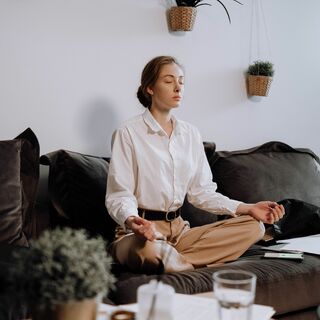
So take a seat,
Close your eyes and gently clasp your hands together.
Just interlace your fingers and place your hands on your lap.
And as you're settling into this session,
I want you to draw your attention to the sensations coming from your fingers.
Just wiggle them a little bit,
Squeeze your hands a little bit,
And just really focus and feel what you're actually feeling.
So now I want you to change your grip.
Rather than clasping your hands the way they naturally fall,
With for example your right thumb over left,
I want you to switch it up.
So in this case you'd put your left thumb over your right,
Or whatever the opposite grip is for you.
And once again,
Place your hands back in your lap and just focus your attention onto the sensations coming from your hands.
This time as you're listening to my voice,
I just want you to keep your hands completely still.
No tension or pressure,
Just rest your hands in that position clasped together.
There's an interesting thing that happens with mindfulness when we apply it to physical sensations.
When we really look at physical sensations,
For example those coming from our hands right now,
It's easy to imagine that you will feel each finger individually.
It's easy to think that we will be feeling certain things,
But when you start paying active mindful attention to them,
You'll notice that what you feel and what you expect to feel are actually different.
So let's give this a try.
Turn your attention to what you can feel from your hands right now.
So what are you feeling?
Do you feel each individual finger or is it something different?
I'm hesitant to share what I feel because I don't want you to start imagining what I'm feeling in place of what you are actually feeling.
But I know that personally when I practice this way,
I feel like a cloud of sensations.
I feel like my hands are melding together.
I certainly don't feel each individual finger.
The longer you keep your hands together clasped in the opposite way,
The less natural way,
You'll find that they may start to alter.
The feeling might change.
If that happens,
That's okay.
Just observe it.
But the reason we're doing it with the opposite grip is to help you to highlight specifically what you're feeling.
The natural grip is easy to ignore because it's normal,
It's expected,
It's falling into that same groove.
But the opposite grip gives you new and interesting and novel sensations to explore mindfully.
The lessons that we're learning from focusing on our hands mindfully can be applied to all physical sensations,
But also importantly to our mental state,
To our thoughts,
Moods,
Emotions,
Feelings,
Memories.
Often we expect certain things to feel certain ways and for us to have certain responses to them.
For example pain.
Pain feels a certain way.
We know what pain feels like and we don't lack pain.
That all sounds reasonable,
But when was the last time you turned and faced pain?
When you looked into it?
When you investigated it for what it is as it is?
When was the last time you actively tried to be mindful with your pain?
Now I'm not saying to grit and bear and marty yourself through extreme suffering,
But the next time you have a minor annoyance,
Something that's a little bit painful,
Try it.
Try turning your mindful attention to it and see how it feels.
But also try turning your mindful attention to your thoughts,
Good or bad,
Your memories,
Your memories,
Good or bad.
This present moment.
The skill of mindfulness enables us to be fully present in the moment,
To investigate reality as it is for what it is,
Without judgments and without filter.
By that process we get closer to what's actually happening and we're pulling ourselves out of the delusion that our mind,
That maya,
That our ego,
Whatever you call it,
Is causing.
We get out of our heads and into the present moment.
As this session draws to a close,
I just want you to leave with the intention to take your formal your formal meditation practice off the mat and into your daily life.
Remember we practice meditation daily,
Not to get good at meditation,
But to get the benefits of our meditation in our everyday life.
So if you find yourself getting a bit frustrated,
Getting a little bit of pain,
Feeling a bit annoyed,
Something like that,
Take that as a cue to take a brief mindful pause.
Step back and employ some of the skills that you're learning from these sessions.
Cheers.
Have a great day.
This guided meditation has been taken from the book,
Mindfulness,
A guidebook to the present moment.