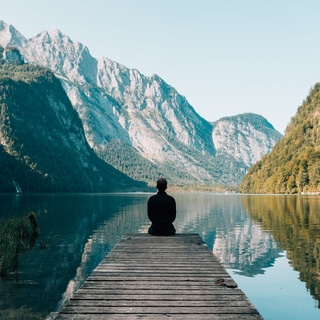
One of the traps that meditators fall into is leaving their meditation practice on the mat.
The guided meditation ends or the bell goes and they hop up and they go about their life and they go about their life in a non mindful dull sort of fashion.
This isn't meant as an offense,
But more as a observation of the purpose of our practice.
The purpose of meditation isn't to have a good meditation session.
You don't sit down every day for your 10 minutes and go,
Okay,
I'm gonna have a great 10 minutes and I'm gonna leave the rest of my life unexabined.
I'm going to be subject to the whim of my mind's storm.
I'm going to just fall through the day and struggle.
No,
We meditate to best improve ourselves to see the world with clarity,
To see our thoughts with clarity,
To improve ourselves.
Whether or not you're going for the loftier goals of attainment or enlightenment,
Or you're just looking at improving your mental state in general,
You know a reduction of anxiety or rumination and depression and all of those sort of things.
We want to have those benefits in our day-to-day life.
We want to see improvements in our relationship and our performance and our functionality.
So we really want to make sure that we incorporate our practice into the day.
So what does that mean from a practical perspective?
Well,
A couple of things.
It means we should obviously be meditating at a minimum once per day consistently because if we've got that consistent practice it's likely to show our mental states,
Our minds that this is important,
That this is something we're focusing on.
But let's say we're already doing that.
What else can we do?
What else can we do to bring our practice into our day?
The first thing that we can consider is the intention.
The marks of a good meditation practice will be setting an intention prior to the practice.
This is what I hope to get out of the procession.
This is what I hope to accomplish.
This is my focus.
So you set your intention,
You sit down,
You do your meditation.
But I would also suggest that you set an intention when you finish.
When you finish your practice,
You set the intention and you say to yourself,
I'm going to bring this practice into my day.
When I'm interacting with people,
When I'm doing tasks that I like or that I don't like.
For the rest of my day,
I'm going to bring some mindfulness into that day.
I'm going to continue to have this same dedication,
This same focus,
This same clarity,
Or at least attempt to in my everyday interactions.
And beyond that we can start using little triggers,
Little day-to-day cues.
One of the best ones that I like to sort of do these daily cues is touching a door handle.
Think of how many times you touch a door handle in your day.
Probably at least 10 to 20 times,
If not more.
Imagine if you associated that trigger,
That cue,
With a mindful breath.
Every time you touch a door handle,
You take one mindful breath.
Just one.
It's not to instill a meditative practice in that sense.
It's just to remind you that mindfulness is the thing.
The idea being that if you get into the habit of touching a door handle and taking a mindful breath,
Thinking of mindfulness practice,
You're likely to carry that practice on further into your day and eventually you will just be mindful.
You won't need the trigger of a door handle.
You won't need that trigger because you will just be feeling that mindfulness throughout the day,
All day.
And the other way that you can look at improving your mindfulness is to purposely avoid distracting yourself when bad things occur or when negative situations occur or when you're bored.
So let's take that one because it's the easiest one to respond to.
There's this temptation to always have a podcaster talk or music in your ear because given modern technology,
It's feasible that we go the entire day without silence.
Now,
A meditation practice is a good opportunity to embrace some silence,
But the reality of the situation is that you could feasibly go the entire time without it.
So potentially when you're doing your dishes,
When you're cleaning the house,
When you're driving,
When you're doing things that you would potentially block yourself off and distract yourself,
Do them in silence and just feel what you feel.
That's a possibility and extending that into the more negative stimulus.
If you face someone that's upset or negative or aggressive,
A co-worker,
A boss,
A partner,
A worker at a shop,
Whatever it is,
There's some sort of negative emotion coming your way.
Rather than instantly turning to distract yourself to avoid feeling that,
Just take a moment and actually see,
Just check into your emotions.
Just take a look and go,
All right,
This is what I'm actually meditating for.
It's to be able to investigate,
To address,
To accept,
To understand,
To work through these emotions.
You actually have to put it into play.
The exercise analogy to this is we don't lift weights to just get stronger at lifting weights.
Like we won't do a bench press to get better at bench press and squats and deadlifts and all that sort of stuff.
You lift the weights to get stronger for your life.
Yeah,
There's no point exercising if you're not going to apply it to an actual situation.
So in the same way,
There's a little point meditating if you're not going to attempt to use it live,
Attempt to use it when it matters.
If you've had a rough day and you come home and the people that you live with are not giving you the space you need or they're acting in a way that's annoying or disruptive or argumentative or any sort of negativity rather than avoiding.
Rather than moving away from it either internally or realistically,
Literally.
Instead it might be wise to just take a little step back internally and look at what's happening in your emotional landscape.
Take the opportunity to practice meditation in the moment,
Live.
You don't need to be meditating sitting down with your candle on and your incense burning in front of a shrine.
You cannot take and you should take those skills off the mat into your daily life.
Otherwise,
The benefits are significantly reduced.
If you need to have that full setup to get the benefits of meditation,
You're missing out on a lot.
So start practicing it live.
And the final suggestion to bring your meditation into your day,
Into your life,
Off the mat is to start applying it to change yourself.
We all have habits that we dislike.
You know,
Maybe we overeat too much sugar,
Have too much coffee.
Maybe we smoke or do drugs or some other sort of negative behavior that we want to stop.
So when you find those temptations popping up rather than just instantly acquiescing to them,
Take a look at them,
Feel them,
Let them,
Let them be where they are and observe them mindfully.
And if you observe them mindfully,
Potentially you can move beyond them.
Potentially you can help to address them and ultimately overcome the habit in your life.
So remember if we're practicing meditation,
It's good to bring it into our day.
It's good to bring it into our lives because that's where the real benefits to our mental state,
To our functionality,
To our ongoing existence will be felt.
Give it a try.