So as the sound of the bell starts to slowly fade into the background,
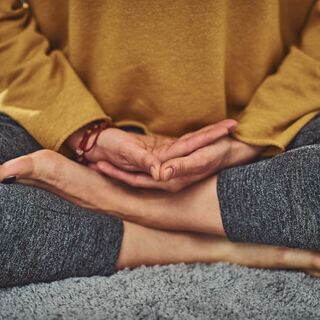
Just take a moment to just settle into your meditation posture,
Whether you're seated,
Lying down or standing.
Just take a moment to really feel your connection to the earth.
Maybe that sense of connection feels particularly pronounced in your legs.
Maybe it's in your hips,
Your sits bones,
Or maybe it's the bottom of your feet.
And when you bring your sense of attention to that point,
What we're really doing is just trying to kind of feel the weight of our bodies,
To feel the structure of our bodies as we just sit here and start to relax.
We're not necessarily looking for a problem.
We're not looking for something to change.
We're just trying to kind of feel structured and supported at the beginning of our practice.
And if at any time you find that you're having pain,
Whether it's in your knees or your legs or your low back,
Feel free to move around or make any adjustments that you need to be comfortable.
The right meditation posture is the posture that supports you the best.
I'd like you to take a second to bring your attention regardless of where it is to your big toe.
It doesn't matter if it's on your right foot or your left foot,
But just allow your attention to make its way to your big toe and just focus on and try to visualize what your big toe feels like right now.
Just see what you can notice there.
Maybe your big toe feels cold and clammy.
Maybe it's a little sore after skiing all day.
Maybe you don't notice anything at all.
Just take a second to try to embody and inhabit that space.
And now we can repeat the same exercise with the other foot,
Bringing our attention to our big toe,
Just noticing what's there.
Maybe you notice that you're curling your toes a little bit.
Whatever it is,
We're not trying to change anything.
We're not trying to solve any problems,
Just noticing things for what they are.
And as you continue to feel into that space,
I'd like you to try and keep both of your big toes in your awareness at the same time,
Seeing if you can feel into both of those spaces simultaneously,
Balancing the left side of the body with the right side of the body.
Maybe noticing if one foot feels different than the other.
We're going to allow our awareness to start to roll out to the rest of our feet,
The rest of our toes,
The ball of your foot,
Your arch and your heel.
Just slowly inspecting bit by bit what's going on,
Any tenderness or tightness,
Any places where the muscles are loose or warm.
Just inspecting slowly.
Starting to move further up the legs,
Into the ankles,
The shins and the calf.
If you're seated on the floor like me,
Your shins might be pressed against the floor.
Maybe you can feel the sensation of the weight of your body pressing down.
Notice if your muscles are tensed or if they're relaxed.
Maybe they feel tight after a workout or a whole week's worth of work.
Bring your attention up the legs to your knees and really taking time to investigate what's going on in the knees.
As if you could feel around inside your knees the space between the back of your knee and the kneecap.
Noticing what's going on there.
Noticing what's coming up.
A lot of times if we have some kind of historical injury or past trauma,
Physical trauma that can come up in a body scan.
So if you ever notice that part of the body is maybe too difficult to work with or makes you feel uncomfortable,
It's always fine just to move on to another part.
Or maybe you notice that your mind wanders or it feels like you're pushing yourself away.
There's nothing wrong with that but it's just worth noting and investigating.
Continuing up the legs through the thighs,
Hamstring,
The IT band and the hips.
Up through the pelvis,
Into our waist and our low belly.
Trying to feel inside all the organs,
Our digestive system,
The bottom of our diaphragm.
Just all that internal circuitry and piping that supports us all day long.
Just noticing what's coming up.
Working the way up into the low diaphragm,
The bottom of the lungs,
Starting to notice any of the ways that your breathing shows up in your body.
Maybe your breathing feels easy and natural.
Maybe it feels short and hurried.
Maybe your breathing deeply,
Your breathing shallow.
Just noticing what's going on.
If you're like me,
You might find that it's really hard to watch your breath.
That it's difficult and uncomfortable and that's okay too.
We can always just keep moving up through the body,
Into the chest.
Trying to see if you can feel the beating of your heart.
The rhythm of your breathing.
As we get farther up into our body,
Our posture tends to become more apparent.
Maybe just checking in,
Noticing the alignment of your neck and your spine.
Your shoulder blades,
Your first rib.
Just notice where everything is lying.
You hunched over,
Curled up,
Or in a position that feels sustainable.
We'll continue our investigation up into the throat.
Just noticing what's going on at the base of your neck,
Your lower throat.
Noticing the gentle feel of your breath as it enters and exits your body.
Moving up into the upper parts of our neck and our lower jaw.
Starting to feel the masseter and all the little tiny muscles in your jaw.
Noticing the space in the tongue,
The teeth,
Our lips.
Noticing the space in the ears,
Our cheekbones,
And the space behind our eyes.
Just kind of investigating these silent spaces.
Investigating the eyelids.
Maybe noticing if your eyes are closed or your lids being held down with lots of effort or does your eyes being closed feel natural?
Notice if you're squinting or if your brow is furrowed.
Notice if maybe you're scrunching your nose.
We have so many muscles in our face.
There's so many opportunities to investigate little micro movements,
Little expressions that we don't know we're holding.
Starting to move up into the forehead.
Noticing the forehead and the sides of the head,
The back of the head.
Finally moving your attention to the very top of your head and embodying that single point,
The very tip top of your body.
As if a piece of string was tied to the floor running up your back,
Up through your head and holding you up like a marionette.
Just allowing your attention to hold that point.
And then letting your attention go.
Letting your attention fall over all of the experiences that you're having in your body all at once.
The aches and the pains,
The ease and the looseness,
The hot and the cold.
Just noticing all of those micro sensations.
Firing all at the same time.
And as we sit here I'd like you to really bring your attention to the skeletal structure of your body.
See if you can bring your focus and your awareness to the bones that are holding our frame up.
Just try to embody that space.
Almost as if you were visualizing it in your mind.
Now see if you can bring your awareness to all the muscle and tissue,
All the material that's hanging on the frame.
Just feeling all that at once.
And remembering too that even though we have this awareness,
This ability to see,
This view on the world,
We do still have a body.
We have a point.
We have a GPS location.
And our body exists in the space that we're in,
In the room.
Take a minute to just feel what it feels like to be in your body in that space.
Maybe you notice the temperature of the room.
Maybe there's a sound,
The sound of a dog snoring softly.
Maybe there's a child in another room,
The sound of some HVAC machinery.
Whatever it is that makes that space,
That space in this moment.
Just tune into that.
As we start to come to the end of this first guided meditation,
Just take a second to bring some gentle movement back into your posture.
If you've been sitting rigidly or lying down,
Maybe start by wiggling your toes or your fingers.
Really flexing your feet,
Your legs,
Rolling your shoulders back,
Or stretching your arms out wide.
Whatever you need to do to gently re-enter the environment.
Take a moment to just feel what it feels like to be in your body in that space.